
Understanding Compound Interest: The Engine of Wealth Growth
At its core, compound interest is interest calculated on the initial principal, which also includes all of the accumulated interest from previous periods on a deposit or loan. It’s a concept that builds upon itself, creating a snowball effect over time. Think of it as earning interest on your interest. Unlike simple interest, which is only calculated on the original principal amount, compound interest allows your money to grow exponentially because the base amount on which interest is earned continually increases. This subtle but profound difference is precisely why compound interest is so potent for wealth accumulation.
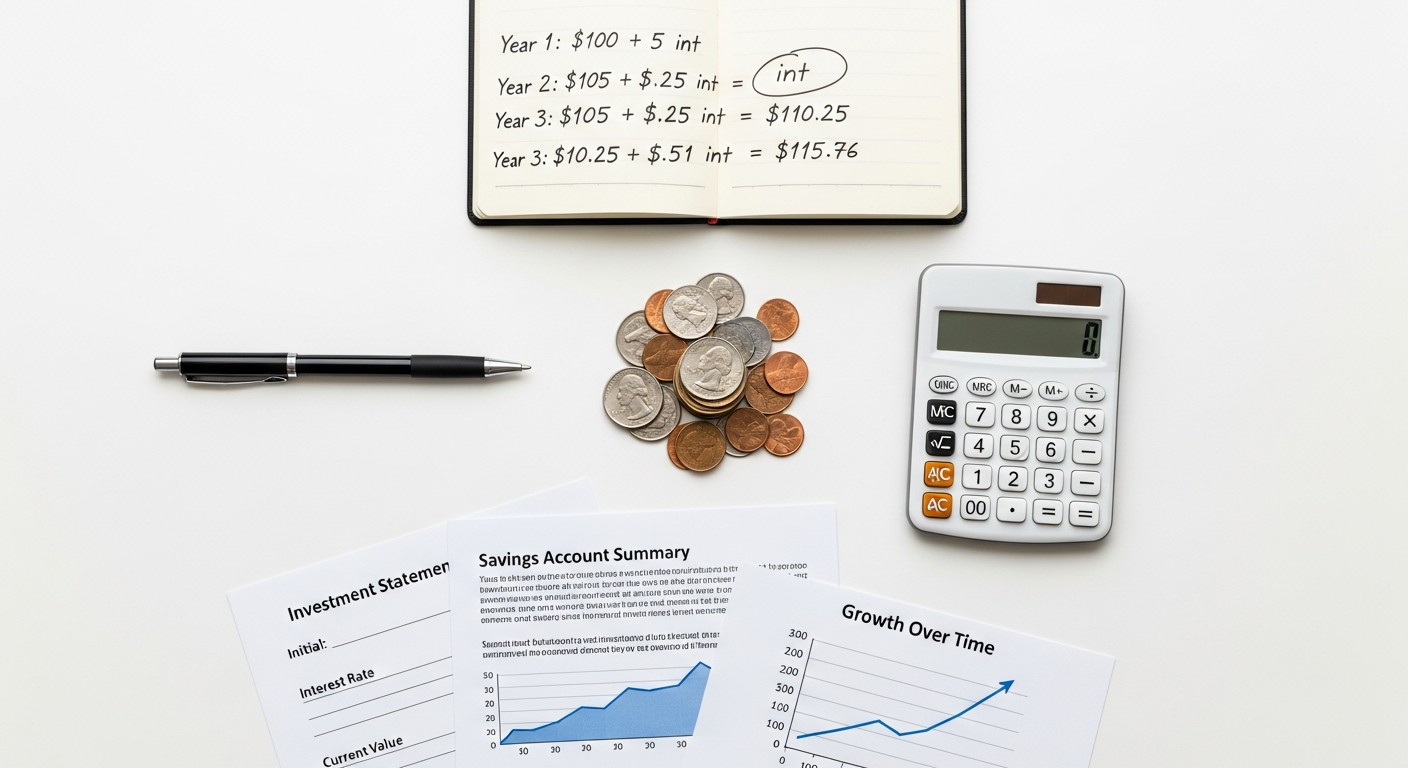
To grasp this simply, imagine you deposit $1,000 into a savings account that pays 5% annual interest. With simple interest, you would earn $50 each year ($1,000 0.05). After 10 years, you’d have $1,500 ($1,000 original + $500 interest). Now, consider compound interest. In the first year, you still earn $50, bringing your total to $1,050. However, in the second year, you earn 5% not just on your initial $1,000, but on the new total of $1,050. This means you earn $52.50 ($1,050 0.05). Your balance becomes $1,102.50. This additional $2.50 might seem small initially, but over many years, and with larger sums, these small increments compound into significant gains. The longer your money has to grow, the more pronounced this effect becomes, demonstrating why starting early is perhaps the single most impactful decision you can make.
The magic of compounding truly comes alive when you visualize it over extended periods. It’s not a linear progression; rather, it’s an accelerating curve. In the early years, growth might appear slow, even modest. However, as the principal and accumulated interest grow, each subsequent interest calculation yields a larger absolute dollar amount. This acceleration is what allows small, consistent contributions to transform into substantial sums capable of funding a comfortable retirement or providing a foundation for future generations. Understanding this fundamental principle is the first step towards mastering your financial future, transforming you from a passive observer to an active participant in your wealth creation journey.
Simple vs. Compound Interest: A Crucial Distinction for Your Money
While both simple and compound interest involve earning or paying interest, the fundamental difference between them dictates vastly different financial outcomes. Grasping this distinction is paramount for anyone looking to make informed decisions about savings, investments, and debt.
Simple Interest: The Straightforward Approach
Simple interest is calculated solely on the original principal amount of a loan or deposit. It’s a fixed percentage of the initial sum over a specific period, typically a year. The formula for simple interest is straightforward: Principal x Rate x Time (I = P R T). For instance, if you invest $1,000 at a 5% simple annual interest rate for 10 years, you would earn $50 per year. Over 10 years, your total interest would be $500, and your investment would grow to $1,500. This type of interest is often used for short-term loans, some bonds, or basic savings accounts where interest is paid out and not reinvested. Its predictable, linear growth makes it easy to calculate, but it lacks the exponential power of compounding.
Compound Interest: The Exponential Powerhouse
As we’ve discussed, compound interest is calculated on the initial principal AND on the accumulated interest from previous periods. This “interest on interest” mechanism means your money earns money, and then that money earns even more money. The formula for compound interest is more complex: A = P(1 + r/n)^(nt), where:
- A = the future value of the investment/loan, including interest
- P = the principal investment amount (the initial deposit or loan amount)
- r = the annual interest rate (as a decimal)
- n = the number of times that interest is compounded per year
- t = the number of years the money is invested or borrowed for
Let’s revisit our $1,000 example at a 5% annual interest rate, compounded annually for 10 years. Using the compound interest formula: A = $1,000(1 + 0.05/1)^(1*10) = $1,000(1.05)^10 ≈ $1,628.89. This means you would have approximately $1,628.89 after 10 years. Compared to the $1,500 from simple interest, compound interest yields an additional $128.89. While this difference might seem modest in the short term, the gap widens dramatically over longer periods and with larger sums. Imagine this over 30 or 40 years, and the difference becomes hundreds of thousands, if not millions, of dollars.
The key takeaway is that for growing your wealth, compound interest is overwhelmingly superior. It leverages time as its greatest ally, allowing even small, consistent contributions to blossom into significant capital. Conversely, when you are the one paying interest, such as on credit card debt or high-interest loans, compound interest works against you, making the debt grow exponentially and often trapping individuals in a cycle of payments. Understanding this critical distinction is the first step toward making compound interest work for you, not against you, in every financial decision you make.
The Power of Compounding: Real-World Examples and Calculations
Example 1: The Early Bird Investor
Consider two individuals, Sarah and Mark, both aspiring to retire comfortably by age 65. Sarah starts investing $200 per month at age 25 into a diversified portfolio earning an average annual return of 7%, compounded monthly. She consistently invests for 10 years, then stops contributing, letting her money grow until age 65. Mark, on the other hand, waits until age 35 to start investing, contributing $200 per month into the same type of portfolio earning 7% annually, compounded monthly. He continues investing until age 65.
- Sarah (Age 25-35): Invests $200/month for 10 years ($24,000 total). This money then compounds for another 30 years (from age 35 to 65).
- Mark (Age 35-65): Invests $200/month for 30 years ($72,000 total).
Calculations reveal that Sarah’s initial $24,000, compounding for 40 years, would grow to approximately $400,000 by age 65. Mark, despite investing three times as much money ($72,000) over 30 years, would accumulate roughly $250,000. This stark difference highlights the immense power of time in compounding. Sarah’s earlier start, even with fewer total contributions, allowed her money to compound for a longer duration, resulting in significantly greater wealth. This isn’t just a hypothetical; it’s a powerful argument for starting your investment journey as early as possible, even with modest amounts.
Example 2: Reinvesting Dividends
Many investments, particularly stocks and mutual funds, pay out dividends or interest. The decision to take these payouts as cash or to reinvest them can have a profound impact due to compounding. Imagine you own shares of a company worth $10,000 that pays a 3% annual dividend. If you choose to receive the cash, you get $300 per year. If you reinvest those dividends, you use the $300 to buy more shares. Now, the next year, your 3% dividend is paid on a larger number of shares, generating a slightly higher dividend payment, which in turn buys even more shares. This cycle creates a compounding effect, where your ownership stake grows without additional out-of-pocket contributions, accelerating your wealth accumulation over time. Over decades, this strategy can dramatically boost the overall return of your portfolio.
The Rule of 72: A Quick Estimation Tool
While the compound interest formula provides precise calculations, the “Rule of 72” offers a quick and easy way to estimate how long it will take for your investment to double in value. Simply divide 72 by your annual interest rate. For example, if your investment earns a 6% annual return, it will take approximately 72 / 6 = 12 years to double. If it earns 8%, it will double in about 9 years (72 / 8). This rule is a fantastic mental shortcut to understand the exponential growth potential of different interest rates and the importance of even slightly higher returns over the long run.
These real-world examples underscore the undeniable truth: compound interest is the bedrock of long-term financial success. Whether you’re saving for a down payment, a child’s education, or your retirement in 2026 and beyond, understanding and actively leveraging this principle is non-negotiable. It emphasizes the critical roles of starting early, investing consistently, and allowing time to work its magic.
Key Factors Influencing Compound Growth
While the concept of compound interest is simple, its actual growth is influenced by several critical factors. Understanding how these elements interact allows you to optimize your strategies and maximize the compounding effect on your investments and savings.
1. The Principal Amount (P)
The initial amount of money you deposit or invest, known as the principal, is the foundation upon which all future interest is calculated. Naturally, a larger principal will generate more interest from the outset. If you start with $10,000 earning 7% annually, you earn $700 in the first year. If you start with $1,000, you only earn $70. This highlights the benefit of making significant initial contributions when possible. However, it’s crucial to remember that even small principals, consistently added to and given enough time, can grow substantially thanks to compounding.
2. The Interest Rate (r)
The interest rate is arguably the most straightforward factor. A higher interest rate means your money grows faster. A 10% annual return will cause your money to compound significantly quicker than a 3% return. For example, using the Rule of 72, an investment at 10% doubles in about 7.2 years, while an investment at 3% takes approximately 24 years to double. This underscores the importance of seeking out competitive interest rates for savings accounts and, more importantly, choosing investments with historically strong returns (while always considering associated risks). Even a seemingly small difference of 1-2 percentage points can lead to hundreds of thousands of dollars difference over several decades.
3. Time (t) – The Most Powerful Lever
As illustrated by the Sarah and Mark example, time is the single most crucial and powerful factor in compound interest. The longer your money has to compound, the more dramatic the growth becomes. This is because interest earned in earlier periods gets more time to earn its own interest. The growth curve of compound interest is exponential, meaning it accelerates over time. The last few years of a long-term investment often see the most significant dollar growth, far surpassing the growth in the initial years. This principle is why financial advisors universally advocate for starting to save and invest as early as possible. Delaying even a few years can mean missing out on significant wealth accumulation opportunities due to lost compounding time.
4. Compounding Frequency (n)
Compounding frequency refers to how often the interest is calculated and added to the principal. Interest can be compounded annually, semi-annually, quarterly, monthly, daily, or even continuously. The more frequently interest is compounded, the faster your money grows, assuming the same annual interest rate. For example, interest compounded monthly will result in slightly more growth than interest compounded annually over the same period, because the interest starts earning interest sooner. While the difference between daily and monthly compounding might be marginal for most personal finance scenarios, understanding that higher frequency generally means better returns is important, especially for longer durations. When comparing financial products, always look for the Annual Percentage Yield (APY), which accounts for the compounding frequency, rather than just the stated annual interest rate.
By strategically managing these four factors – contributing a solid principal, seeking competitive interest rates, prioritizing early and long-term investing, and understanding compounding frequency – you can effectively harness the full power of compound interest to achieve your financial objectives, setting yourself up for success well into 2026 and beyond.
Harnessing Compound Interest for Your Financial Future
Leveraging compound interest effectively is not just about understanding its mechanics; it’s about integrating it into a holistic financial strategy. This principle can be a cornerstone for achieving significant milestones, from retirement security to creating lasting generational wealth.
Building a Robust Retirement Fund
For most individuals, retirement savings represent the largest and most critical application of compound interest. Vehicles like 401(k)s, IRAs, and other investment accounts are designed for long-term growth, making them perfect candidates for compounding. By contributing regularly to these accounts, especially starting in your 20s or 30s, you give your investments decades to grow. Even modest monthly contributions, like a few hundred dollars, can balloon into a million-dollar-plus nest egg by retirement age, thanks to consistent investing and the relentless power of compounding. The earlier you start, the less you need to contribute overall to reach your goals, as time is the most potent multiplier.
Investing Wisely
Compound interest thrives in investment environments. While traditional savings accounts offer minimal returns, investing in diversified portfolios of stocks, bonds, mutual funds, and exchange-traded funds (ETFs) historically provides higher average annual returns, allowing compound interest to work its magic more effectively. When you invest, the returns you earn (e.g., capital gains, dividends) can be reinvested to buy more shares or units, which then generate their own returns, creating a powerful feedback loop. This strategy amplifies your portfolio’s growth far beyond what simple interest could ever achieve. Always consider your risk tolerance and financial goals when selecting investment vehicles, but remember that the underlying principle of compounding remains constant.
How to Build Generational Wealth: A Compounding Legacy
One of the most profound applications of compound interest extends beyond personal retirement to the ambitious goal of How To Build Generational Wealth. This involves creating a financial legacy that can be passed down through families, providing opportunities and security for future generations. The core strategy here is to invest early and consistently, allowing assets to compound over many decades, even centuries. Imagine an initial investment made today, allowed to grow and compound for 50 or 100 years. The sheer scale of that growth can be astronomical. For example, setting up a trust with well-managed investments, whose returns are reinvested and only a portion distributed, can ensure continuous growth. Teaching financial literacy and the power of compounding to heirs is equally crucial, ensuring they understand how to manage and continue to grow this legacy. By establishing a foundation of compounded assets, you can provide an enduring financial advantage, funding education, entrepreneurial ventures, and financial stability for generations to come, creating a powerful ripple effect that transcends individual lifetimes.
To effectively harness compound interest for any of these goals, consistency is key. This often means making regular contributions to your investment accounts, which directly ties into the importance of budgeting. A well-structured personal budget helps you identify disposable income that can be allocated to savings and investments, ensuring a consistent flow of capital into your compounding machine. Without a clear understanding of your income and expenses, finding the funds to invest regularly can be a challenge. Therefore, mastering tools like “How To Create A Monthly Budget” is not just about managing daily finances; it’s a foundational step towards unlocking the full potential of compound interest for your long-term wealth creation.
Avoiding the Pitfalls: When Compound Interest Works Against You
While compound interest is a powerful ally for wealth creation, it can quickly become a formidable foe when applied to debt. Understanding this double-edged nature is crucial for maintaining financial health and preventing debt from spiraling out of control. When you borrow money, especially at high interest rates, compound interest works against you, causing your debt to grow exponentially, just as it causes your investments to grow.
The Trap of High-Interest Debt
The most common and dangerous example of compound interest working against you is with high-interest debt, such as credit card balances. Credit cards typically carry annual interest rates ranging from 15% to 25% or even higher, and interest is usually compounded daily or monthly. If you carry a balance on your credit card, the interest accrued today is added to your principal, and tomorrow, you pay interest on that new, larger principal. This means that a seemingly small balance can quickly become unmanageable if only minimum payments are made.
For example, imagine you have a $5,000 credit card balance with a 20% annual interest rate, compounded monthly. If you only make the minimum payment (often 1-3% of the balance), a significant portion of that payment goes towards interest, leaving very little to reduce the principal. This perpetuates the cycle, making it feel like you’re running on a treadmill. What might have started as a $5,000 debt could end up costing you thousands more in interest and take many years to repay, significantly hindering your ability to save and invest for your future.
Student Loans and Mortgages
Even “good debt,” like student loans or mortgages, involves compound interest. While these loans typically have much lower interest rates than credit cards and can be necessary for education or homeownership, the principle remains. The interest on your mortgage, for instance, is calculated on the remaining principal balance. Early in a mortgage term, a larger portion of your monthly payment goes towards interest because the principal is still high. Over time, as the principal decreases, more of your payment goes towards reducing the principal. Understanding this structure can help you make informed decisions, such as making extra principal payments to reduce the overall interest paid and shorten the loan term.
Strategies for Tackling Compounding Debt
Recognizing that compound interest can work against you is the first step. The next is to implement strategies to mitigate its negative effects. This is where debt payoff methods become invaluable, particularly the Snowball Vs Avalanche Debt Payoff Method.
- Debt Avalanche Method: This strategy focuses on paying off debts with the highest interest rates first, regardless of the balance. By tackling the most expensive debt first, you prevent compound interest from accumulating as rapidly on those high-rate balances, ultimately saving you the most money in interest over time. Once the highest-interest debt is paid off, you roll that payment amount into the next highest-interest debt.
- Debt Snowball Method: This method focuses on paying off the smallest debt balance first, regardless of the interest rate. Once the smallest debt is paid off, you take the money you were paying on that debt and add it to the payment of the next smallest debt. While mathematically less efficient than the avalanche method (as it might not target the highest interest rates first), the snowball method provides psychological wins, as you quickly eliminate debts, building momentum and motivation to continue your debt-free journey.
Both methods are effective at systematically reducing debt and stopping the negative compounding effect. The best method for you depends on your personal financial psychology and priorities. Whichever method you choose, the goal is the same: eliminate high-interest debt as quickly as possible to free up your financial resources. By doing so, you stop paying compound interest to lenders and redirect that capital towards investments where compound interest can work in your favor, accelerating your journey towards financial independence by 2026 and beyond.
Strategies to Maximize Your Compounding Journey
To truly leverage the extraordinary power of compound interest, a proactive and disciplined approach is essential. It’s not enough to simply understand the concept; you must integrate it into your financial habits. Here are actionable strategies to maximize your compounding journey:
1. Start Early, Invest Consistently
This cannot be stressed enough: time is your greatest asset with compound interest. The earlier you begin investing, even with small amounts, the more time your money has to grow exponentially. If you start investing $100 a month at age 20 into an account earning 7% annually, you could have significantly more by retirement than if you started investing $200 a month at age 30. Consistency is equally vital; regular contributions, whether weekly, bi-weekly, or monthly, ensure that new capital is constantly being added to your compounding base, accelerating growth. Make investing a habit, not a one-time event.
2. Prioritize Higher Returns (Within Reason)
While not advocating for excessive risk, seeking investments with historically stronger returns can significantly boost your compounding. A 7% average annual return will compound much faster than a 3% return. This often means moving beyond basic savings accounts (which are important for emergency funds) into diversified investment vehicles like stocks, ETFs, and mutual funds, which historically offer higher growth potential over the long term. Understand your risk tolerance and diversify your portfolio to mitigate risk, but don’t shy away from growth opportunities that align with your long-term goals.
3. Automate Your Savings and Investments
One of the easiest ways to ensure consistency is to automate your contributions. Set up automatic transfers from your checking account to your savings or investment accounts immediately after payday. This “pay yourself first” strategy ensures that you prioritize your financial future before other expenses. Automation removes the temptation to spend the money and makes saving an effortless, built-in part of your financial routine. This steady stream of capital is the fuel for your compounding engine.
4. Reinvest Dividends and Interest
If your investments generate dividends or interest payments, always choose to reinvest them rather than taking them as cash. Reinvesting means those payments are used to buy more shares or units of the same investment, immediately adding to your principal and allowing those new shares to generate their own returns. This creates a powerful compounding loop, accelerating your wealth accumulation without requiring additional out-of-pocket contributions.
5. Understand and Minimize Fees
Fees, even seemingly small ones, can eat into your returns and significantly impede the compounding process over decades. Investment fees (e.g., expense ratios on mutual funds, trading fees), advisory fees, and even high annual fees on certain financial products can reduce your net returns. Be diligent in understanding all fees associated with your investments and choose low-cost options whenever possible. Every dollar saved in fees is a dollar that remains invested and continues to compound for your benefit.
6. Utilize Tax-Advantaged Accounts
Leverage tax-advantaged accounts like 401(k)s, IRAs (Traditional or Roth), HSAs, and 529 plans. These accounts offer significant tax benefits, such as tax-deferred growth or tax-free withdrawals in retirement, which further enhance the power of compounding. For example, tax-deferred growth means your investment compounds on the full amount, including the portion that would otherwise be lost to taxes each year, until withdrawal. This accelerates your growth compared to a taxable account.
How To Create A Monthly Budget: The Foundational Step
None of these strategies can be effectively implemented without a clear understanding of your finances. This is where mastering How To Create A Monthly Budget becomes absolutely foundational. A comprehensive budget allows you to track your income and expenses, identify areas where you can cut back, and most importantly, allocate specific amounts towards savings and investments. Without a budget, it’s difficult to consistently find the capital needed to fuel your compounding journey. By creating and sticking to a monthly budget, you gain control over your money, ensuring that you consistently have funds available to invest, pay down debt, and ultimately maximize the positive effects of compound interest in your life, paving the way for a financially secure 2026 and beyond.
Frequently Asked Questions
Recommended Resources
Related reading: How To Get First Clients As A Freelancer (Page Release).
For more on compound interest explained, see Price Comparison Tools Guide 2026 on Gold Points.