


The 2026 Guide to Thrifting for Quality: How to Build a High-End Wardrobe on a Low-End Budget
By Fin3go Editorial Team — Financial writers covering personal finance, banking, and consumer protection.
In the economic landscape of 2026, the traditional retail model is undergoing a radical shift. As inflation remains a persistent pressure and the “fast fashion” bubble continues to burst due to rising production costs and environmental regulations, savvy consumers are turning toward the circular economy to preserve their capital. Thrifting is no longer just a hobby for the eclectic or a necessity for the strictly budget-conscious; it has become a sophisticated financial strategy. For the personal finance-focused individual, clothing represents a significant recurring expense that often depreciates to zero the moment it leaves the store. However, by mastering the art of sourcing high-quality, pre-owned garments, you can flip this script. Finding a $400 wool coat for $25 isn’t just a “win”—it’s a tactical preservation of your net worth. This guide will move beyond the basic “look for labels” advice and dive into the technical, financial, and strategic methods required to find investment-grade clothing in thrift stores, ensuring your wardrobe reflects a high-net-worth lifestyle without the associated price tag.
1. Master the “Fabric First” Philosophy
The most common mistake amateur thrifters make is looking at the brand name before touching the fabric. In 2026, many “heritage” brands have diluted their quality to maintain margins, meaning a recognizable logo no longer guarantees a long-lasting garment. To find true quality, you must train your hands to recognize premium fibers.
Natural fibers—silk, wool, cashmere, linen, and heavy-weight cotton—are the gold standard of thrifting. These materials hold their shape, breathe better, and can often be restored to like-new condition. When you enter a thrift store, run your hand across the racks. Your fingers will naturally stop on the softness of cashmere or the cool, crisp texture of high-grade linen.
**The Burn Test and the Tag Check:**
Always check the care tag. If the tag is missing, look for signs of quality construction. Real silk has a shimmering sheen, not a metallic shine. Real wool will feel slightly oily (lanolin) and spring back when crushed. By focusing on materials rather than logos, you often find “stealth wealth” items—boutique brands that the thrift store’s pricing staff didn’t recognize, allowing you to snag a $300 pima cotton shirt for $6 because it wasn’t a “mall brand.”
2. Decode the “Cost-Per-Wear” (CPW) Math
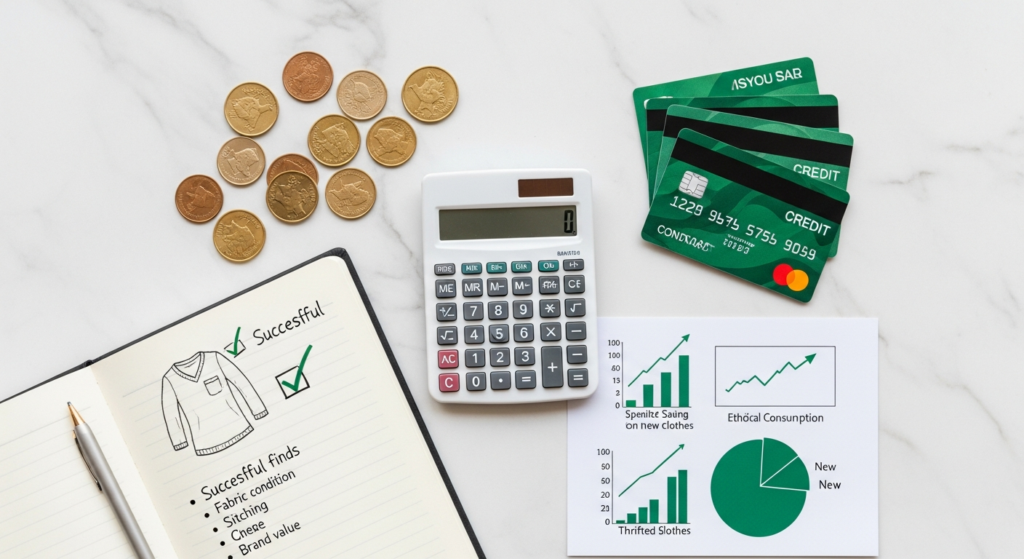
Personal finance is built on the foundation of ROI (Return on Investment). In clothing, this is measured by Cost-Per-Wear. A $10 polyester shirt that falls apart after five washes has a CPW of $2.00. A $40 thrifted pair of Selvedge denim jeans that lasts five years (worn 200 times) has a CPW of $0.20.
In 2026, we are seeing a massive resurgence in “Buy It For Life” (BIFL) mentalities. When evaluating a thrift store find, ask yourself:
* **Can this be repaired?** A high-quality Goodyear-welted leather boot can be resoled for $50, extending its life by a decade. A glued-sole fashion boot is garbage once the tread wears down.
* **Is the style timeless?** Avoid “micro-trends.” Look for blazers with standard lapels, straight-leg trousers, and neutral-colored knitwear.
* **What is the replacement cost?** If you found a Loro Piana sweater for $15, you aren’t just saving $15; you are avoiding the $1,200 cost of buying it new. That $1,185 difference is money that stays in your brokerage account, compounding over time.
3. Leverage 2026 Digital Tools for Real-Time Appraisal
The days of guessing an item’s value are over. To maximize your financial efficiency, use your smartphone as a mobile appraisal unit. High-speed 5G and AI-integrated search tools have made it possible to identify an obscure designer or a vintage manufacturing era in seconds.
* **Visual Search:** Use tools like Google Lens or specialized fashion AI apps to snap a photo of a unique pattern or a specific hardware detail. This can reveal the original retail price and the current resale value on platforms like The RealReal or Poshmark.
* **Registry of RN Numbers:** Every garment sold in the U.S. has an RN (Registration Number) on the care tag. If the brand name is faded, look up the RN number in the FTC database. This will tell you exactly who manufactured the garment, often revealing high-end parent companies behind “store brand” labels.
* **Resale Comps:** If you are undecided on a purchase, check the “sold” listings on eBay. If the item is selling for 5x the thrift price, it’s a high-margin acquisition. Even if you decide you don’t like it later, you can flip it for a profit, effectively making your hobby a side hustle.
4. The “Tailoring Premium”: Factoring in the Fit
One of the biggest barriers to thrifting quality clothing is the fit. High-quality vintage items were often cut for different body types, or you might find a perfect Italian suit that is two sizes too large. A key personal finance tip for 2026 is to build a relationship with a local tailor.
**The Strategy:**
Budget for alterations. A $10 thrifted blazer plus $40 in tailoring equals a $50 custom-fitted garment. A custom-made blazer of similar quality would cost $800+.
* **What can be fixed:** Hems, sleeve length, waist intake, and minor tapering.
* **What to avoid:** Shoulders and chest. If the shoulders don’t fit, the cost of reconstruction will almost always exceed the value of the garment.
By looking for “large” high-quality items (like 100% cashmere overcoats) and having them tailored down, you access a segment of the thrift store that most people ignore, often leading to deeper discounts on “clunky” looking high-end pieces.
5. Strategic Scouting: Location and Timing
Where you thrift is just as important as how you thrift. In the personal finance world, we talk about “arbitrage”—buying low in one market and selling high in another (or in this case, consuming high).
* **The “Wealthy Zip Code” Theory:** Thrift stores in affluent neighborhoods often receive donations from residents who value closet space over resale profit. You are more likely to find current-season designer items in these locations.
* **The “Commuter Edge”:** Stores located near transit hubs often get a higher volume of professional wear.
* **The Timing Algorithm:** Most thrift stores restock on Monday and Tuesday after the weekend donation rush. 2026 data shows that mid-morning on a Tuesday is the optimal time for “first pick” of new inventory.
* **Out-of-Season Investing:** Buy your heavy wool coats in July and your linen shirts in January. Thrift stores often price “off-season” items aggressively to move inventory, allowing you to lock in massive savings for the coming year.
6. Inspection: The 10-Point Quality Checklist
Before taking your find to the register, perform a rigorous inspection. High-quality items can be ruined by hidden defects that are expensive to fix.
1. **The Armpit Check:** Look for permanent perspiration stains or fabric thinning.
2. **The Crotch Test:** On trousers, check for pilling or thinning in the inner thigh.
3. **The Zipper Stress Test:** Is it a YKK or RiRi zipper? High-end hardware is a sign of a high-end garment.
4. **The Seam Allowance:** Turn the garment inside out. Quality clothes have extra fabric at the seams to allow for letting out.
5. **The Pattern Match:** On plaid or striped shirts, does the pattern line up at the pockets and seams? If it does, it was cut by hand—a hallmark of quality.
6. **Buttonholes:** Are they frayed? Are the buttons made of plastic, or are they horn, mother-of-pearl, or metal?
7. **The “Light Test”:** Hold the garment up to the light. If the weave is uneven or shows tiny holes (moth damage), put it back.
8. **Lining Construction:** A fully lined jacket hides the internal construction; a half-lined or unlined jacket with “piped” seams shows the highest level of craftsmanship.
9. **The Smell Factor:** Avoid items with heavy smoke or “old trunk” odors. Some smells are baked into the fibers and are nearly impossible to remove without damaging the fabric.
10. **The Brand Tag Stitching:** Is the tag sewn on straight? Is it itchy polyester or soft silk? Designer tags are usually held on by four tiny “tack” stitches at the corners.
—
FAQ: Frequently Asked Questions
**Q1: Is thrifting still sanitary in 2026?**
Absolutely. While the stigma has long since faded, the protocol remains the same: treat every thrifted item as if it needs a deep clean. For natural fibers like wool and silk, a professional dry clean or a home steam treatment is recommended. For cotton and synthetics, a standard wash with an enzymatic cleaner will remove any lingering bacteria or odors.
**Q2: How do I avoid “fast fashion” brands that have ended up in thrift stores?**
The “Donation Dump” is a real phenomenon where thrift stores are flooded with low-quality, used fast-fashion items. To avoid these, memorize the “disposable” brand names and focus on the weight and feel of the fabric. If it feels like paper or thin plastic, it probably is—regardless of the brand.
**Q3: Can thrifting really impact my long-term financial goals?**
Yes. The average American spends roughly $1,500 to $2,500 a year on clothing. By switching to high-quality thrifted items, you can reduce this by 70-80% while increasing the actual value of your wardrobe. Redirecting $1,500 a year into a Roth IRA or an index fund over 20 years, assuming a 7% return, results in over $60,000. Your “old clothes” are literally a retirement strategy.
**Q4: How do I find my size when thrift stores are so disorganized?**
Don’t shop by the size on the tag—shop by measurements. Sizes have changed over the decades (vanity sizing). Carry a small sewing measuring tape in your pocket. Know your neck, sleeve, chest, and waist measurements. If a vintage 34-waist pant actually measures 31 inches, you’ll know it won’t fit without having to wait for a fitting room.
**Q5: Is it ethical to thrift if I can afford new clothes?**
In 2026, the ethical conversation has shifted. Thrifting is considered the most sustainable way to consume fashion, regardless of income level. By purchasing pre-owned, you are keeping garments out of landfills and reducing the demand for new resource-intensive manufacturing. Many “high-income” thrifters also donate high-quality items back into the system, keeping the cycle healthy.
—
Conclusion: The Wealth-Building Wardrobe
Thrifting for quality is more than just a way to save a few dollars; it is a lifestyle adjustment that aligns your consumption with your financial and environmental values. In 2026, the most stylish and financially secure individuals are those who have mastered the “hunt.” They understand that a garment’s value is found in its construction, its material, and its longevity—not in the marketing budget of a luxury conglomerate.
By applying the principles of fabric identification, digital appraisal, and cost-per-wear analysis, you can curate a wardrobe that is indistinguishable from one costing tens of thousands of dollars. The key takeaways are simple:
* **Prioritize natural fibers** over brand names.
* **Use technology** to verify value in real-time.
* **Invest in tailoring** to turn a “find” into a “fit.”
* **Think long-term** by calculating the cost-per-wear.
Every dollar you don’t spend on a depreciating asset like a new shirt is a dollar that can be put to work in your investment portfolio. Start viewing the thrift store not as a place for “used clothes,” but as a treasure vault of mispriced assets. Your net worth—and your closet—will thank you.