


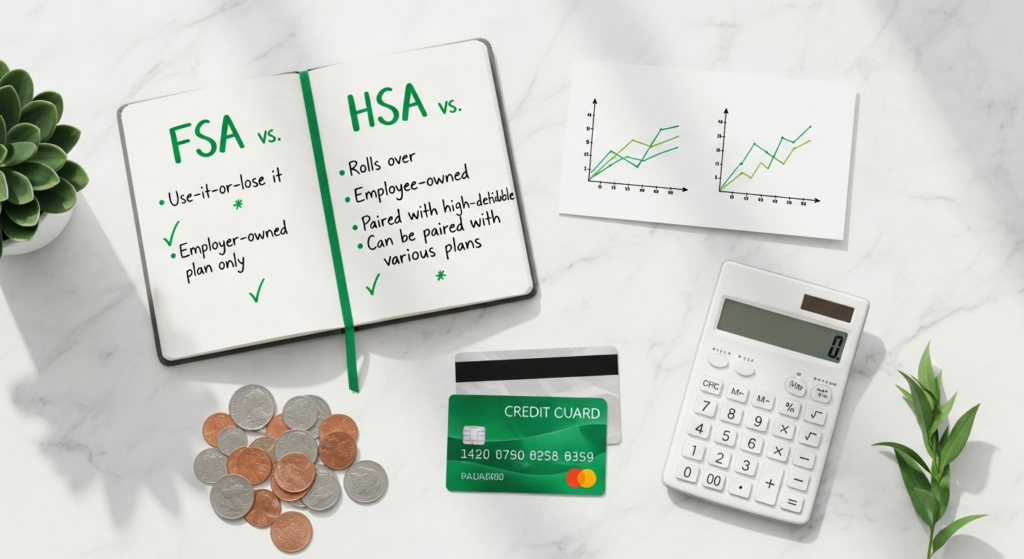
FSA vs. HSA: Decoding Your Health Savings Options for 2026
This comprehensive guide from Fin3go will break down what an FSA and an HSA are, highlight their key differences, and help you determine which option aligns best with your personal health and financial situation, leveraging the latest insights and projected 2026 figures.
What is a Flexible Spending Account (FSA)?
A Flexible Spending Account (FSA) is an employer-sponsored benefit that allows you to set aside a portion of your pre-tax income to pay for eligible out-of-pocket healthcare costs. Offered through your employer’s benefits package, FSAs are a convenient way to reduce your taxable income while budgeting for medical, dental, vision, and even certain prescription expenses throughout the year.
When you elect to contribute to an FSA, the money is deducted from your paycheck before taxes are calculated. This means you effectively lower your taxable income, saving you money on federal income taxes, and often state and local taxes, as well as FICA taxes (Social Security and Medicare). The funds are then available to you, typically through a debit card, to pay for qualified medical expenses as they arise.
Key Characteristics of an FSA:
- Employer-Sponsored: FSAs are only available if your employer offers one. You cannot open an FSA independently.
- Pre-Tax Contributions: Funds are deducted from your paycheck before taxes, reducing your taxable income.
- Access to Funds: The full amount you elect to contribute for the year is generally available on the first day of your plan year, even if you haven’t contributed the full amount yet. This is a significant advantage, particularly for unforeseen expenses early in the year.
- Eligible Expenses: A wide range of medical, dental, and vision expenses are covered, including deductibles, copayments, coinsurance, prescription medications, insulin, and over-the-counter drugs and medical supplies (no prescription needed).
- “Use-It-Or-Lose-It” Rule: This is arguably the most critical feature of an FSA. Historically, any money left in your FSA at the end of the plan year was forfeited. However, the IRS has introduced some flexibility. For plan years ending in 2026, many employers may offer one of two options:
- Grace Period: An extension of up to 2.5 months into the new plan year during which you can still use the previous year’s funds.
- Rollover: A limited amount of unused funds (projected to be around $640 for 2026, subject to inflation adjustments) can be carried over to the next plan year. Employers can choose either a grace period or a rollover, but not both. It’s crucial to check your specific plan’s rules.
- Contribution Limits: The IRS sets annual limits on how much you can contribute. For 2026, the projected maximum contribution for a health FSA is around $3,200 per employee, subject to inflation adjustments. This limit applies per employer, meaning if you work for two different employers that both offer FSAs, you could potentially contribute to both, up to the individual limit for each.
Types of FSAs:
- Health FSA: The most common type, used for medical, dental, and vision expenses.
- Dependent Care FSA (DCFSA): Specifically for childcare expenses for dependents under 13, or for a spouse or dependent who is physically or mentally incapable of self-care. The contribution limit for a DCFSA is typically lower than a health FSA and is set per household, not per employee. For 2026, this limit is expected to remain around $5,000 for single filers and married couples filing jointly, and $2,500 for married couples filing separately.
- Limited-Purpose FSA (LPFSA): This type of FSA is often paired with an HSA. It allows you to use pre-tax dollars for vision and dental expenses only, preserving your HSA funds for other medical costs or long-term growth.
FSAs are an excellent tool for those with predictable healthcare spending or specific dependent care needs, providing immediate tax savings on funds used within the plan year.
Diving into Health Savings Accounts (HSAs)
The core principle of an HSA is to empower individuals to take more control over their healthcare spending while providing a robust savings and investment vehicle for future medical costs, even into retirement. The link to an HDHP is non-negotiable for eligibility; you must be covered by an HDHP and generally not have other health coverage (with some exceptions like dental, vision, or specific disease policies) to contribute to an HSA.
Key Characteristics of an HSA:
- HDHP Requirement: You must be enrolled in a High-Deductible Health Plan (HDHP) to contribute to an HSA. For 2026, an HDHP is projected to be defined as a health plan with a minimum annual deductible of approximately $1,650 for self-only coverage and $3,300 for family coverage. The maximum out-of-pocket expenses (including deductibles, copayments, and coinsurance but not premiums) are projected to be around $8,300 for self-only coverage and $16,600 for family coverage. These figures are subject to annual inflation adjustments by the IRS.
- Individual Ownership: Unlike an FSA, an HSA belongs to you, not your employer. This means it’s fully portable if you change jobs or retire.
- Triple Tax Advantage: HSAs offer a unique “triple tax advantage”:
- Tax-Deductible Contributions: Contributions are made pre-tax through payroll deductions or are tax-deductible if made directly to the account.
- Tax-Free Growth: The money in your HSA can be invested, and any earnings or interest grow tax-free.
- Tax-Free Withdrawals: Funds can be withdrawn tax-free at any time to pay for qualified medical expenses.
- No “Use-It-Or-Lose-It”: This is a major differentiator from an FSA. Your HSA funds roll over year after year, indefinitely. There’s no deadline to use the money, allowing it to accumulate and grow over time.
- Investment Potential: Once your HSA balance reaches a certain threshold (often $1,000 or $2,000, depending on the custodian), you typically have the option to invest the funds in various mutual funds, stocks, or other investment vehicles, similar to a 401(k) or IRA. This allows your health savings to grow significantly over decades.
- Contribution Limits: The IRS sets annual limits. For 2026, the projected maximum contribution for individuals with self-only HDHP coverage is around $4,300, and for those with family HDHP coverage, it’s around $8,550. These limits include both your contributions and any contributions made by your employer.
- Catch-Up Contributions: If you are age 55 or older by the end of the tax year, you can contribute an additional $1,000 annually (remaining constant) beyond the regular limits, allowing for accelerated savings as you approach retirement.
- Qualified Expenses: Similar to FSAs, HSAs cover a broad range of medical, dental, and vision expenses. Crucially, after age 65 (or if you become disabled), you can withdraw HSA funds for any purpose without penalty. While non-medical withdrawals are subject to ordinary income tax, they are not subject to the 20% penalty that applies to non-qualified withdrawals before age 65. This makes an HSA a de facto retirement account for healthcare, or even for general expenses if needed later in life.
HSAs are particularly appealing to those who are relatively healthy, want to save for long-term healthcare costs, and are comfortable with the higher deductible of an HDHP in exchange for lower monthly premiums and significant tax benefits.
The Head-to-Head Comparison: FSA vs. HSA
While both FSAs and HSAs are excellent tools for managing healthcare costs with tax-advantaged money, their fundamental differences dictate which might be a better fit for you. Here’s a direct comparison of their key features for 2026:
| Feature | Flexible Spending Account (FSA) | Health Savings Account (HSA) |
|---|---|---|
| Eligibility | Must be offered by employer; generally requires enrollment in an employer-sponsored health plan. | Must be enrolled in a High-Deductible Health Plan (HDHP) and generally have no other health coverage. |
| Ownership & Portability | Owned by the employer; generally not portable if you leave your job. | Owned by the individual; fully portable and stays with you even if you change jobs or retire. |
| “Use-It-Or-Lose-It” | Yes, generally, though employers may offer a grace period (up to 2.5 months) or a limited rollover (projected $640 for 2026). | No, funds roll over year after year and never expire. |
| Investment Potential | No, funds are typically held in a checking-like account. | Yes, funds can be invested in various assets, allowing for tax-free growth over time. |
| Tax Benefits | Pre-tax contributions (reduces taxable income). No tax-free growth or withdrawals. | Triple tax advantage: tax-deductible contributions, tax-free growth, tax-free withdrawals for qualified medical expenses. |
| Availability of Funds | Full elected amount typically available on day one of the plan year. | Only the amount actually contributed is available (plus any previous balances). |
| Contribution Limits (2026 Projected) | Approx. $3,200 (Health FSA, per employee). $5,000 (Dependent Care FSA, per household). | Approx. $4,300 (self-only); $8,550 (family). Plus $1,000 catch-up for age 55+. |
| Interaction with Medicare | No direct impact. | Cannot contribute to an HSA once enrolled in any part of Medicare. However, existing HSA funds can still be used tax-free for medical expenses, including Medicare premiums (excluding Medigap). |
| Employer Contributions | Common for employers to contribute, but those contributions count towards the individual’s annual limit. | Common for employers to contribute, and those contributions count towards the individual’s annual limit. |
The distinction between “employer-owned” vs. “individual-owned” and the “use-it-or-lose-it” rule are often the most defining factors for many people. HSAs offer long-term savings and investment power, while FSAs provide immediate tax relief for planned, shorter-term spending.
Choosing Your Champion: When to Pick Which for 2026
Deciding between an FSA and an HSA depends heavily on your current health status, financial goals, and your employer’s offerings. Here’s a breakdown to help you make an informed decision for 2026:
When an FSA Shines (Predictable Costs & Specific Needs):
- You have predictable healthcare expenses: If you know you’ll have ongoing medical needs (e.g., specific prescriptions, regular doctor visits, orthodontic work, glasses/contacts), an FSA is excellent for budgeting and paying for these known costs with pre-tax money.
- You are not on a High-Deductible Health Plan (HDHP): If your employer offers a traditional health plan with lower deductibles or copays, an FSA is likely your only option for tax-advantaged health savings.
- You need Dependent Care support: A Dependent Care FSA is a fantastic option if you have children under 13 or qualifying adult dependents and incur expenses for daycare, preschool, or elder care. This is a unique benefit not offered by HSAs.
- You want immediate tax savings on known expenses: Because the full elected amount is often available at the start of the plan year, an FSA provides immediate relief for large, early-year expenses, even if you haven’t contributed all the funds yet.
- Your employer contributes: Some employers contribute to FSAs, which is essentially free money to help cover your medical costs.
Remember the “use-it-or-lose-it” rule and plan your contributions carefully to avoid forfeiting funds. However, with grace periods and limited rollovers becoming more common for 2026, the risk is somewhat mitigated.
When an HSA is King (Long-Term Savings & Investment Power):
- You are enrolled in a High-Deductible Health Plan (HDHP): This is the fundamental requirement. If you’re eligible, an HSA offers unparalleled benefits.
- You want to save for future healthcare costs, including retirement: The ability to invest funds, let them grow tax-free, and withdraw them tax-free for medical expenses makes an HSA a powerful retirement savings vehicle specifically for healthcare. It’s often called the “most powerful retirement account.”
- You are relatively healthy or have significant discretionary income: If you don’t anticipate many medical expenses annually, you can let your HSA balance grow substantially. You can pay for smaller expenses out-of-pocket and save your receipts to reimburse yourself years later, allowing your funds to grow longer.
- You want portability: If you’re likely to change jobs, an HSA moves with you, ensuring continuity in your healthcare savings.
- You want ultimate flexibility: With no “use-it-or-lose-it” rule and the option to use funds for non-medical expenses (with tax, but no penalty after 65), an HSA offers maximum flexibility.
Can You Have Both an FSA and an HSA?
Generally, no. You cannot contribute to a standard Health FSA and an HSA simultaneously. The primary reason is that a standard FSA is considered “other health coverage” which makes you ineligible to contribute to an HSA. However, there are exceptions:
- Limited-Purpose FSA (LPFSA): You can contribute to an LPFSA alongside an HSA. An LPFSA typically covers only vision and dental expenses, allowing you to use pre-tax dollars for these specific needs while preserving your HSA for broader medical expenses or long-term investment.
- Post-Deductible FSA: Some employers offer a post-deductible FSA, which only pays for expenses after you’ve met your HDHP deductible. This is also HSA-compatible.
- Dependent Care FSA (DCFSA): A DCFSA is entirely separate from health savings and can be used in conjunction with an HSA.
For most people, the choice comes down to their health plan type and financial priorities. If you qualify for an HSA, its long-term benefits and investment potential often make it the more attractive option for those focused on accumulating wealth and planning for future healthcare needs. If you’re on a traditional plan or have significant, predictable short-term medical or dependent care expenses, an FSA offers immediate tax relief.
Maximizing Your Health Savings in 2026
Regardless of whether you choose an FSA, an HSA, or a combination, effective management is key to leveraging these accounts to their fullest potential. Here are some practical tips for 2026:
- Understand Your Plan: Carefully read your employer’s benefits guide. Know your HDHP’s deductible and out-of-pocket maximums for an HSA, or your FSA’s grace period/rollover rules.
- Budget Carefully: For FSAs, estimate your annual medical, dental, or vision expenses. Contribute enough to cover these, but not so much that you risk forfeiting funds. For HSAs, consider contributing the maximum allowable amount, especially if your employer contributes.
- Track Everything: Keep meticulous records of all eligible expenses and receipts. This is crucial for reimbursement and for tax purposes, especially with HSAs if you plan to reimburse yourself years down the line. Many HSA providers offer tools to help you manage receipts digitally.
- For HSAs, Invest Your Funds: Don’t let your HSA sit in a low-interest checking account. Once you have a comfortable emergency reserve, explore the investment options offered by your HSA custodian. Compounding returns over decades can turn a modest balance into a substantial nest egg for retirement healthcare costs.
- Consider Employer Contributions: Always contribute at least enough to get any matching contributions from your employer. This is essentially free money that significantly boosts your savings.
- Review Annually: Healthcare needs and IRS limits change. Re-evaluate your contributions and strategy each open enrollment period to ensure your accounts still align with your financial and health situation. For 2026, be sure to check the final IRS announced limits, as our figures are projections.
- Utilize the Portability (HSA): If you change jobs, your HSA goes with you. You can often transfer it to a different custodian if you find one with better investment options or lower fees.
In a healthcare landscape where costs continue to rise, utilizing tax-advantaged accounts like FSAs and HSAs is a cornerstone of smart financial planning. By understanding their unique benefits and aligning them with your personal circumstances, you can significantly reduce your out-of-pocket expenses and build a more secure financial future.
Both Flexible Spending Accounts (FSAs) and Health Savings Accounts (HSAs) offer powerful ways to save on taxes while covering healthcare costs. FSAs are employer-owned, tied to specific plan years with a “use-it-or-lose-it” rule (though mitigated by grace periods or limited rollovers), and are ideal for predictable, short-term medical or dependent care expenses. HSAs, conversely, are individually owned, linked to High-Deductible Health Plans (HDHPs), offer a triple tax advantage, and function as long-term savings and investment vehicles with no expiration date. Your choice for 2026 hinges on your health plan type, risk tolerance for higher deductibles, and whether your priority is immediate tax savings on known expenses or long-term growth for future healthcare needs, especially in retirement.
FAQ: Frequently Asked Questions About FSAs and HSAs
Can I have both an FSA and an HSA simultaneously?
Generally, no, you cannot contribute to a standard Health FSA and an HSA at the same time, because a regular FSA is considered “other health coverage” that disqualifies you from HSA contributions. However, you can typically have a Health Savings Account (HSA) along with a Limited-Purpose FSA (LPFSA) that covers only dental and vision expenses, or a Dependent Care FSA (DCFSA) for childcare expenses. Always check your specific plan details during open enrollment.
What happens to my HSA/FSA if I change jobs?
An HSA is entirely yours and completely portable. If you change jobs, your HSA stays with you, and you can continue to contribute to it if your new health plan is an HDHP, or simply let the funds grow and use them for future medical expenses. An FSA, however, is employer-sponsored and generally not portable. If you leave your job, any unused funds are typically forfeited, though some plans may allow you to use funds for a limited period after termination (e.g., through COBRA for a healthcare FSA).
Are over-the-counter medications eligible expenses for FSA/HSA in 2026?
Yes, for 2026, over-the-counter (OTC) medications and menstrual products are generally considered eligible medical expenses for both FSAs and HSAs. The CARES Act permanently removed the requirement for a prescription for these items, making it easier to use your tax-advantaged funds for common health needs like pain relievers, cold medicines, and allergy treatments. Always verify with your specific plan administrator for any nuanced rules.
How do I find out my specific plan’s rules regarding grace periods or rollovers for my FSA?
The rules regarding FSA grace periods or limited rollovers are determined by your employer and the plan administrator. To find out your specific plan’s rules for 2026, you should consult your benefits enrollment materials, contact your human resources department, or reach out directly to your FSA plan administrator (often a third-party company). These details are typically outlined clearly during open enrollment periods.