



Updated October 2023. Figuring out how to create a personal budget step-by-step is the single most powerful action you can take to secure your financial future. Far too often, individuals view money management as a restrictive diet designed to punish spending habits, rather than a tactical tool that unlocks true financial freedom. A properly structured spending plan directs your capital toward the things you genuinely value while aggressively eliminating waste.
The path to lasting wealth does not begin with complex investment portfolios; it starts with granular, day-to-day cash flow management. Whether your goal is rapidly eliminating high-interest debt, building an unbreakable emergency fund, or aggressively investing for early retirement, every major financial milestone relies on a baseline understanding of what comes in and what goes out. This comprehensive guide details the precise actions required to build, implement, and sustain a financial framework that adapts to your life, allowing you to move beyond living paycheck to paycheck and finally take absolute control over your financial trajectory.
Why Do Financial Roadmaps Fail Without a Clear Strategy?
Many individuals attempt to manage their finances by simply checking their bank balance before making a purchase. A 2023 study by Charles Schwab found that 58% of Americans live paycheck to paycheck, a vulnerability that stems directly from relying on mental math rather than documented strategies. Reactive spending ensures that short-term impulses constantly override long-term wealth objectives. Creating a spending plan shifts an individual from a reactive financial posture to a proactive one. Proactive allocation works because assigning every dollar a specific job prior to the start of the month removes the cognitive burden of decision-making at the point of sale. When you have a predetermined limit for dining out, you are not debating whether you can afford a meal; you are simply checking a ledger. This reduction in decision fatigue dramatically lowers the likelihood of emotional overspending. What failure looks like in this initial stage: Checking your bank balance on the 28th of the month and realizing you are overdrawn due to forgotten auto-renewals and weekend impulse buys, leaving no capital for wealth accumulation. Before diving into the detailed methodology, review the core phases of the financial planning lifecycle. If you are currently focused on structuring an early-career wealth strategy, these foundational elements are non-negotiable.
| Phase | Core Action | Primary Objective |
|---|---|---|
| 1. Income | Determine net monthly earnings | Establish the absolute baseline of available capital |
| 2. Expenses | Audit past transactions | Identify fixed obligations and discretionary leaks |
| 3. Goals | Set quantifiable targets | Give the budget a distinct, motivating purpose |
| 4. Framework | Select an allocation method | Create structured boundaries for spending categories |
| 5. Monitoring | Track daily/weekly variances | Ensure the actual behavior matches the theoretical plan |
By understanding these phases, you transition from merely surviving your financial obligations to actively directing your wealth accumulation.
Step 1: Calculate Your Monthly Net Earnings Accurately

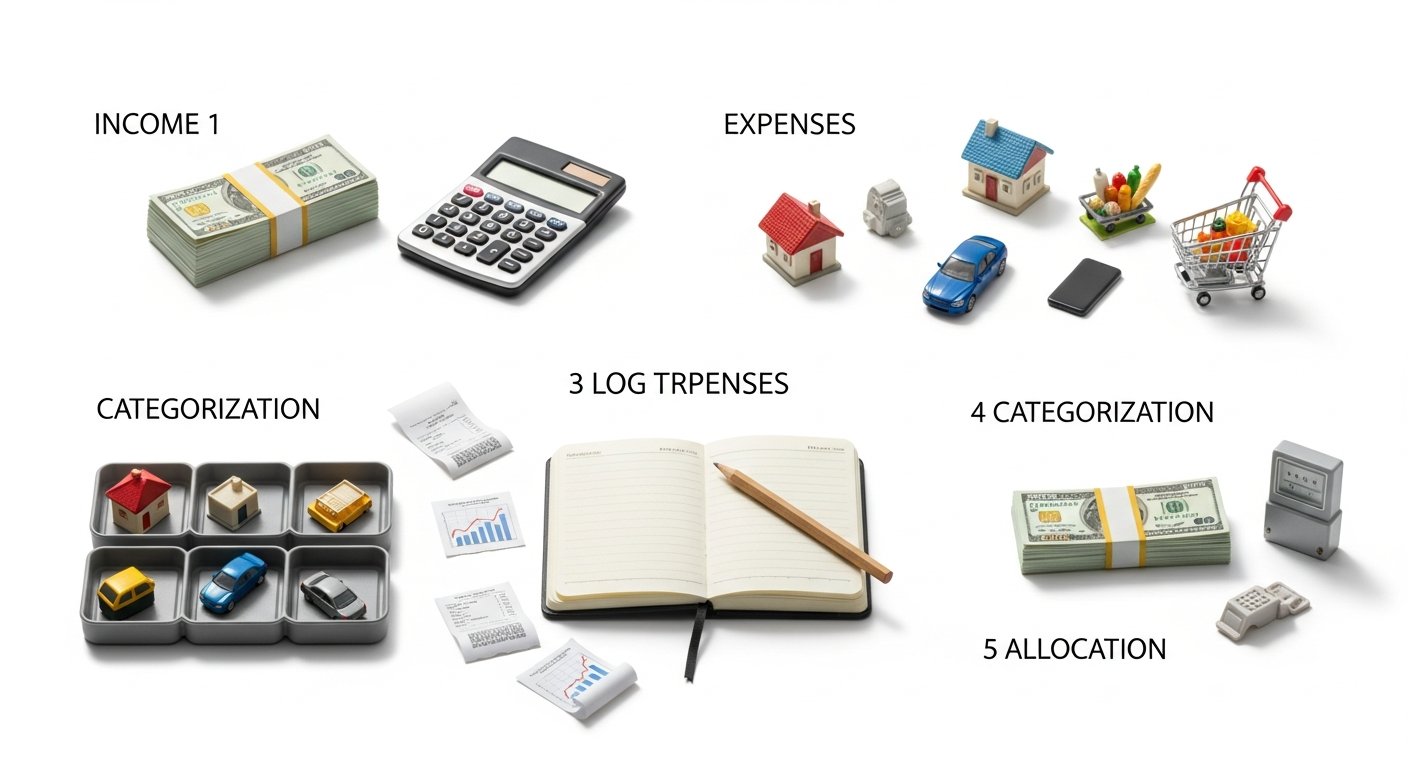
The foundation of any financial system begins with an exact calculation of your inbound cash flow. A common error is building a plan based on gross salary rather than Net Adjusted Income—the actual liquid capital deposited into your accounts after taxes, healthcare premiums, and mandatory retirement contributions have been deducted. For salaried employees with consistent paychecks, this calculation is straightforward. You review three months of bank statements and average the direct deposits. However, for those with irregular earnings, such as freelancers or commission-based sales professionals, the approach must shift toward defensive planning. A freelance graphic designer might earn $4,000 in March, $1,500 in April, and $6,000 in May. Building a plan around the $3,833 average creates a severe cash flow crisis during the low-earning month of April.
Arjun Reddy: “When dealing with variable income, always base your essential living expenses on your lowest earning month from the past year. Any income generated above that baseline should be immediately routed into a ‘buffer account’ to artificially smooth out your paychecks during lean periods.”
Accurate income assessment prevents the immediate collapse of a new spending framework. If your planned expenditures exceed your true liquid income from day one, reliance on high-interest credit becomes inevitable. Gather your most recent pay stubs, business profit and loss statements, and any secondary revenue documentation before moving to the next phase. If you are looking into turning leisure activities into secondary revenue streams, ensure you track that variable income separately. Understanding the exact timing of your cash inflows is just as critical as the total amount. Aligning your major bill due dates with your pay schedule prevents artificial cash shortages and overdraft fees.
[INLINE IMAGE 2: Flowchart illustrating the transition from gross salary to net adjusted income after taxes and pre-tax deductions.]
Types of Expenditures and Classification Techniques
Once you have quantified your earnings, the next critical phase involves an aggressive audit of your outflows. Understanding where your money has historically gone is a prerequisite for dictating where it should go in the future. This requires pulling the last 60 to 90 days of bank and credit card statements and systematically classifying every transaction. Segregating fixed costs from discretionary spending prevents accidental over-allocations. Fixed costs—such as rent, mortgage payments, auto insurance, and baseline utilities—remain relatively static and represent your baseline survival number. Variable expenses, like groceries and transportation fuel, fluctuate but are fundamentally essential. The most critical category to isolate is Discretionary Leakage: the non-essential spending on dining, entertainment, and digital subscriptions. According to a 2023 consumer finance report by C&R Research, uncategorized and forgotten subscriptions cost the average consumer $133 per month in unused services. Identifying these leaks provides immediate capital that can be redirected toward debt reduction or savings.
Categorization Strategies
- Housing & Utilities: Rent, mortgage, property taxes, electricity, water, internet. Target: ~25-35% of net income.
- Transportation: Car payments, fuel, public transit passes, maintenance sinking funds. Target: ~10-15%.
- Food: Groceries and household consumables (separate from dining out). Target: ~10-15%.
- Debt Obligations: Minimum payments on student loans, credit cards, and personal loans.
- Lifestyle & Discretionary: Restaurants, hobbies, streaming services, travel.
By classifying these expenditures accurately, you build the required data set for setting up monthly cash flow systems that reflect reality rather than optimistic guesswork. Advanced practitioners often create a ‘sinking fund’ category for predictable but irregular expenses, such as annual insurance premiums or holiday shopping, ensuring these costs do not derail the monthly equilibrium.
How Do You Define SMART Targets and Select a Methodology?
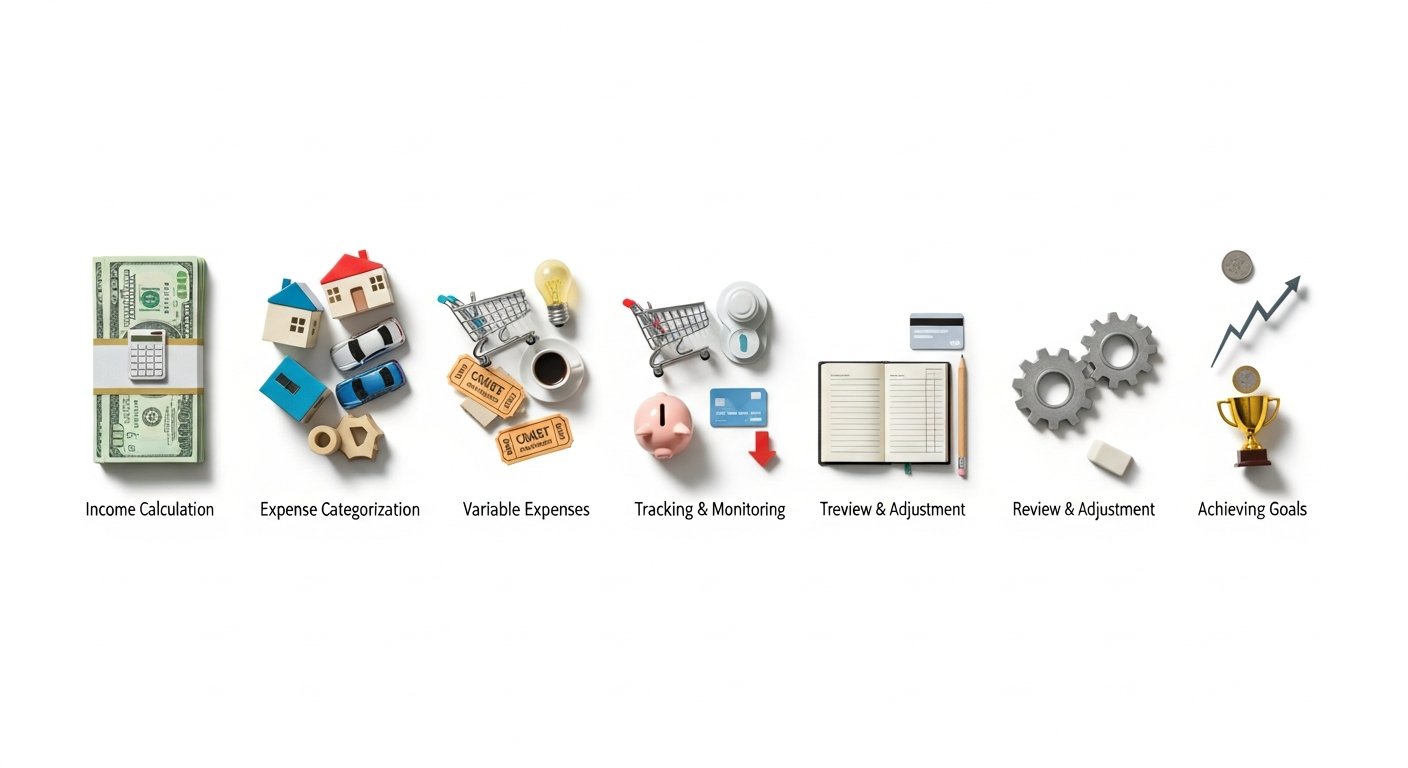
A cash flow plan without specific targets is merely a tracking exercise, not a growth strategy. Step three demands the creation of goals using the SMART framework (Specific, Measurable, Achievable, Relevant, Time-bound). Rather than a vague desire to ‘save more,’ a SMART goal dictates: ‘Accumulate a $10,000 emergency fund by December 31st by automatically transferring $400 from every bi-weekly paycheck.’ If your immediate priority is accelerating property down payment savings, that specific target dictates which methodology you select in step four. The financial framework you choose acts as the operating system for your daily habits.
Prominent Allocation Frameworks
- The 50/30/20 Rule: A proportional system allocating 50% to needs, 30% to wants, and 20% to savings/debt payoff. This method excels because it dynamically adapts to income increases without requiring complex recalculations.
- Zero-Based Budgeting: A rigorous system where Income minus Expenses exactly equals zero. Every single dollar is given a specific assignment before the month begins.
- The Envelope System: A behavioral approach utilizing physical cash or segregated digital accounts for categories prone to overspending, creating a hard stop when funds are depleted.
What success looks like: Selecting the zero-based method, allocating $300 to a digital ‘dining out’ envelope, and comfortably declining an expensive dinner invitation on the 25th of the month because the specific envelope is empty, knowing your long-term goals remain fully funded. Choosing the right framework depends heavily on your psychological relationship with money; those prone to impulse buying often require the strict boundaries of the envelope system, while high-earners with disciplined habits may prefer the flexibility of proportional allocation.
[INLINE IMAGE 4: Side-by-side bar chart comparing the 50/30/20 rule allocation against a zero-based budget allocation.]
Construction Elements of a Realistic Spending Plan
With your income assessed, expenses categorized, goals defined, and methodology selected, step five requires physically constructing the plan. This is where theory translates into execution. Begin by subtracting your fixed, essential expenses from your net income. The remaining capital must then be divided among your savings goals, debt repayment strategies, and discretionary categories according to your chosen framework. Households utilizing active spending trackers save an average of 18% more annually than those who rely on memory alone (National Endowment for Financial Education, 2023). The tool you choose to house your plan must reduce friction. If the software is too complex, abandonment is highly probable.
Arjun Reddy: “The most common error during the construction phase is failing to build a ‘miscellaneous’ buffer. Always allocate 5-10% of your net income to an unassigned category to absorb forgotten expenses or minor emergencies, protecting the integrity of your core plan.”
| Tracking Medium | Primary Advantage | Optimal User Profile |
|---|---|---|
| Automated Apps (e.g., YNAB, Monarch) | Automatically imports and categorizes bank transactions via API. | Busy professionals who require real-time updates without manual data entry. |
| Custom Spreadsheets (Excel, Google Sheets) | Infinite customizability and zero monthly subscription costs. | Detail-oriented individuals who prefer deep analytical control over their data. |
| Physical Ledgers / Cash Envelopes | Maximum psychological friction when parting with money. | Individuals struggling with chronic credit card debt and impulse control. |
A user sets up a digital spreadsheet with conditional formatting; when their grocery spending exceeds $500, the cell turns bright red. This immediate visual feedback mechanism alerts the user mid-month, prompting them to substitute premium ingredients for cost-effective staples during their final shopping trip, successfully avoiding a budget deficit. The key is to select a medium that aligns with your daily habits, ensuring that logging transactions becomes as routine as checking your email.
Step 6: Track Variances and Implement Ongoing Adjustments
A financial plan is not a static document; it is a living mechanism that requires continuous oversight. Step six involves establishing a strict cadence for monitoring actual spending against the projected numbers. Setting up the framework is useless if you do not review the variance—the difference between what you planned to spend and what actually left your account. Reviewing transactions weekly ensures that minor deviations do not compound into massive deficits. If you allocated $150 for transportation but an unexpected fuel price spike pushes your mid-month total to $120, a weekly review allows you to temporarily reduce your entertainment allocation by $30 to cover the impending shortfall.
Furthermore, life circumstances change. A sudden increase in utility rates, a rent hike, or a new job will fundamentally alter your cash flow realities. Regular adjustments ensure your targets remain realistic. If you consistently overspend in a specific category for three consecutive months despite genuine efforts to cut back, the flaw is likely in your unrealistic projection, not just your discipline. You must adjust the allocation upward and reduce funding elsewhere to compensate, maintaining absolute equilibrium. Advanced budgeting often involves anticipating these variances by analyzing historical data. For instance, if you know your utility bills spike every July due to air conditioning, your June review should proactively shift funds from discretionary categories into your utility envelope. This level of foresight transforms a basic tracking habit into a sophisticated cash flow management system.
What Blind Spots Sabotage New Money Management Strategies?
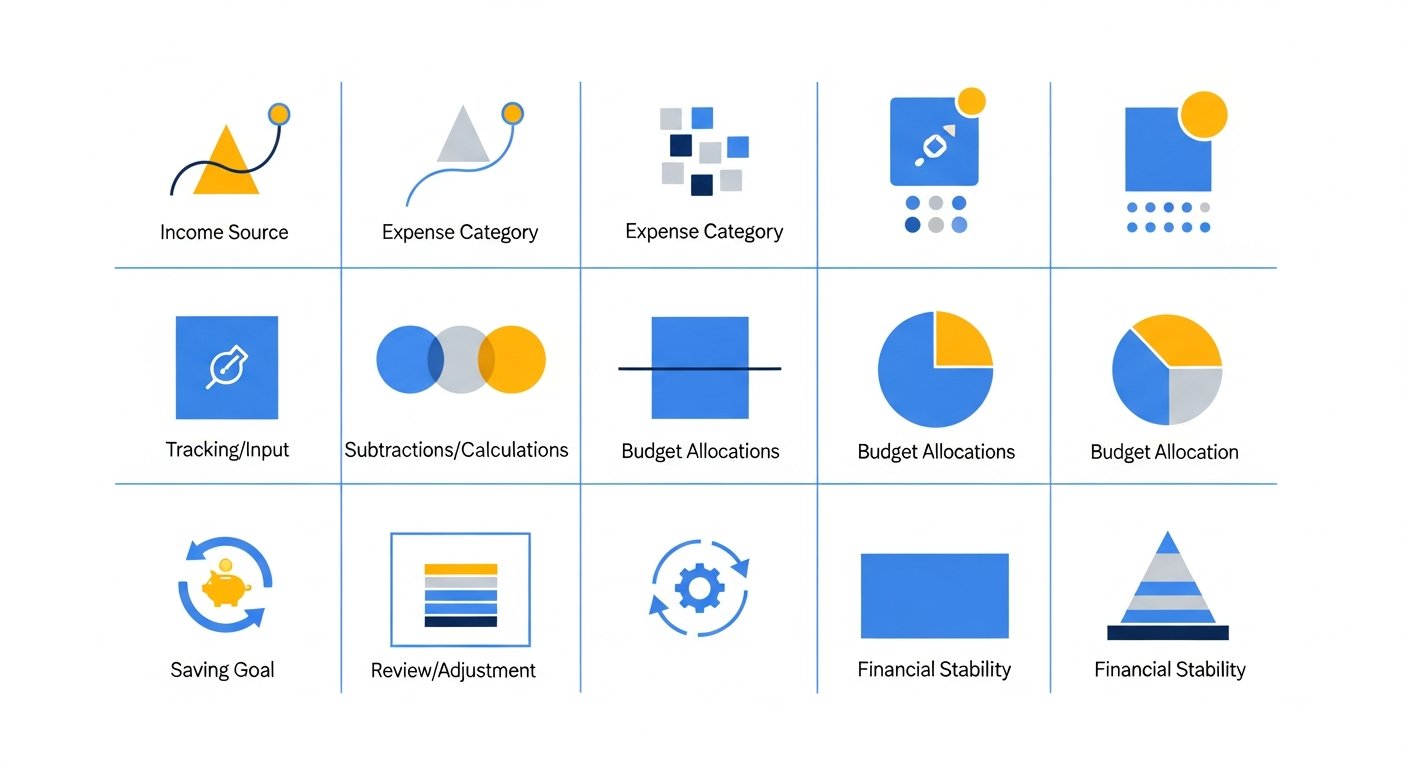
Even with rigorous planning, novices frequently encounter specific friction points that can derail their progress. Understanding these common blind spots allows you to implement defensive measures before frustration sets in.
Why do irregular expenses cause budgets to fail?
Annual obligations like property taxes, vehicle registration, or holiday gifts often catch people off guard. These should be treated as monthly expenses through ‘sinking funds’—dividing the annual cost by twelve and saving that fraction each month.
How does over-restriction lead to financial bingeing?
Slashing all discretionary spending to zero in a burst of initial motivation inevitably leads to burnout. Severe financial deprivation functions exactly like a severe caloric deficit; it usually ends in a massive binge. Allow for small, guilt-free indulgences to maintain long-term compliance.
Why is failing to communicate fatal for shared finances?
For couples, managing shared finances in a silo breeds resentment. A cohesive plan requires joint input, shared visibility, and agreed-upon spending thresholds. Schedule monthly financial check-ins to align on goals and address discrepancies.
What happens if you neglect to reconcile your accounts?
Simply logging purchases does not guarantee accuracy. Reconciling your tracking tool against your actual bank statements twice a month catches fraudulent charges, double-billings, and simple input errors.
The mechanism behind early failure is almost always decision fatigue. When individuals have to manually calculate every small purchase against their total bank balance, the cognitive load becomes unsustainable. By assigning funds to strict categories in advance, you eliminate the mental strain of daily financial calculations. Once you master the fundamentals of personal finance, these recurring blind spots fade, replaced by a permanent system that systematically converts active income into long-term wealth. Recognizing these psychological hurdles is just as important as the mathematical calculations themselves.
Sources & References
- Charles Schwab. (2023). Modern Wealth Survey: The Impact of Reactive Spending on Household Stability.
- National Endowment for Financial Education (NEFE). (2023). Consumer Cash Flow and Active Tracking Efficacy Report.
- C&R Research. (2023). Subscription Creep: The Hidden Cost of Digital Autopay Systems.
Reviewed by Julian Vance, Editorial Director, Digital Finance — Last reviewed: October 15, 2023