



Understanding the Financial Landscape of a Restaurant Startup
Before you even think about seeking funding, it’s imperative to have a crystal-clear understanding of the financial demands a new restaurant will place on you. This isn’t just about the initial outlay; it’s about sustaining operations until profitability is achieved, which can take months, or even a year or more. Many aspiring restaurateurs underestimate the true costs, leading to undercapitalization – a common pitfall that can doom a promising venture before it truly begins.
Startup costs for a restaurant are multifaceted and substantial. They typically include:
- Leasehold Improvements/Build-Out: This is often the largest single expense. Depending on whether you’re taking over an existing restaurant space or starting from a shell, costs can range from minor cosmetic changes to complete gut renovations, including plumbing, electrical, HVAC, kitchen hoods, and dining area design.
- Kitchen Equipment: Ovens, ranges, refrigerators, freezers, dishwashers, fryers, prep tables, smallwares – the list is extensive and essential. High-quality commercial equipment is a significant investment.
- Furniture, Fixtures, and Equipment (FF&E): Dining tables, chairs, barstools, lighting, point-of-sale (POS) systems, sound systems, decor, and office equipment.
- Initial Inventory: Food, beverages, cleaning supplies, paper goods – you need to stock up before opening day.
- Licenses and Permits: Health permits, liquor licenses (which can be incredibly expensive and time-consuming to acquire), business licenses, food handler certifications, fire safety permits, and potentially signage permits.
- Pre-Opening Marketing: Website development, social media setup, grand opening promotions, local advertising.
- Working Capital: This is arguably the most critical and most often underestimated cost. Working capital is the cash reserve needed to cover initial operating expenses (salaries, rent, utilities, ingredient purchases) during the period before your restaurant generates sufficient revenue to sustain itself. Experts often recommend having at least 3-6 months of operating expenses in reserve.
- Professional Fees: Attorneys for lease review and business formation, accountants for financial planning and tax setup, consultants for kitchen design or menu development.
- Security Deposits: For rent, utilities, and potentially equipment leases.
The total sum for these items can easily range from $100,000 for a small, quick-service cafe to well over $1 million for a full-service, upscale dining establishment, especially in competitive urban markets. Developing a comprehensive, line-item budget that details every anticipated expense, along with realistic timelines, is the foundational step. This budget will not only guide your spending but also serve as a critical component of your business plan when seeking financing. Without a deep dive into these costs, you risk not securing enough capital, which can lead to a premature and heartbreaking closure. Understanding these numbers is the first step towards taking control of your financial future and ensuring your restaurant’s longevity.
Traditional Financing Routes: Banks, SBA, and Personal Capital

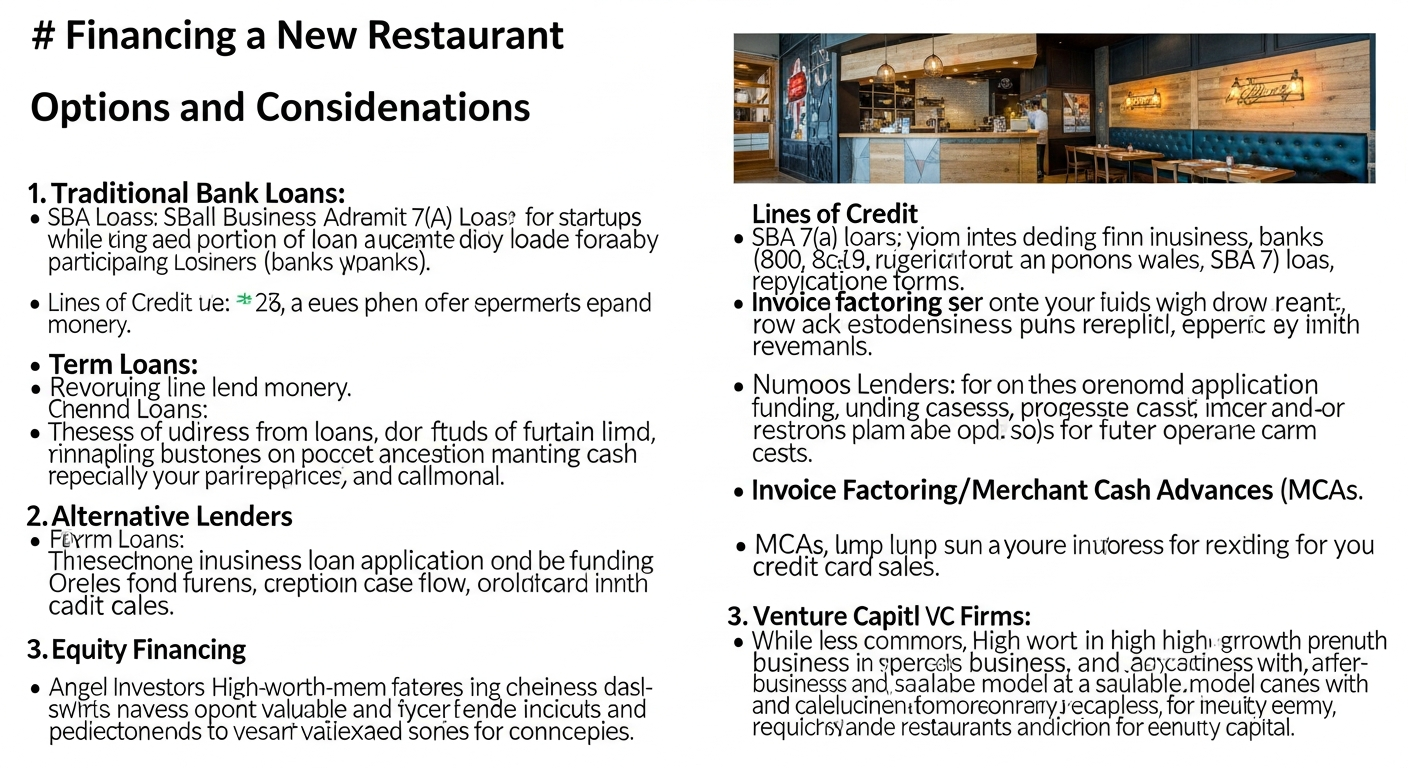
When it comes to securing significant capital for a new restaurant, traditional financing methods often come to mind first. These avenues, while sometimes more rigorous in their application process, can provide substantial funds with competitive interest rates and structured repayment plans. Understanding each option is key to determining which best aligns with your financial situation and business goals.
Commercial Bank Loans
Traditional banks remain a primary source of funding for established businesses, but they can be a viable option for startups with strong fundamentals. Banks typically offer term loans, where you receive a lump sum and repay it with interest over a fixed period, or lines of credit, which provide flexible access to funds up to a certain limit. For a new restaurant, lenders will scrutinize several factors:
- Creditworthiness: Both your personal and any existing business credit scores will be heavily evaluated. A strong personal credit history is paramount.
- Business Plan: A detailed, well-researched business plan demonstrating market viability, a sound operational strategy, and robust financial projections is non-negotiable.
- Collateral: Banks often require collateral, such as real estate, equipment, or other assets, to secure the loan. For startups, this often means personal assets, which increases your personal risk.
- Experience: Lenders prefer to see a track record of success in the restaurant industry, either through prior ownership or significant management experience.
- Debt Service Coverage Ratio: Your financial projections must show that your restaurant will generate enough cash flow to comfortably cover loan repayments.
While bank loans offer structure and often lower interest rates than alternative lenders, the application process can be lengthy, and approval for startups can be challenging without significant equity injection or collateral.
SBA-Backed Loans
The U.S. Small Business Administration (SBA) doesn’t lend money directly, but it guarantees a portion of loans made by commercial banks, reducing the risk for lenders and making it easier for small businesses, especially startups, to qualify. SBA loans are highly popular for restaurants due to their favorable terms:
- Lower Down Payments: Often require less equity contribution from the borrower compared to conventional bank loans.
- Longer Repayment Terms: Spreading payments over a longer period (up to 10 years for working capital, up to 25 years for real estate) results in lower monthly payments.
- Competitive Interest Rates: Often capped by the SBA, making them more affordable.
The most common SBA programs for restaurants include the SBA 7(a) Loan Program, which is highly flexible and can be used for working capital, equipment, real estate, and more, and the SBA 504 Loan Program, ideal for major fixed assets like real estate and heavy equipment. While the SBA guarantees loans, you still apply through a participating lender (a bank or credit union). The application process involves extensive documentation, including detailed financial statements, tax returns, and a comprehensive business plan, but the benefits often outweigh the administrative hurdles. This is often the best “traditional” route for new restaurant owners.
Personal Capital: Savings, Home Equity, and Friends & Family
Many entrepreneurs initially tap into their personal financial resources, and for good reason. Using your own money means no interest payments, no repayment schedule, and complete control over your business. This can come from:
- Personal Savings: A straightforward option, but it ties your personal financial security directly to the business’s success. It’s crucial to assess your personal financial runway. When thinking about drawing down significant personal savings, it’s wise to consider its impact on your long-term goals. For instance, if you’ve been diligently working on how to plan for retirement, diverting those funds to a high-risk venture could set you back years. A careful balance is essential.
- Home Equity Loans or Lines of Credit (HELOCs): These leverage the equity in your home, offering lower interest rates than unsecured loans. However, your home becomes collateral, putting it at risk if the business fails. This is a serious consideration requiring careful assessment of risk versus reward.
- Loans from Friends and Family: Often more flexible than institutional lenders, with potentially lower or no interest and lenient repayment terms. However, it’s paramount to treat these arrangements professionally. Draft a formal loan agreement outlining terms, interest (if any), and repayment schedules to avoid straining personal relationships. Even the most casual family loan should be documented like a professional transaction.
While using personal capital offers speed and autonomy, it also places your personal financial well-being directly on the line. It’s often a necessary component, as lenders typically want to see that you have “skin in the game” through personal investment, demonstrating your commitment to the venture.
Alternative & Fintech Financing Solutions for Restaurants
Online Lenders
Online lenders have streamlined the loan application process, often requiring less paperwork and providing faster approval times compared to traditional banks. They offer various products, including term loans, lines of credit, and short-term loans. While convenience is a major advantage, interest rates can sometimes be higher, reflecting the increased risk these lenders often take on, especially for businesses with less robust credit histories or shorter operating times. When exploring online lenders, it’s like navigating the personal finance world – you need to compare options carefully, much like you would when deciding which online bank is right for you for your personal banking needs. Look at APR, fees, and repayment terms closely.
Merchant Cash Advances (MCAs)
MCAs provide a lump sum of cash in exchange for a percentage of your future credit and debit card sales. Repayment is typically made daily or weekly, automatically deducted from your sales. For restaurants, which often have high volumes of card transactions, MCAs can offer very quick access to funds, even for businesses with less-than-perfect credit. However, MCAs are often the most expensive form of financing, with effective APRs that can be extremely high. They should generally be considered a last resort for short-term cash flow gaps, not for long-term startup financing due to their high cost.
Equipment Financing
Given the substantial cost of kitchen equipment, specialized equipment financing can be an excellent option. These loans are specifically designed for purchasing new or used equipment, with the equipment itself serving as collateral. This reduces the risk for the lender, often leading to easier qualification and competitive rates. Repayment terms are typically aligned with the useful life of the equipment. This allows you to conserve working capital for other immediate needs, rather than tying it up in large equipment purchases.
Crowdfunding
Crowdfunding platforms allow entrepreneurs to raise capital from a large number of individuals, often in small amounts. There are several types relevant to restaurants:
- Reward-Based Crowdfunding: Platforms like Kickstarter or Indiegogo allow you to offer non-financial rewards (e.g., a free meal, a cooking class, naming a dish) in exchange for pledges. This is excellent for pre-opening buzz and community building, but typically doesn’t raise enough for full startup costs.
- Equity Crowdfunding: Platforms such as Mainvest or Republic allow you to sell small stakes in your company to a large pool of non-accredited investors. This means everyday people can invest in your restaurant. It’s a powerful way to raise capital while also building a loyal customer base of “owner-investors.”
- Debt Crowdfunding (P2P Lending): Platforms facilitate loans from individual investors to businesses. While less common for early-stage restaurants, it can be an option for those with some operating history.
Crowdfunding not only provides capital but also serves as a fantastic marketing tool, generating excitement and a sense of community ownership around your new establishment.
Invoice Factoring (Less Common but Possible)
While more typical for B2B businesses, invoice factoring could potentially apply if your restaurant has significant catering contracts or institutional clients who pay on net terms. This involves selling your outstanding invoices to a third-party factor at a discount in exchange for immediate cash. The factor then collects the full amount from your clients. For most day-to-day restaurant operations, this isn’t a primary funding mechanism, but it’s worth noting for specific B2B revenue streams.
The world of fintech is constantly evolving, offering innovative solutions that can be more accessible and quicker than traditional routes. However, it’s crucial to thoroughly research and compare terms, interest rates, and fees across different providers. Always ensure transparency in lending agreements and understand the full cost of borrowing. Integrating fintech solutions can be a smart move, but only when carefully evaluated against your business’s financial health and long-term goals.
Leveraging Your Personal Finances and Credit for Business Success
Your personal financial health is inextricably linked to your business’s ability to secure financing, especially in the startup phase. Lenders view your personal credit history, savings, and overall financial stability as key indicators of your reliability and ability to repay debt. This section highlights how your personal financial management directly impacts your restaurant’s funding prospects and what steps you can take to optimize your position.
The Critical Role of Your Personal Credit Score
For a new restaurant, with no established business credit history, your personal credit score (FICO score) will be a primary factor in loan applications. Lenders will examine it closely to assess your payment habits, debt load, and overall financial responsibility. A strong personal credit score (typically 700+) can unlock better loan terms, lower interest rates, and increase your chances of approval. Conversely, a low score can lead to higher interest rates, stricter terms, or outright denial.
To improve your credit score:
- Pay all bills on time, every time. Payment history is the most significant factor.
- Keep credit utilization low (ideally below 30% of your available credit).
- Avoid opening too many new credit accounts simultaneously.
- Review your credit report regularly for errors and dispute any inaccuracies.
Personal Guarantees: Understanding the Risk
Most lenders, particularly for small business loans and almost universally for startups, will require a personal guarantee. This means you, as the business owner, are personally responsible for repaying the business debt if the company defaults. This clause underscores why lenders scrutinize your personal finances so heavily. While it’s a necessary step for many loans, it’s crucial to understand the full implications and the personal risk you are undertaking. This is why a solid business plan and contingency fund are so important – to mitigate the chance of having to tap into your personal assets.
Separating Personal and Business Finances from Day One
This cannot be stressed enough: establishing clear boundaries between your personal and business finances is absolutely critical. Not only is it essential for accurate bookkeeping and tax purposes, but it also protects your personal assets and helps build your business’s credit history independently. As soon as you decide to start your restaurant, you should prioritize setting up a dedicated business bank account. Fin3go offers a step by step guide to opening a business bank account that walks you through the process, from choosing the right institution to gathering the necessary documents. This separation is vital for:
- Legal Protection: In many business structures (like LLCs or corporations), it helps maintain the “corporate veil,” protecting your personal assets from business liabilities.
- Financial Clarity: Makes it easier to track business income and expenses, prepare financial statements, and manage cash flow.
- Building Business Credit: Lenders prefer to see distinct financial records. Over time, this allows your business to build its own credit profile, potentially reducing the need for personal guarantees in the future.
- Tax Compliance: Simplifies tax preparation and reduces the risk of an audit.
When selecting a business bank, consider options that integrate well with accounting software and offer features beneficial to a restaurant, such as robust online banking and merchant services. The choice of which online bank is right for you isn’t just for personal accounts; many online banks now offer excellent business banking solutions with lower fees and better digital tools than traditional brick-and-mortar institutions.
Personal Financial Runway and Expense Management
Launching a restaurant is a demanding endeavor that often requires your full attention, meaning you might not draw a significant salary, or any salary, for an extended period. Assess your personal financial runway: how long can you sustain your personal living expenses without income from the business? This requires a clear understanding of your personal budget and any non-negotiable expenses. Ensuring your personal finances are in order – perhaps by reducing personal debt, building an emergency fund, and having a clear plan for your own living costs – provides a crucial safety net and allows you to focus on the business without added personal financial stress. This proactive approach to your personal financial health is a direct investment in your restaurant’s future.
Crafting a Robust Business Plan: Your Financing Blueprint
A well-researched, meticulously crafted business plan is not just a formality; it is the cornerstone of your restaurant’s success and your most powerful tool for securing financing. For lenders and investors, your business plan serves as a comprehensive roadmap, demonstrating your understanding of the market, your operational strategy, and your path to profitability. Without a compelling and realistic plan, even the most innovative restaurant concept will struggle to attract the necessary capital.
Think of your business plan as the detailed narrative of your vision, backed by solid data and financial projections. It addresses the critical questions that lenders will undoubtedly ask. Here are the essential components:
1. Executive Summary
This is arguably the most important section, as it’s often the first and sometimes only part a busy lender will read in full. It should be a concise (one to two pages) yet compelling overview of your entire plan, highlighting:
- Your restaurant concept and unique selling proposition (USP).
- The target market and its size.
- Key management team members and their relevant experience.
- The amount of funding requested and how it will be used.
- Your projected financial highlights and expected return on investment (for investors).
It needs to capture attention and convey the viability and excitement of your venture.
2. Company Description
Provide details about your restaurant’s legal structure (e.g., sole proprietorship, LLC, corporation), mission statement, vision, and core values. Describe the type of cuisine, atmosphere, and overall dining experience you aim to create. What problem does your restaurant solve, or what unique niche does it fill in the market?
3. Market Analysis
This section demonstrates your deep understanding of the industry and your target customers. It should include:
- Industry Overview: Trends, growth rates, and relevant statistics for the restaurant industry (e.g., dining out habits in 2026).
- Target Market Analysis: Who are your ideal customers? Demographics (age, income, location), psychographics (lifestyle, values), and their dining habits.
- Competitive Analysis: Identify your direct and indirect competitors. Analyze their strengths, weaknesses, pricing, menus, and marketing strategies. How will your restaurant differentiate itself and gain a competitive edge?
- Location Analysis: Justify your chosen location. Discuss foot traffic, visibility, accessibility, proximity to target customers, and local demographics.
4. Organization and Management
Detail your management team, including their experience, roles, and responsibilities. Highlight any specific culinary, operational, or business expertise that strengthens your team. Include an organizational chart and discuss your staffing plan (front-of-house, back-of-house), hiring strategy, and training programs.
5. Service or Product Line
Elaborate on your menu concept, signature dishes, pricing strategy, and any unique offerings (e.g., catering, delivery, special events). Discuss sourcing of ingredients, kitchen design and flow, and quality control measures. If you plan to serve alcohol, detail your beverage program.
6. Marketing and Sales Strategy
How will you attract and retain customers? This section should cover:
- Branding: Your restaurant’s name, logo, and overall brand identity.
- Marketing Channels: Digital marketing (website, social media, email campaigns, online reviews), local advertising, PR, grand opening events, loyalty programs.
- Sales Strategy: How will you encourage repeat business and manage reservations?
7. Funding Request and Financial Projections
This is where you bring it all together for lenders. Clearly state:
- Funding Request: The exact amount of capital you need.
- Use of Funds: A detailed breakdown of how every dollar will be spent (e.g., X for build-out, Y for equipment, Z for working capital).
- Startup Costs: A comprehensive list of all pre-opening expenses.
- Financial Projections: This is critical. Include at least three years of projected financial statements:
- Income Statement (Profit & Loss): Monthly for the first year, then quarterly or annually. Show projected revenues, cost of goods sold (COGS), operating expenses, and net profit.
- Cash Flow Statement: Monthly for the first year. Essential for demonstrating how you will manage day-to-day liquidity and make loan payments.
- Balance Sheet: Projected at startup and annually thereafter.
- Break-Even Analysis: When do you expect to cover all costs and start making a profit?
- Assumptions: Clearly state the assumptions behind your projections (e.g., average customer spend, daily covers, food cost percentage, rent). Be realistic and conservative.
Ensure your financial projections are grounded in market research and industry benchmarks, not just optimistic guesses. Lenders want to see realistic, achievable numbers for 2026 and beyond, with clear evidence of how you arrived at them. Your business plan is a living document that will evolve, but its initial robust creation is non-negotiable for successful financing.
Navigating the Application Process and What Lenders Look For
Once your business plan is polished and your financial projections are sound, you’re ready to engage with potential lenders. The application process can be daunting, but thorough preparation and understanding what lenders prioritize can significantly increase your chances of securing the necessary funding. This isn’t just about filling out forms; it’s about presenting a compelling case that instills confidence in your venture’s potential.
Preparing Your Documentation Package
Lenders require extensive documentation to assess your risk and ability to repay. Having these documents organized and ready will streamline the application process. Key documents typically include:
- Comprehensive Business Plan: As detailed in the previous section, this is your primary communication tool.
- Personal Financial Statement: Details your personal assets, liabilities, and net worth.
- Personal and Business Credit Reports: Lenders will pull these, but it’s wise to review them yourself beforehand for accuracy.
- Tax Returns: Personal tax returns (typically for the last 2-3 years) and any existing business tax returns.
- Bank Statements: Personal and any existing business bank statements (usually for the last 6-12 months).
- Legal Documents: Business registration documents, articles of incorporation/organization, partnership agreements, EIN (Employer Identification Number).
- Resumes: For all key management personnel, highlighting relevant industry experience.
- Lease Agreement or Purchase Agreement: For your restaurant space.
- Licenses and Permits: Copies of health permits, liquor licenses (if applicable), business licenses, etc., or proof of application.
- Collateral Documentation: If offering collateral, proof of ownership and valuation.
- Letters of Intent/Vendor Quotes: For major equipment purchases or build-out costs.
The more organized and complete your submission, the more efficiently the lender can review your application.
What Lenders Look For: The 5 Cs of Credit
Lenders typically evaluate loan applications based on five key criteria, often referred to as the “5 Cs of Credit”:
- Character: This refers to your trustworthiness and integrity. Lenders assess this through your credit history (personal and any existing business), references, and how you present yourself and your plan. They want to see a track record of responsible financial behavior.
- Capacity: Your ability to repay the loan. This is primarily assessed through your financial projections (cash flow statements are crucial here) and your debt-to-income ratio. Can your restaurant realistically generate enough profit to cover all expenses, including loan payments, for 2026 and beyond?
- Capital: The amount of money you (the owner) have personally invested in the business. Lenders want to see “skin in the game,” demonstrating your commitment and reducing their risk. A significant personal equity contribution is often a strong positive signal.
- Collateral: Assets that can be pledged to secure the loan, which the lender can seize if you default. For restaurants, this might include real estate, kitchen equipment, or even accounts receivable for catering. As mentioned, personal guarantees effectively turn your personal assets into collateral for startup loans.
- Conditions: The economic environment and specific factors related to your industry and business model. This includes overall economic outlook, local market conditions, industry trends (e.g., the state of the restaurant industry in 2026), and the specific purpose of the loan. Lenders want to know that external factors are favorable for your success.
Demonstrating strength in each of these areas will significantly bolster your loan application.
Navigating Interviews and Due Diligence
Be prepared to discuss your business plan in detail with lenders. They will ask probing questions about your market research, financial assumptions, operational strategy, and contingency plans. Be confident, knowledgeable, and honest. Highlight your industry experience, passion, and the unique aspects of your restaurant. Transparency is key; it’s better to address potential weaknesses or challenges upfront with a well-thought-out mitigation strategy than to try and hide them.
Lenders will also conduct their own due diligence, which may include site visits, contacting references, and verifying financial information. This entire process can take weeks or even months, especially for SBA loans, so it’s essential to start well in advance of when you need the funds.
Common Pitfalls to Avoid
- Undercapitalization: Not asking for enough money to cover all startup and initial operating costs, including a contingency fund.
- Unrealistic Projections: Overly optimistic revenue forecasts or underestimated expenses.
- Poor Personal Credit: Neglecting your personal credit history can jeopardize your business funding.
- Lack of Experience: Without relevant industry experience (either yours or a key team member’s), lenders may be hesitant.
- Incomplete or Disorganized Documentation: Causes delays and reflects poorly on your professionalism.
- Not Shopping Around: Failing to compare terms from multiple lenders, whether traditional banks or fintech providers.
By meticulously preparing your application, understanding lender expectations, and proactively addressing potential concerns, you can navigate the financing process effectively and secure the capital needed to bring your restaurant dream to life.
Managing Your Restaurant’s Finances Post-Launch
Securing financing is a monumental first step, but the journey of financial stewardship for your restaurant is ongoing. Effective financial management post-launch is paramount to ensuring sustained profitability, managing cash flow, and positioning your business for future growth. Many restaurants falter not from a lack of customers, but from poor financial oversight. For Fin3go readers, this means applying the principles of personal financial control to your business.
Mastering Cash Flow Management
Restaurants are notorious for their tight margins and volatile
Recommended Resources
Learn more about this topic in How To Use Linkedin For Marketing at Page Release.
Check out How To Price Products For Ecommerce on E-ComProfits for a deeper dive.