


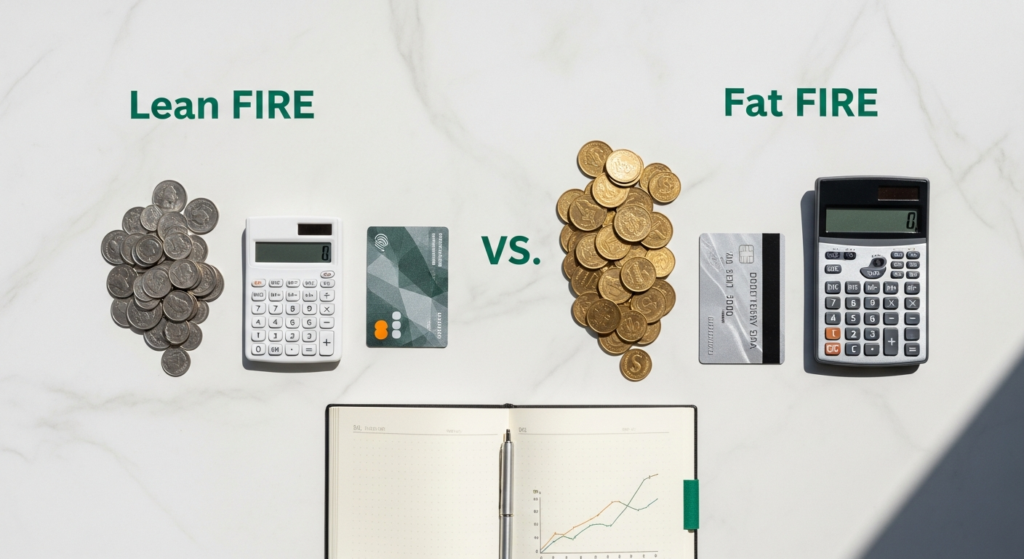
Lean FIRE vs. Fat FIRE: Which Path to Financial Independence is Right for You in 2026?
By Fin3go Editorial Team — Financial writers covering personal finance, banking, and consumer protection.
The dream of walking away from a 9-to-5 is no longer a fringe fantasy reserved for the ultra-wealthy or the Silicon Valley elite. In 2026, the Financial Independence, Retire Early (FIRE) movement has evolved into a sophisticated spectrum of lifestyle choices, tailored to individual values rather than a one-size-fits-all retirement age. Whether you are a digital nomad living out of a backpack or a high-earner who enjoys the finer things in life, the path you choose dictates your savings rate, your investment strategy, and, ultimately, your freedom.
But as the economic landscape shifts—with healthcare costs rising and market volatility becoming the “new normal”—the stakes have never been higher. Choosing between **Lean FIRE** and **Fat FIRE** isn’t just about how much money you have in the bank; it’s about defining what a “good life” looks like for you. Do you value time over luxury, or security over speed? Understanding these two extremes—and the vast middle ground between them—is the most critical financial decision you will make this decade. This guide breaks down the math, the mindset, and the actionable steps to help you determine which FIRE path will lead to your personal version of paradise.
—
1. The Math of Freedom: Understanding the Foundation
Before choosing a side, you must understand the universal “Rule of 25.” In the FIRE community, your target “number” is typically 25 times your annual expenses. This is based on the 4% Safe Withdrawal Rate (SWR), a guideline suggesting you can withdraw 4% of your portfolio annually without running out of money over a 30-year retirement.
In 2026, many experts suggest a more conservative **3.3% to 3.5% withdrawal rate** due to longer life expectancies and current market valuations.
* **The Lean FIRE Number:** Typically targets annual spending of $40,000 or less. This requires a portfolio of roughly **$1 million to $1.2 million**.
* **The Fat FIRE Number:** Targets annual spending of $150,000 or more. This requires a portfolio of at least **$4.5 million to $5 million**.
**Actionable Advice:** Start by tracking every cent you spend for three months. Use an aggregator like Empower or Monarch Money to categorize your “needs” vs. “wants.” Your current lifestyle is the baseline; your FIRE lifestyle is the goal.
—
2. Lean FIRE: The Minimalist’s Fast Track to Liberty
Lean FIRE is the “hacker” version of retirement. It’s for those who prioritize time above all else and are willing to embrace extreme frugality or “geographic arbitrage” to get there faster.
#
Characteristics of Lean FIRE:
* **Low Overhead:** Living in a low-cost-of-living (LCOL) area or choosing “house hacking” (renting out rooms) to eliminate housing costs.
* **Geographic Arbitrage:** Moving to countries like Portugal, Mexico, or Vietnam where a $30,000 annual budget affords a middle-class lifestyle.
* **Minimalism:** Prioritizing experiences, nature, and community over consumer goods.
#
The Real-World Example:
Meet Sarah and Mark. In 2026, they reached their Lean FIRE goal of $900,000. By relocating from Seattle to a small town in the Midwest and maintaining a $36,000 annual budget, they retired in their mid-30s. They don’t own a new car, and they cook 90% of their meals at home, but they spend 40 hours a week hiking, volunteering, and pursuing creative hobbies.
**Practical Tip for Lean FIRE:** Focus on “The Big Three”: Housing, Transportation, and Food. If you can optimize these, you can often save 50-70% of your income, drastically shortening your path to independence.
—
3. Fat FIRE: Wealth, Luxury, and the Ultimate Safety Net
Fat FIRE is for the high-achievers who don’t want to compromise. If you want to travel first-class, live in a high-cost-of-living (HCOL) city like New York or London, and never worry about the price of a dinner out, Fat FIRE is your target.
#
Characteristics of Fat FIRE:
* **Safety Margin:** A much larger portfolio provides a buffer against massive inflation or healthcare emergencies.
* **Abundance:** The ability to support family members, donate significantly to charity, and maintain a high-end lifestyle.
* **Continued Growth:** Because the portfolio is so large, “Fat FIRE” retirees often see their net worth continue to grow even while spending heavily.
#
The Real-World Example:
David, a tech executive, retired in 2026 with a $6 million portfolio. His $200,000 annual withdrawal allows him to maintain a luxury condo, keep his premium health insurance, and take three international vacations per year. For David, the extra ten years of work were worth the “fat” cushion that protects him from ever having to check a bank balance.
**Practical Tip for Fat FIRE:** Focus on “Income Expansion.” You cannot frugality-loop your way to $5 million easily. Focus on career pivots, scaling a business, or high-yield real estate investments to accelerate your “Fat” goals.
—
4. The 2026 Economic Reality: Healthcare and Inflation
The FIRE landscape in 2026 is different than it was a decade ago. Two major factors have changed the math:
#
The Healthcare Crisis
For early retirees, healthcare is the single largest variable expense. In 2026, private insurance premiums for a family of four can easily exceed $2,000 a month.
* **Lean FIRE Strategy:** Utilize the Affordable Care Act (ACA) subsidies by carefully managing “taxable income” to keep costs low.
* **Fat FIRE Strategy:** Budget for “Gold” level private plans or health shares, often allocating $25,000+ per year just for medical contingencies.
#
The “New” Inflation
We’ve moved past the transitory inflation of the early 2020s into a more stabilized but higher-cost environment.
* **Actionable Advice:** When calculating your FIRE number, use a **3% inflation buffer**. If you need $50,000 today, you might need $65,000 in ten years just to maintain the same purchasing power. Ensure your portfolio has a high equity tilt (60-80% stocks) to outpace inflation.
—
5. Which Path is For You? The “Choose Your Fighter” Framework
Choosing between Lean and Fat FIRE isn’t just about the money; it’s a psychological profile. Ask yourself these four questions:
1. **What is your “Why”?** If your job is soul-crushing and you need out *now*, Lean FIRE is your escape hatch. If you enjoy your work but want the *option* to quit, Fat FIRE allows you to build a “Work Optional” life over a longer period.
2. **How do you view luxury?** Does a $150 dinner feel like a waste of money or a vital life experience? If you find joy in simplicity, Lean FIRE will feel liberating. If you feel deprived without high-end amenities, Lean FIRE will feel like a self-imposed prison.
3. **What is your risk tolerance?** Lean FIRE has a thinner margin for error. A market crash or a medical emergency can derail a $1M portfolio faster than a $5M one.
4. **Where do you want to live?** If you are tied to a specific expensive city for family or cultural reasons, Fat FIRE (or at least “Regular FIRE”) is likely your only sustainable option.
—
6. The Hybrid Option: Coast FIRE and Flamingo FIRE
Many people in 2026 are finding that the “all or nothing” approach of Lean vs. Fat is too restrictive. This has led to the rise of hybrid models:
* **Coast FIRE:** You save aggressively early on until your retirement account has enough to grow to your target number by age 65 *without any further contributions*. You then quit your high-stress job and work a “fun” job just to cover your current living expenses.
* **Barista FIRE:** You have enough to cover most expenses but work a part-time job (often for the health insurance benefits).
* **Flamingo FIRE:** You save 50% of your target number, then “retire” and let the remaining half double over 7-10 years through compound interest while you work part-time.
**Actionable Advice:** If the gap between your current savings and “Fat FIRE” feels insurmountable, aim for Coast FIRE first. It provides immediate psychological relief and a “safety floor” for your future.
—
FAQ: Navigating the FIRE Movement in 2026
**Q1: Can I still achieve FIRE if I have kids?**
Yes, but it usually moves you toward a “Regular” or “Fat” FIRE path. You will need to account for 529 college savings plans and higher insurance premiums. Many FIRE families choose LCOL areas specifically to afford a “Fat” lifestyle on a “Lean” budget.
**Q2: What is the biggest risk to Lean FIRE?**
Sequence of Returns Risk (SORR). If the market drops 20% in the first two years of your retirement, a Lean portfolio is much more likely to be depleted. Having a “cash cushion” of 2 years of expenses can mitigate this.
**Q3: How do taxes change between Lean and Fat FIRE?**
Lean FIRE followers often pay $0 in federal income tax by leveraging the standard deduction and long-term capital gains brackets. Fat FIRE retirees usually face higher tax brackets and may need to utilize complex strategies like Charitable Remainder Trusts or tax-loss harvesting.
**Q4: Is the 4% rule still valid in 2026?**
It is a starting point, not a law. Most 2026 retirees are using a “Variable Percentage Withdrawal” (VPW) strategy—spending more when the market is up and cutting back when it’s down—to ensure portfolio longevity.
**Q5: Should I pay off my mortgage before retiring?**
In a Lean FIRE scenario, yes. Eliminating your largest monthly expense lowers your “withdrawal need,” which significantly reduces your risk. In a Fat FIRE scenario, if you have a low-interest mortgage, you may prefer to keep the liquidity in the market.
—
Conclusion: Designing Your 2026 Exit Strategy
The debate between Lean FIRE and Fat FIRE isn’t about which one is “better”—it’s about which one aligns with your internal compass.
**Lean FIRE** is an incredible tool for those who crave autonomy, adventure, and a break from the consumerist treadmill. It requires discipline and a shift in perspective, but it offers the fastest route to the exit sign.
**Fat FIRE** is the ultimate insurance policy. It provides a lifestyle of luxury and the peace of mind that comes with a massive financial buffer. It takes longer to achieve, but for those who enjoy their careers or have high spending needs, it is the gold standard of financial independence.
#
Your 3-Step Action Plan for 2026:
1. **Calculate your “Floor”:** What is the absolute minimum you need to survive? This is your Lean FIRE number.
2. **Calculate your “Dream”:** What would your life look like if money were no object? This is your Fat FIRE number.
3. **Choose your “First Milestone”:** Don’t get overwhelmed by the $5 million goal. Aim for $100k, then $500k, then Coast FIRE.
In 2026, the power is in your hands. Whether you choose the path of the minimalist or the path of the mogul, the result is the same: a life lived on your own terms. Which one will you start building today?