
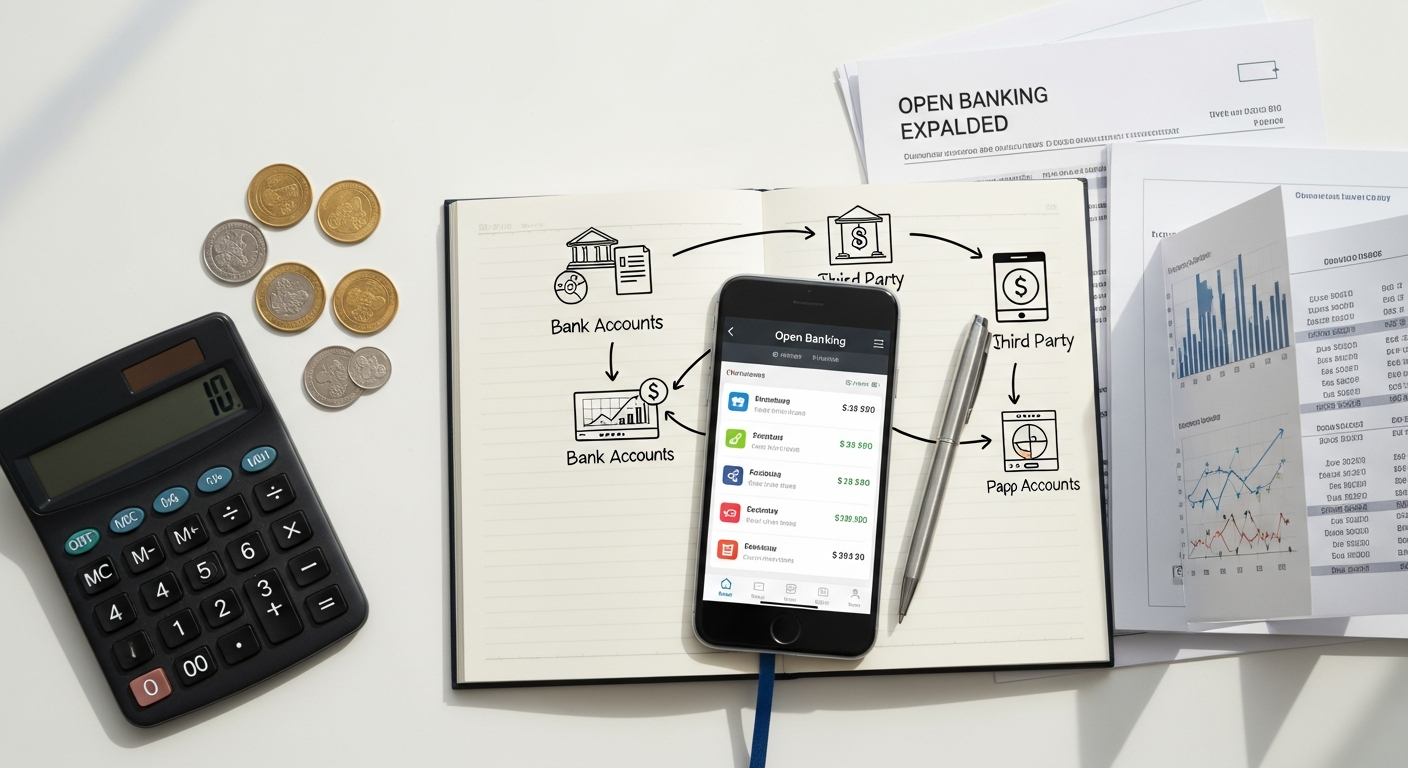
The Core Concept: What Exactly is Open Banking?
At its heart, Open Banking is a secure technological framework that allows third-party financial service providers to access consumer banking data, with the explicit consent of the consumer. This isn’t about banks simply giving away your information; rather, it’s about empowering you, the account holder, to grant permission for your financial data – such as transaction history, account balances, and credit card statements – to be securely shared with other regulated entities. Imagine a world where your different bank accounts, credit cards, investments, and even loans, all from various providers, can be viewed and managed from a single, unified interface. This is the promise of Open Banking.
Traditionally, if you wanted to get a comprehensive picture of your financial health, you would have to log into multiple banking apps or websites, download statements, and manually consolidate the information. This process was not only time-consuming but also made it difficult to identify trends, track spending across all accounts, or find optimal financial products. Open Banking addresses this inefficiency by standardizing the way financial data is exchanged. It’s predicated on the principle that the data generated by your financial activity ultimately belongs to you, and you should have the right to control who accesses it and for what purpose.
The mechanism through which this data sharing occurs is primarily via Application Programming Interfaces (APIs). These are sets of rules and protocols that allow different software applications to communicate with each other. In the context of Open Banking, APIs act as secure digital conduits, enabling a bank’s system to talk to a third-party app’s system, facilitating the requested data exchange in a standardized and encrypted format. This technological backbone ensures that data transfer is not only efficient but also highly secure, adhering to stringent industry standards and regulatory requirements.
The paradigm shift introduced by Open Banking is profound. It moves away from a closed, proprietary banking system towards an open, interconnected ecosystem. This fosters a competitive environment where traditional banks, challenger banks, and innovative fintech companies can all develop and offer new services that are tailored to individual needs. For consumers, this translates into more choice, greater convenience, and potentially better financial outcomes. It’s about creating a marketplace of financial services where your data, with your permission, becomes the fuel for personalized tools and smarter decisions.
The Pillars of Open Banking: APIs, Consent, and Robust Data Security
Understanding Open Banking requires a closer look at its foundational elements: APIs, the paramount importance of consumer consent, and the sophisticated security measures that underpin the entire framework. Without these pillars, the system would not function effectively or safely.
Application Programming Interfaces (APIs): The Digital Connectors
APIs are the unsung heroes of Open Banking. Think of an API as a waiter in a restaurant. You (the consumer using a third-party app) tell the waiter (the API) what you want (e.g., your transaction history). The waiter goes to the kitchen (your bank’s database), gets the specific information, and brings it back to you in a readable format, without you ever having to go into the kitchen yourself or even know how the kitchen works. In Open Banking, APIs allow different financial institutions and third-party providers to communicate and exchange data in a standardized, machine-readable format. This ensures seamless integration and interoperability between various platforms, irrespective of their underlying technologies. The data transmitted via these APIs is not just raw information; it’s structured, encrypted, and designed to be easily processed by applications to deliver insights and services.
Explicit Consumer Consent: Your Data, Your Rules
The bedrock of Open Banking is unequivocal consumer consent. You, and only you, have the power to decide which third parties can access your financial data, for what specific purpose, and for how long. This is not an opt-out system; it’s an opt-in system where your explicit permission is required at every step. Regulators have put strict rules in place to ensure that consent is:
- Informed: You must clearly understand what data is being requested and why.
- Specific: Consent must be given for particular data points and specific services, not a blanket approval.
- Revocable: You can withdraw your consent at any time, instantly cutting off access for the third party.
This emphasis on consent ensures that Open Banking remains a consumer-centric initiative, empowering individuals with unprecedented control over their financial information. It shifts the power dynamic from institutions to individuals, making data privacy and control a central feature, rather than an afterthought.
Robust Data Security: Protecting Your Financial Information
Given the sensitive nature of financial data, security is paramount in Open Banking. The framework is built with multiple layers of protection to safeguard consumer information. Key security measures include:
- Strong Customer Authentication (SCA): This mandates multi-factor authentication (e.g., password plus a one-time code from your phone) for accessing accounts or approving payments, significantly reducing the risk of unauthorized access.
- Encryption: All data transmitted via Open Banking APIs is encrypted, meaning it’s scrambled into an unreadable format during transit, making it unintelligible to anyone without the proper decryption key.
- Regulatory Oversight: Third-party providers (TPPs) seeking to access Open Banking data must be authorized and regulated by financial authorities (e.g., the Financial Conduct Authority in the UK, or national competent authorities under PSD2 in Europe). This involves rigorous vetting, ongoing monitoring, and adherence to strict data protection laws like GDPR.
- Limited Data Access: TPPs are typically only granted “read-only” access to financial data for information services, preventing them from making transactions on your behalf. Payment initiation services, while allowing transactions, still require direct authentication and authorization from the consumer with their bank.
- Data Masking and Anonymization: In some cases, data can be masked or anonymized to remove personally identifiable information, further enhancing privacy, especially when used for aggregated insights or statistical analysis.
These robust security protocols, combined with a strong regulatory framework, aim to build and maintain trust in the Open Banking ecosystem. The goal is to provide the convenience and innovation of data sharing without compromising the integrity and privacy of personal financial information.
Benefits for Consumers: Empowering Your Financial Journey
- Holistic View of Finances: Perhaps the most immediate and impactful benefit is the ability to see all your bank accounts, credit cards, and even some investment portfolios from different providers in one consolidated dashboard. This eliminates the need to jump between multiple apps and websites, providing a clear, real-time overview of your entire financial position. Imagine effortlessly tracking your spending across all accounts or identifying your true net worth at a glance.
- Enhanced Budgeting and Spending Analysis: With consolidated data, Open Banking-powered apps can offer sophisticated budgeting tools. By aggregating your transaction history from all accounts, these apps can categorize your spending automatically, help you set realistic budgets, and alert you when you’re nearing your limits. This makes it significantly easier to answer the question, “How To Create A Monthly Budget?” These tools provide the granular insights needed to identify areas for saving, optimize your spending habits, and stick to your financial goals.
- Personalized Financial Advice and Product Recommendations: Armed with a comprehensive understanding of your financial behavior, Open Banking apps can offer highly personalized advice. This could range from identifying subscriptions you no longer use, suggesting better savings accounts based on your spending patterns, or even providing insights into debt management strategies. For instance, an app might analyze your debts and suggest whether the Snowball Vs Avalanche Debt Payoff Method would be more effective for your specific financial situation, guiding you towards quicker debt eradication.
- Faster and Simpler Loan Applications: Applying for loans or mortgages often involves extensive paperwork and manual submission of bank statements. Open Banking streamlines this process by allowing lenders, with your consent, to securely access your financial data directly. This can lead to quicker approval times, potentially better interest rates due to more accurate risk assessment, and a significantly reduced administrative burden for the applicant.
- Improved Account Switching: Switching bank accounts, while often beneficial, can be perceived as a hassle. Open Banking facilitates a smoother transition by making it easier for new providers to access your payment history and set up direct debits and standing orders, simplifying the process of moving your financial relationships.
- Innovative Payment Solutions: Open Banking enables “Payment Initiation Services” (PIS), which allow you to authorize third-party providers to initiate payments directly from your bank account. This can offer an alternative to traditional card payments, potentially with lower transaction fees for merchants and enhanced security for consumers, as sensitive card details are not shared.
- Access to New Financial Services: The open nature of the framework fosters innovation, leading to a proliferation of new fintech services. These could include micro-investing apps, sophisticated expense management tools for freelancers, or even services that help you find and claim refunds for various charges. Open Banking is a catalyst for a more competitive and diverse financial services market, ultimately benefiting consumers through more choice and better-tailored solutions.
In essence, Open Banking empowers consumers by giving them control over their data, transforming it from a static record into an active tool for better financial decision-making. It’s about moving from reactive money management to proactive financial stewardship, guided by intelligent insights and personalized services.
Benefits for Businesses: Driving Innovation and Competition
While the consumer benefits of Open Banking are compelling, its impact on businesses, particularly in the financial sector and related industries, is equally transformative. It fosters a dynamic environment for innovation, competition, and efficiency, creating new opportunities for growth and enhancing customer experiences.
- New Product Development and Market Entry for FinTechs: For challenger banks and fintech startups, Open Banking is a game-changer. It lowers the barrier to entry into the financial services market by providing secure, standardized access to customer data (with consent). This enables them to develop highly specialized and innovative products and services that can compete with traditional offerings. Examples include advanced budgeting apps, expense management platforms, personalized lending solutions, and automated savings tools. This surge of innovation benefits consumers by providing more choice and specialized solutions.
- Enhanced Customer Understanding and Personalization for Banks: Traditional banks can leverage Open Banking to gain a more holistic view of their customers’ financial lives, even beyond their own products. By integrating with third-party data (with consent), banks can offer more personalized products, proactive advice, and improved customer service. This deeper understanding can help them retain customers and compete more effectively with nimble fintechs.
- Streamlined Onboarding and Reduced Fraud: Open Banking simplifies customer onboarding processes by allowing businesses to verify identity and financial standing more quickly and accurately. This reduces friction for customers and lowers administrative costs for businesses. Furthermore, by accessing real-time transaction data and account information (with consent), businesses can significantly improve their fraud detection capabilities, making financial transactions safer for everyone.
- Improved Credit Scoring and Lending Decisions: Lenders, whether traditional banks or alternative finance providers, can use Open Banking data to gain a richer and more accurate picture of an applicant’s financial health than traditional credit scores alone. This can lead to more inclusive lending, offering credit to individuals who might otherwise be overlooked, and more tailored loan products at competitive rates. It allows for a more granular assessment of affordability and risk.
- Efficient Payment Processing and Lower Costs: Open Banking’s Payment Initiation Services (PIS) offer businesses an alternative to card networks for receiving payments. By initiating payments directly from a customer’s bank account, businesses can potentially reduce transaction fees, accelerate settlement times, and improve cash flow. This is particularly beneficial for businesses with high transaction volumes or those operating on thin margins.
- Data-Driven Business Intelligence: Beyond direct customer services, aggregated and anonymized Open Banking data can provide valuable insights into market trends, consumer behavior, and competitive landscapes. This data-driven intelligence can inform strategic decisions, product roadmaps, and marketing efforts, helping businesses stay agile and responsive in a rapidly evolving market.
- Facilitating Debt Management Solutions: For businesses that offer financial advisory or debt consolidation services, Open Banking provides the tools to quickly and securely gather a client’s complete financial picture. This enables them to offer more precise advice on methods like the Snowball Vs Avalanche Debt Payoff Method, helping clients effectively manage and reduce their liabilities.
Ultimately, Open Banking fosters a more competitive and innovative financial ecosystem. It encourages collaboration between established institutions and agile startups, driving a wave of new services that improve efficiency, reduce costs, and enhance the overall financial experience for both businesses and their customers.
The Regulatory Landscape and Global Adoption
The global emergence of Open Banking hasn’t happened in a vacuum; it’s largely been driven by proactive regulatory initiatives aimed at fostering competition, empowering consumers, and stimulating innovation within the financial sector. Understanding these regulatory frameworks is crucial to appreciating the widespread adoption and future trajectory of Open Banking.
Europe: PSD2 and the UK’s Open Banking Implementation Entity (OBIE)
Europe has been at the forefront of the Open Banking revolution, primarily driven by the revised Payment Services Directive (PSD2). Implemented across the European Union (EU) and European Economic Area (EEA) in 2018, PSD2 mandated that banks allow regulated third-party providers (TPPs) access to customer account information and payment initiation services, with the customer’s explicit consent. The directive aimed to:
- Increase Competition: By opening up banking data, PSD2 sought to enable new players to enter the market and offer innovative services, challenging the dominance of traditional banks.
- Enhance Consumer Protection: It introduced strong customer authentication (SCA) and clear rules around consent and data security, giving consumers greater control and protection.
- Promote Innovation: By standardizing access to data through APIs, PSD2 created a fertile ground for fintech innovation.
In the United Kingdom, which was an early adopter and a global leader in Open Banking, the Competition and Markets Authority (CMA) went a step further. Following an investigation into the retail banking market, it mandated the nine largest banks to implement Open Banking by 2018. The Open Banking Implementation Entity (OBIE) was established to oversee the development and implementation of common standards and specifications for APIs, ensuring interoperability and security across the industry. The UK’s approach has often been cited as a blueprint for other nations.
Global Momentum: Beyond Europe
The success and potential of Open Banking in Europe quickly caught the attention of regulators and governments worldwide, leading to a wave of similar initiatives:
- Australia: Launched its Consumer Data Right (CDR) in 2020, starting with banking data (Open Banking) and expanding to energy and telecommunications. CDR is broader than PSD2, aiming to give consumers control over their data across various sectors.
- United States: While not a single, overarching federal mandate like PSD2, the US market is moving towards Open Banking through a combination of market-driven initiatives and regulatory encouragement. The Consumer Financial Protection Bureau (CFPB) has been exploring rules under Section 1033 of the Dodd-Frank Act to facilitate consumer data access, and major financial institutions are increasingly engaging with fintechs via secure APIs.
- Canada: Is progressing with its own made-in-Canada framework for consumer-directed finance, with a multi-phase implementation plan aiming to create a secure and robust ecosystem.
- Other Regions: Brazil, Singapore, Hong Kong, Japan, India, and several other countries are actively developing or have already implemented their own Open Banking or broader Open Finance frameworks, each tailored to their local market conditions and regulatory priorities.
The common thread across these global initiatives is the recognition that secure, consent-driven data sharing can unlock significant value for consumers, foster competition, and drive innovation in financial services. While the specific regulatory approaches and implementation timelines vary, the global trend towards greater data portability and consumer control is undeniable, solidifying Open Banking as a permanent and expanding feature of the modern financial landscape.
Challenges and the Future of Open Banking: Towards Open Finance and Beyond
While Open Banking has already demonstrated immense potential, its journey is not without challenges. Understanding these hurdles and anticipating future developments is crucial for appreciating its long-term impact on personal finance and the broader economy.
Current Challenges:
- Consumer Trust and Awareness: Despite regulatory safeguards, many consumers remain wary of sharing their financial data. A lack of clear understanding about how Open Banking works, its security protocols, and the benefits it offers can hinder adoption. Ongoing education and transparent communication are vital to build trust.
- Standardization and Interoperability: While frameworks like PSD2 and OBIE have driven standardization, variations can still exist, particularly across different regions or between various financial institutions. Ensuring seamless interoperability and consistent API performance across the entire ecosystem remains an ongoing technical challenge.
- Data Quality and Consistency: The quality and consistency of data provided by different banks can vary, which can impact the effectiveness of third-party applications. Ensuring high-quality, standardized data feeds is essential for robust analytics and reliable service delivery.
- Monetization Models: For fintechs and other third-party providers, developing sustainable monetization strategies for Open Banking services is key. While some offer premium features, others rely on advertising or partnerships, and the optimal models are still evolving.
- Regulatory Complexity: Navigating the intricate regulatory landscape, especially for providers operating across multiple jurisdictions, can be complex and costly. Harmonization of regulations where possible could accelerate adoption.
The Future: Beyond Open Banking to Open Finance and Open Data
Open Banking is merely the first step in a much larger vision known as “Open Finance” and, eventually, “Open Data.”
- Open Finance: This concept expands the principles of Open Banking beyond traditional bank accounts to include a much broader array of financial products and services. Imagine securely sharing data from your:
- Investments: Stocks, bonds, mutual funds, pensions, and even cryptocurrencies.
- Insurance: Policies, claims history, premiums.
- Mortgages and Loans: Beyond basic account information, including detailed terms and conditions.
- Savings and Pensions: Comprehensive views of long-term financial planning.
With Open Finance, a single app could provide a truly comprehensive view of your entire financial life, enabling hyper-personalized wealth management, retirement planning, and even dynamic insurance offerings. This could unlock entirely new avenues for Passive Income Ideas 2026, as platforms leverage integrated data to identify tailored investment opportunities or optimize existing portfolios for maximum returns.
- Open Data (or Consumer Data Right): This is the ultimate expansion, extending the principles of consumer-directed data sharing beyond finance to almost every sector where consumer data is generated. This could include telecommunications, energy, healthcare, retail, and more. The vision is to empower consumers with control over all their digital data, enabling them to share it securely with trusted providers to receive better, more personalized services across their entire digital footprint.
The integration of technologies like Artificial Intelligence (AI) and Machine Learning (ML) will also play a pivotal role. These technologies, fueled by the rich data streams of Open Finance, will enable more sophisticated predictive analytics, automated financial advice, proactive fraud detection, and highly tailored product offerings. Imagine an AI assistant that not only helps you budget but also automatically optimizes your investments, identifies the best mortgage rates based on your current financial situation, and even advises on tax efficiencies in real-time.
In conclusion, Open Banking is laying the groundwork for a future where finance is more integrated, intelligent, and entirely consumer-centric. While challenges remain, the trajectory is clear: greater data portability, increased consumer control, and an accelerating pace of innovation that will fundamentally reshape how we interact with our money and manage our financial lives for decades to come.
Frequently Asked Questions About Open Banking
As a relatively new and evolving concept, Open Banking often raises numerous questions. Here, we address some of the most common inquiries to provide further clarity and understanding.
What is the primary difference between Open Banking and traditional banking?
The primary difference lies in data control and accessibility. In traditional banking, your financial data is largely confined within your bank’s systems, with limited ability for you to share it securely with other providers. Open Banking, conversely, empowers you to grant explicit consent for regulated third-party providers (TPPs) to access your banking data (e.g., transaction history, account balances) via secure APIs. This shifts control of your data from the bank to you, fostering a more interconnected and competitive financial ecosystem.
Is Open Banking safe and secure? What about my privacy?
Yes, Open Banking is built with stringent security and privacy protocols. It operates under strict regulatory frameworks (like PSD2 in Europe) that mandate robust security measures such as Strong Customer Authentication (SCA), end-to-end encryption for data transmission, and rigorous vetting of all authorized third-party providers. Your explicit consent is always required before any data is shared, and you can revoke this consent at any time. TPPs are typically granted “read-only” access for information services, meaning they cannot move money without your direct authorization to your bank. Your privacy is protected by data protection laws like GDPR, which dictate how your data must be handled.
Who regulates Open Banking?
Open Banking is regulated by financial authorities in each jurisdiction where it’s implemented. For instance, in the UK, it’s overseen by the Financial Conduct Authority (FCA) and the Open Banking Implementation Entity (OBIE). Across the EU, it falls under the purview of national competent authorities implementing the Payment Services Directive 2 (PSD2). These regulators authorize and supervise the banks and third-party providers involved, ensuring they adhere to strict security, data protection, and consumer protection standards.
What kind of data can be shared through Open Banking?
With your consent, Open Banking allows for the sharing of various types of financial data, primarily related to your current accounts, savings accounts, and credit cards. This typically includes:
- Account balances
- Transaction history (e.g., incoming and outgoing payments, dates, merchants)
- Account details (e.g., account number, sort code, account holder name)
- Direct debits and standing orders
Crucially, sensitive information like your login credentials (username and password for your bank) is never shared with third parties. You authenticate directly with your bank.
How can I start using Open Banking services?
To start using Open Banking services, you typically need to download an app or sign up for a service from a regulated third-party provider (e.g., a budgeting app, a financial aggregator, or a lending platform). When you connect your bank accounts to these services, you will be securely redirected to your bank’s own online banking portal to verify your identity and explicitly grant consent for the specific data sharing. Your bank will clearly outline what data is being requested and for what purpose before you approve. You can manage and revoke these permissions at any time through your bank’s online platform or the third-party app itself.
What is the difference between Open Banking and Open Finance?
Open Banking is the foundational step, focusing primarily on current account, savings account, and credit card data from traditional banks. Open Finance is a broader concept that expands this principle to encompass a wider array of financial products and services. This includes data from investments (stocks, bonds, pensions), insurance policies, mortgages, and other lending products. The goal of Open Finance is to provide a truly holistic view of an individual’s entire financial life, enabling even more sophisticated and integrated financial management tools and services.
Recommended Resources
You might also enjoy How To Build A Business Website from Page Release.
Check out Ecommerce Analytics Guide What To Track on E-ComProfits for a deeper dive.