


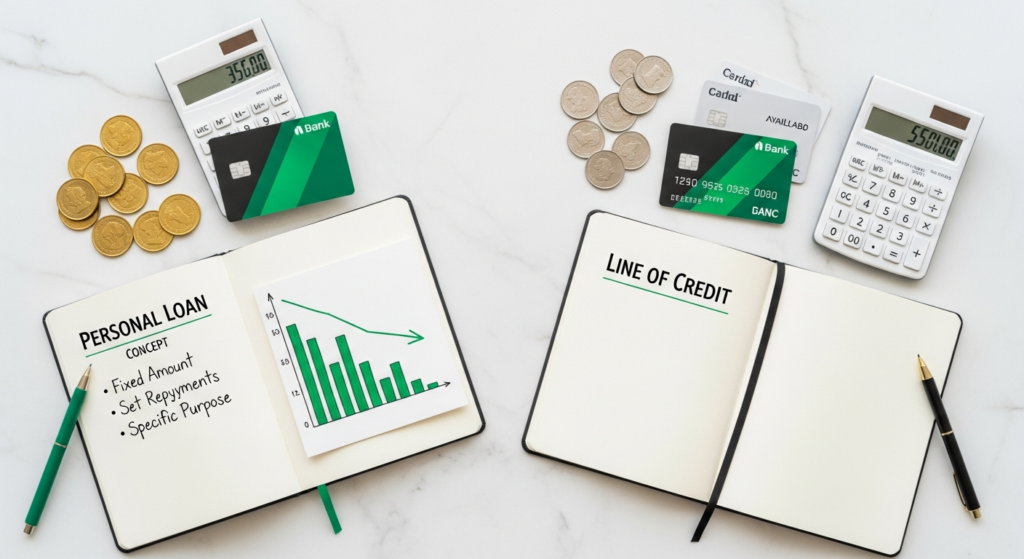
Personal Loan vs. Line of Credit: Unpacking Key Differences for Savvy Borrowing with Fin3go
Navigating the world of personal finance can sometimes feel like deciphering a complex puzzle, especially when it comes to borrowing. You’ve heard terms like “personal loan” and “line of credit” tossed around, but what exactly sets them apart? And more importantly, which one is the right fit for your unique financial situation in 2026? At Fin3go, we believe in empowering you with clear, practical knowledge to make informed decisions.
Both personal loans and lines of credit serve as valuable financial tools, offering access to funds when you need them. However, they operate on fundamentally different principles, impacting everything from how you receive money to how you pay it back. Understanding these core distinctions isn’t just about choosing a product; it’s about optimizing your financial health, managing debt effectively, and achieving your financial goals without unnecessary stress. Let’s dive deep into the key differences to help you borrow smarter.
What is a Personal Loan? Your Fixed-Term Funding Solution
Imagine you need a specific amount of money for a clearly defined purpose – perhaps a major home renovation, consolidating high-interest credit card debt, or covering an unexpected medical bill. This is where a personal loan typically shines. A personal loan is an installment loan, meaning you receive a lump sum of money upfront and then repay it in fixed, predictable monthly payments over a set period, known as the loan term.
By 2026, the personal loan market has become incredibly streamlined, with digital applications and swift approval processes being the norm for many lenders, including traditional banks, credit unions, and online lenders. These loans can be either secured (backed by collateral like a car or savings account) or, more commonly, unsecured (based solely on your creditworthiness). Interest rates are generally fixed for the life of the loan, providing stability and making budgeting straightforward.
Key Features of a Personal Loan:
- Lump Sum Disbursement: You receive the entire approved loan amount at once.
- Fixed Interest Rate: Your interest rate remains the same throughout the loan term, leading to predictable monthly payments.
- Fixed Repayment Term: You have a clear start and end date for your loan, typically ranging from 1 to 7 years.
- Predictable Payments: Each monthly payment amount is the same, making budgeting easier.
- Secured or Unsecured: While many personal loans are unsecured, some lenders offer secured options which might come with lower interest rates.
When a Personal Loan is Generally Ideal:
- Large, one-time expenses with a clear cost (e.g., home renovation, wedding, significant medical expense).
- Debt consolidation, allowing you to combine multiple high-interest debts into a single, lower-rate payment.
- Purchasing a large item like an appliance or furniture.
- You prefer predictability and a clear timeline for debt repayment.
What is a Line of Credit? Your Flexible, Revolving Financial Lifeline
The flexibility of a line of credit makes it a popular choice for managing fluctuating expenses or as a financial safety net. As of 2026, many fintech platforms and traditional institutions are offering various types of lines of credit, including personal lines of credit (unsecured) and Home Equity Lines of Credit (HELOCs, secured by your home equity). HELOCs have seen a resurgence in popularity for larger, ongoing home improvement projects due to their lower rates compared to unsecured options, though they carry the risk of potentially losing your home if you default.
Key Features of a Line of Credit:
- Revolving Credit: You can borrow, repay, and re-borrow funds up to your approved limit, much like a credit card.
- Draw as Needed: You only take out money when you need it and only pay interest on the amount you’ve borrowed.
- Variable Interest Rate: Most lines of credit have variable interest rates, meaning the rate can fluctuate based on market conditions (e.g., the prime rate).
- Flexible Repayment: You typically make minimum monthly payments on your outstanding balance, which often includes a mix of principal and interest, but you can pay more to reduce the principal faster.
- Access Period: Many lines of credit have a “draw period” (e.g., 5-10 years) during which you can access funds, followed by a “repayment period” where you can no longer draw and must repay the outstanding balance.
When a Line of Credit is Generally Ideal:
- Ongoing or unpredictable expenses, such as covering short-term cash flow gaps or managing a fluctuating renovation budget.
- As an emergency fund backup, providing access to funds without paying interest until you use them.
- For smaller, recurring expenses where you’re unsure of the exact total cost upfront.
- You need flexible access to capital for a business or personal project over time.
Key Difference 1: Funding Structure and Access to Funds
This is arguably the most fundamental distinction between a personal loan and a line of credit. Understanding how you receive and access your funds will heavily influence which product suits your immediate and future needs.
With a personal loan, the process is straightforward: once your application is approved and finalized, the entire loan amount is disbursed to you in a single lump sum. This means if you apply for a $20,000 personal loan, you’ll receive all $20,000 in your bank account, often within a few business days, depending on the lender and the year 2026’s prevalent digital banking speeds. You then immediately begin accruing interest on the full amount and are responsible for repaying the entire sum, regardless of whether you’ve spent every last dollar. This structure is ideal for expenses with a clear, fixed price tag, providing all the necessary funds upfront.
A line of credit operates quite differently. Instead of a lump sum, you’re approved for a maximum credit limit. For example, if you’re approved for a $20,000 line of credit, you don’t receive that money all at once. Instead, that $20,000 becomes an available pool of funds from which you can draw money as needed. You might take out $5,000 today, $3,000 next month, and another $2,000 a few months later. You only pay interest on the specific amounts you draw, not the total approved limit. This “as-needed” access makes a line of credit exceptionally flexible for ongoing projects or when facing unpredictable expenses, allowing you to manage your borrowing more precisely.
Key Difference 2: Repayment Structure and Interest Calculation
The way you repay these financial products and how interest is calculated are critical factors that impact your budget and long-term financial planning.
For a personal loan, repayment is highly predictable. You’ll have a fixed repayment schedule, meaning you make the exact same payment amount each month until the loan is fully paid off. This amount is calculated to include both principal and interest, amortized over the loan term. Because personal loans typically feature fixed interest rates, your payment amount will not change, providing stability and making it easy to budget. This fixed structure ensures you know exactly when your debt will be extinguished, offering a clear path to becoming debt-free.
A line of credit, on the other hand, offers more flexible, albeit potentially less predictable, repayment. You’ll typically have a minimum monthly payment requirement based on your outstanding balance, similar to a credit card. This minimum payment often covers a portion of the principal plus all the accrued interest. However, since most lines of credit come with variable interest rates, your monthly interest charges can fluctuate based on market conditions, which means your minimum payment could change over time. Many LOCs also feature an initial “draw period” (e.g., 5-10 years) where you can continuously borrow and repay, followed by a “repayment period” where you can no longer draw funds and must pay back the remaining balance over a set timeframe. This revolving nature means that without strict discipline, it’s possible to stay in debt longer, as you can continually draw new funds.
Key Difference 3: Flexibility and Reusability
The core philosophy behind these two borrowing options greatly differs in terms of how flexible they are and whether you can reuse them.
A personal loan is generally considered a one-time borrowing solution. Once you receive the lump sum, that’s it. If you need more money later, you’d have to apply for an entirely new loan, which involves another application process, credit check, and potential impact on your credit score. This makes personal loans less flexible for ongoing, unforeseen expenses or projects where the total cost isn’t perfectly clear from the outset. Their strength lies in their defined purpose and fixed structure.
Conversely, a line of credit is built for flexibility and reusability. As long as your account remains open and in good standing, and you haven’t exceeded your credit limit, you can continue to draw funds, repay them, and then draw again. This revolving nature means it acts as an ongoing financial resource. For instance, if you have a $15,000 line of credit, borrow $5,000, and then repay $2,000, you’ll have $12,000 available to borrow again ($15,000 limit – $3,000 outstanding balance). This makes lines of credit excellent for managing fluctuating costs, providing an accessible financial buffer without needing to reapply each time you need funds.
Key Difference 4: Interest Rates and Associated Fees
The cost of borrowing is a major consideration, and personal loans and lines of credit often differ significantly in their interest rate structures and potential fees.
Personal loans typically come with fixed interest rates. This means the rate you’re approved for on day one will remain the same for the entire life of the loan. This offers financial certainty, as your interest costs won’t change even if broader market rates fluctuate. The Annual Percentage Rate (APR) on personal loans, which includes interest and certain fees, can vary widely based on your credit score, income, and the lender. By 2026, competitive rates for well-qualified borrowers are common, but for those with lower credit scores, rates can still be high. Some personal loans also carry an origination fee, which is a one-time charge deducted from the loan proceeds at funding, or sometimes a prepayment penalty if you pay off the loan early (though these are becoming less common).
Lines of credit, on the other hand, almost universally feature variable interest rates. This means the rate can go up or down over time, tied to an index like the prime rate. While a variable rate might start lower than a fixed rate on a personal loan, it also introduces uncertainty; if market rates rise, your interest payments will increase. This can make budgeting more challenging. In addition to interest, lines of credit may also come with other fees:
- Annual Fee: Some lenders charge an annual fee for maintaining the line of credit, whether you use it or not.
- Draw Fee: A small fee might be charged each time you draw funds.
- Inactivity Fee: Some lenders charge a fee if you don’t use your line of credit for an extended period.
- Maintenance Fee: Similar to annual fees, these cover the cost of maintaining the account.
It’s crucial to compare the full APR and all potential fees when evaluating either option to understand the true cost of borrowing.
When to Choose Which: Scenarios and Best Use Cases
Knowing the differences is one thing; applying that knowledge to your specific financial situation is another. Here’s a breakdown of when each option typically shines:
Choose a Personal Loan If:
- You have a specific, one-time large expense: Think a substantial home renovation with a clear budget, consolidating multiple debts into one payment, funding a wedding, or covering a significant medical bill.
- You prefer predictable monthly payments: The fixed interest rate and fixed term mean you know exactly what you’ll pay and when you’ll be debt-free, simplifying budgeting.
- You want a clear end date for your debt: The amortization schedule provides a definitive timeline for repayment, encouraging faster debt elimination.
- You can qualify for a competitive fixed interest rate: If your credit score is strong, you might secure a lower fixed rate that offers stability against market fluctuations.
Choose a Line of Credit If:
- You need access to funds for ongoing or uncertain expenses: This is ideal for projects with fluctuating costs (e.g., a lengthy home renovation where expenses might crop up over months), managing unpredictable business cash flow, or as a general emergency fund.
- You only want to pay interest on what you use: If you’re unsure how much you’ll ultimately need, or if you need to spread out draws over time, a LOC ensures you’re only charged for the funds you actually access.
- You value flexibility and reusability: The ability to borrow, repay, and re-borrow within your credit limit makes it a dynamic financial tool for recurring needs or as a standing financial safety net.
- You are comfortable with variable interest rates: You understand that your payments could fluctuate if market rates change and you’re prepared to manage that variability.
Ultimately, the best choice depends on your specific financial needs, your comfort level with different repayment structures, and your ability to manage varying interest rates. Evaluate your purpose for borrowing, your budgeting style, and your credit profile before making a decision.
Both personal loans and lines of credit are powerful tools, but they cater to different financial scenarios. Personal loans offer a structured, lump-sum approach with fixed payments, ideal for large, one-time expenses and predictable budgeting. Lines of credit provide flexible, revolving access to funds, perfect for ongoing, unpredictable needs where you only pay interest on what you borrow. Understanding these fundamental differences, from funding to repayment and flexibility, is crucial for making a savvy borrowing decision that aligns with your financial goals in the dynamic landscape of 2026. Always compare offers from various lenders on platforms like Fin3go to secure the best terms for your specific situation.
Frequently Asked Questions
Can I have both a personal loan and a line of credit at the same time?▾
Which option is better for debt consolidation?▾
Do personal loans and lines of credit affect my credit score differently?▾
Are interest rates always lower on personal loans compared to lines of credit?▾
What is a Personal Loan? Your Fixed-Term Funding Solution
Imagine you need a specific amount of money for a clearly defined purpose – perhaps a major home renovation, consolidating high-interest credit card debt, or covering an unexpected medical bill. This is where a personal loan typically shines. A personal loan is an installment loan, meaning you receive a lump sum of money upfront and then repay it in fixed, predictable monthly payments over a set period, known as the loan term.
By 2026, the personal loan market has become incredibly streamlined, with digital applications and swift approval processes being the norm for many lenders, including traditional banks, credit unions, and online lenders. These loans can be either secured (backed by collateral like a car or savings account) or, more commonly, unsecured (based solely on your creditworthiness). Interest rates are generally fixed for the life of the loan, providing stability and making budgeting straightforward.
Key Features of a Personal Loan:
- Lump Sum Disbursement: You receive the entire approved loan amount at once.
- Fixed Interest Rate: Your interest rate remains the same throughout the loan term, leading to predictable monthly payments.
- Fixed Repayment Term: You have a clear start and end date for your loan, typically ranging from 1 to 7 years.
- Predictable Payments: Each monthly payment amount is the same, making budgeting easier.
- Secured or Unsecured: While many personal loans are unsecured, some lenders offer secured options which might come with lower interest rates.
When a Personal Loan is Generally Ideal:
- Large, one-time expenses with a clear cost (e.g., home renovation, wedding, significant medical expense).
- Debt consolidation, allowing you to combine multiple high-interest debts into a single, lower-rate payment.
- Purchasing a large item like an appliance or furniture.
- You prefer predictability and a clear timeline for debt repayment.
What is a Line of Credit? Your Flexible, Revolving Financial Lifeline
In contrast to a personal loan’s lump sum, a line of credit (LOC) offers a more flexible, revolving credit solution. Think of it like a credit card, but often with higher borrowing limits and potentially lower interest rates, especially if it’s secured. With a line of credit, you’re approved for a maximum credit limit, and you can draw funds up to that limit as needed. You only pay interest on the amount you actually borrow, not the entire approved limit.
The flexibility of a line of credit makes it a popular choice for managing fluctuating expenses or as a financial safety net. As of 2026, many fintech platforms and traditional institutions are offering various types of lines of credit, including personal lines of credit (unsecured) and Home Equity Lines of Credit (HELOCs, secured by your home equity). HELOCs have seen a resurgence in popularity for larger, ongoing home improvement projects due to their lower rates compared to unsecured options, though they carry the risk of potentially losing your home if you default.
Key Features of a Line of Credit:
- Revolving Credit: You can borrow, repay, and re-borrow funds up to your approved limit, much like a credit card.
- Draw as Needed: You only take out money when you need it and only pay interest on the amount you’ve borrowed.
- Variable Interest Rate: Most lines of credit have variable interest rates, meaning the rate can fluctuate based on market conditions (e.g., the prime rate).
- Flexible Repayment: You typically make minimum monthly payments on your outstanding balance, which often includes a mix of principal and interest, but you can pay more to reduce the principal faster.
- Access Period: Many lines of credit have a “draw period” (e.g., 5-10 years) during which you can access funds, followed by a “repayment period” where you can no longer draw and must repay the outstanding balance.
When a Line of Credit is Generally Ideal:
- Ongoing or unpredictable expenses, such as covering short-term cash flow gaps or managing a fluctuating renovation budget.
- As an emergency fund backup, providing access to funds without paying interest until you use them.
- For smaller, recurring expenses where you’re unsure of the exact total cost upfront.
- You need flexible access to capital for a business or personal project over time.
Key Difference 1: Funding Structure and Access to Funds
This is arguably the most fundamental distinction between a personal loan and a line of credit. Understanding how you receive and access your funds will heavily influence which product suits your immediate and future needs.
With a personal loan, the process is straightforward: once your application is approved and finalized, the entire loan amount is disbursed to you in a single lump sum. This means if you apply for a $20,000 personal loan, you’ll receive all $20,000 in your bank account, often within a few business days, depending on the lender and the year 2026’s prevalent digital banking speeds. You then immediately begin accruing interest on the full amount and are responsible for repaying the entire sum, regardless of whether you’ve spent every last dollar. This structure is ideal for expenses with a clear, fixed price tag, providing all the necessary funds upfront.
A line of credit operates quite differently. Instead of a lump sum, you’re approved for a maximum credit limit. For example, if you’re approved for a $20,000 line of credit, you don’t receive that money all at once. Instead, that $20,000 becomes an available pool of funds from which you can draw money as needed. You might take out $5,000 today, $3,000 next month, and another $2,000 a few months later. You only pay interest on the specific amounts you draw, not the total approved limit. This “as-needed” access makes a line of credit exceptionally flexible for ongoing projects or when facing unpredictable expenses, allowing you to manage your borrowing more precisely.
Key Difference 2: Repayment Structure and Interest Calculation
The way you repay these financial products and how interest is calculated are critical factors that impact your budget and long-term financial planning.
For a personal loan, repayment is highly predictable. You’ll have a fixed repayment schedule, meaning you make the exact same payment amount each month until the loan is fully paid off. This amount is calculated to include both principal and interest, amortized over the loan term. Because personal loans typically feature fixed interest rates, your payment amount will not change, providing stability and making it easy to budget. This fixed structure ensures you know exactly when your debt will be extinguished, offering a clear path to becoming debt-free.
A line of credit, on the other hand, offers more flexible, albeit potentially less predictable, repayment. You’ll typically have a minimum monthly payment requirement based on your outstanding balance, similar to a credit card. This minimum payment often covers a portion of the principal plus all the accrued interest. However, since most lines of credit come with variable interest rates, your monthly interest charges can fluctuate based on market conditions, which means your minimum payment could change over time. Many LOCs also feature an initial “draw period” (e.g., 5-10 years) where you can continuously borrow and repay, followed by a “repayment period” where you can no longer draw funds and must pay back the remaining balance over a set timeframe. This revolving nature means that without strict discipline, it’s possible to stay in debt longer, as you can continually draw new funds.
Key Difference 3: Flexibility and Reusability
The core philosophy behind these two borrowing options greatly differs in terms of how flexible they are and whether you can reuse them.
A personal loan is generally considered a one-time borrowing solution. Once you receive the lump sum, that’s it. If you need more money later, you’d have to apply for an entirely new loan, which involves another application process, credit check, and potential impact on your credit score. This makes personal loans less flexible for ongoing, unforeseen expenses or projects where the total cost isn’t perfectly clear from the outset. Their strength lies in their defined purpose and fixed structure.
Conversely, a line of credit is built for flexibility and reusability. As long as your account remains open and in good standing, and you haven’t exceeded your credit limit, you can continue to draw funds, repay them, and then draw again. This revolving nature means it acts as an ongoing financial resource. For instance, if you have a $15,000 line of credit, borrow $5,000, and then repay $2,000, you’ll have $12,000 available to borrow again ($15,000 limit – $3,000 outstanding balance). This makes lines of credit excellent for managing fluctuating costs, providing an accessible financial buffer without needing to reapply each time you need funds.
Key Difference 4: Interest Rates and Associated Fees
The cost of borrowing is a major consideration, and personal loans and lines of credit often differ significantly in their interest rate structures and potential fees.
Personal loans typically come with fixed interest rates. This means the rate you’re approved for on day one will remain the same for the entire life of the loan. This offers financial certainty, as your interest costs won’t change even if broader market rates fluctuate. The Annual Percentage Rate (APR) on personal loans, which includes interest and certain fees, can vary widely based on your credit score, income, and the lender. By 2026, competitive rates for well-qualified borrowers are common, but for those with lower credit scores, rates can still be high. Some personal loans also carry an origination fee, which is a one-time charge deducted from the loan proceeds at funding, or sometimes a prepayment penalty if you pay off the loan early (though these are becoming less common).
Lines of credit, on the other hand, almost universally feature variable interest rates. This means the rate can go up or down over time, tied to an index like the prime rate. While a variable rate might start lower than a fixed rate on a personal loan, it also introduces uncertainty; if market rates rise, your interest payments will increase. This can make budgeting more challenging. In addition to interest, lines of credit may also come with other fees:
- Annual Fee: Some lenders charge an annual fee for maintaining the line of credit, whether you use it or not.
- Draw Fee: A small fee might be charged each time you draw funds.
- Inactivity Fee: Some lenders charge a fee if you don’t use your line of credit for an extended period.
- Maintenance Fee: Similar to annual fees, these cover the cost of maintaining the account.
It’s crucial to compare the full APR and all potential fees when evaluating either option to understand the true cost of borrowing.
When to Choose Which: Scenarios and Best Use Cases
Knowing the differences is one thing; applying that knowledge to your specific financial situation is another. Here’s a breakdown of when each option typically shines:
Choose a Personal Loan If:
- You have a specific, one-time large expense: Think a substantial home renovation with a clear budget, consolidating multiple debts into one payment, funding a wedding, or covering a significant medical bill.
- You prefer predictable monthly payments: The fixed interest rate and fixed term mean you know exactly what you’ll pay and when you’ll be debt-free, simplifying budgeting.
- You want a clear end date for your debt: The amortization schedule provides a definitive timeline for repayment, encouraging faster debt elimination.
- You can qualify for a competitive fixed interest rate: If your credit score is strong, you might secure a lower fixed rate that offers stability against market fluctuations.
Choose a Line of Credit If:
- You need access to funds for ongoing or uncertain expenses: This is ideal for projects with fluctuating costs (e.g., a lengthy home renovation where expenses might crop up over months), managing unpredictable business cash flow, or as a general emergency fund.
- You only want to pay interest on what you use: If you’re unsure how much you’ll ultimately need, or if you need to spread out draws over time, a LOC ensures you’re only charged for the funds you actually access.
- You value flexibility and reusability: The ability to borrow, repay, and re-borrow within your credit limit makes it a dynamic financial tool for recurring needs or as a standing financial safety net.
- You are comfortable with variable interest rates: You understand that your payments could fluctuate if market rates change and you’re prepared to manage that variability.
Ultimately, the best choice depends on your specific financial needs, your comfort level with different repayment structures, and your ability to manage varying interest rates. Evaluate your purpose for borrowing, your budgeting style, and your credit profile before making a decision.
Both personal loans and lines of credit are powerful tools, but they cater to different financial scenarios. Personal loans offer a structured, lump-sum approach with fixed payments, ideal for large, one-time expenses and predictable budgeting. Lines of credit provide flexible, revolving access to funds, perfect for ongoing, unpredictable needs where you only pay interest on what you borrow. Understanding these fundamental differences, from funding to repayment and flexibility, is crucial for making a savvy borrowing decision that aligns with your financial goals in the dynamic landscape of 2026. Always compare offers from various lenders on platforms like Fin3go to secure the best terms for your specific situation.