


Robo-Advisor Fees: Unpacking the True Cost of Automated Investing in 2026
Affiliate disclosure: This article may contain affiliate links. Recommendations are independent and editorially driven.
In the rapidly evolving landscape of personal finance, robo-advisors have emerged as a powerful, accessible, and often cost-effective alternative to traditional human financial advisors. Offering automated, algorithm-driven portfolio management, they’ve democratized investing, making professional-grade financial planning available to a broader audience. However, while often marketed as “low-cost,” the concept of robo-advisor fees can be more nuanced than a single percentage might suggest. Understanding these fees is paramount for any investor looking to maximize returns and minimize expenses.
As we navigate 2026, the competition among robo-advisors is fiercer than ever, leading to a diverse range of fee structures. From straightforward management fees to complex expense ratios, trading costs, and even premium service charges, discerning the true cost requires a careful look under the hood. This comprehensive guide will dissect the various components of robo-advisor fees, illuminate potential hidden costs, compare popular platforms, and equip you with the knowledge to make an informed decision that aligns with your financial objectives.
Demystifying Robo-Advisors: Beyond the Buzzwords
Before diving deep into the specifics of fees, it’s crucial to understand what robo-advisors are and how they operate. At their core, robo-advisors are digital platforms that provide automated, algorithm-driven financial planning services with little to no human intervention. They leverage technology to build, manage, and rebalance investment portfolios based on an investor’s goals, risk tolerance, and timeline.
How Robo-Advisors Work
The process typically begins with an online questionnaire designed to assess your financial situation, investment objectives (e.g., retirement, home purchase, general wealth accumulation), and your comfort level with risk. Based on your responses, the robo-advisor’s algorithms recommend a diversified portfolio, usually consisting of exchange-traded funds (ETFs) and mutual funds, designed to match your profile. Once funded, the platform automatically invests your money, rebalances your portfolio periodically to maintain the target asset allocation, and often employs strategies like tax-loss harvesting to optimize tax efficiency.
The Value Proposition of Automated Investing
Robo-advisors offer several compelling advantages: they are generally more affordable than traditional human advisors, require lower minimum investments, provide easy access to diversified portfolios, and operate with transparency. Their automation also removes much of the emotional decision-making from investing, which can lead to more disciplined wealth accumulation over time. However, these benefits come with associated costs, which form the crux of our discussion on robo-advisor fees.
For many, the appeal lies in their simplicity and efficiency. They can be an excellent entry point for new investors or a convenient solution for experienced investors seeking a hands-off approach. Yet, it is precisely because of their automated nature that understanding the fee structure is so critical. Every basis point paid in fees directly impacts your long-term returns, making due diligence on costs an indispensable part of your investment strategy.
[INLINE IMAGE 1: place after second H2 | alt=”robo-advisor fees concept illustration”]
Understanding the Core Components of Robo-Advisor Fee Structures


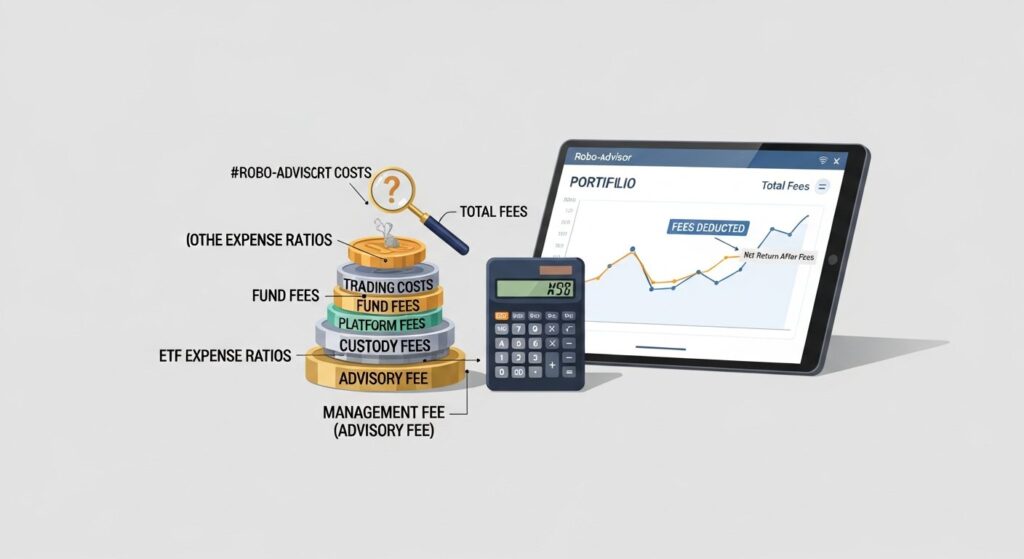
When you sign up for a robo-advisor, you’ll encounter several types of charges. It’s essential to differentiate between them to accurately compare services and identify the true cost of managing your investments. The primary components of robo-advisor fees generally include management fees, underlying investment expense ratios, and sometimes trading fees or additional service charges.
Management Fees (Advisory Fees)
This is perhaps the most visible fee and what most people think of when they consider robo-advisor costs. The management fee is typically an annual percentage of the assets under management (AUM). For example, a 0.25% management fee on a $100,000 portfolio would equate to $250 per year. These fees usually cover the cost of portfolio creation, automated rebalancing, dividend reinvestment, and potentially access to basic planning tools or customer support.
- Range: Management fees can vary significantly, from 0% for some basic accounts (often with limitations or requiring a linked bank account) to 0.50% or more for platforms offering premium features or hybrid models with human advisor access.
- Tiered Structures: Some robo-advisors employ tiered fee structures, where the percentage decreases as your AUM increases, rewarding larger balances with lower effective rates.
- Flat Fees: A few platforms might charge a flat monthly or annual fee, which can be advantageous for investors with larger portfolios where a percentage-based fee would be higher.
Underlying Investment Expense Ratios (ETFs and Mutual Funds)
This is a crucial but often overlooked component of robo-advisor fees. Robo-advisors typically invest your money into a portfolio of low-cost Exchange-Traded Funds (ETFs) or mutual funds. Each of these underlying funds has its own annual operating expenses, known as the expense ratio. This ratio is expressed as a percentage of the fund’s assets and is deducted from the fund’s total return before it reaches your account.
- Impact: While often small (e.g., 0.05% to 0.20%), these expense ratios are separate from the robo-advisor’s management fee and accumulate over time. A portfolio of ETFs with an average expense ratio of 0.15% will cost you an additional $150 per year on a $100,000 portfolio, independent of the robo-advisor’s fee.
- Transparency: Reputable robo-advisors will clearly disclose the average expense ratio of the funds they use. Look for platforms that prioritize low-cost index ETFs.
Trading Fees and Transaction Costs
Most modern robo-advisors strive to minimize or eliminate direct trading commissions for transactions within your managed portfolio. However, it’s worth verifying:
- Commission-Free ETFs: Many platforms exclusively use commission-free ETFs.
- Spread Costs: While not a direct fee, there’s always a bid-ask spread when buying or selling securities. For highly liquid ETFs typically used by robo-advisors, this impact is minimal but exists.
- Fund-Specific Trading Fees: Very rarely, some niche funds might have transaction fees, but these are generally avoided by mainstream robo-advisors.
Miscellaneous and Premium Service Fees
Beyond the core fees, some robo-advisors offer premium services that come with additional charges:
- Human Financial Advisor Access: Many platforms now offer hybrid models, allowing scheduled calls or unlimited access to certified financial planners for an elevated fee. This can range from an extra 0.10% to 0.25% of AUM, or a higher overall management fee.
- Advanced Planning Tools: Some services provide sophisticated planning tools for specific goals (e.g., estate planning, college savings projections) that might be part of a higher-tier package.
- Account Transfer Fees: If you decide to transfer your account to another institution, you might incur outbound transfer fees (e.g., ACATS fees).
- Expedited Services: Requesting expedited checks or wire transfers could also lead to small charges.
When evaluating robo-advisor fees, it’s crucial to sum up all these potential costs to get a complete picture of what you’ll truly be paying annually. A platform advertising a 0.25% management fee might effectively cost 0.40% or more once underlying ETF expense ratios are factored in, and even higher with premium services.
Explore our guide to understanding ETF expense ratios.
Comparing Popular Robo-Advisors and Their Fees in 2026
The robo-advisor market is vibrant and competitive, with each platform attempting to differentiate itself through features, target audience, and, critically, fee structures. Understanding how leading platforms stack up is key to finding the best fit for your financial journey in 2026. Here, we’ll compare some of the most prominent players, focusing on their typical robo-advisor fees and the value they offer.
Wealthfront
Wealthfront is known for its robust automated features, including advanced tax-loss harvesting, automated rebalancing, and sophisticated financial planning tools like Path, which helps users plan for retirement, home purchases, and more. It typically appeals to hands-off investors who appreciate technology-driven optimization.
- Management Fee: Generally around 0.25% of AUM annually.
- Underlying ETF Expense Ratios: Low, often averaging 0.07% to 0.15%, depending on the portfolio.
- Minimum Investment: $500 for a taxable account, $1 for a 529 plan.
- Additional Features: Offers a high-yield cash account, automated bond ladders, and fractional shares. No direct human advisor access in its basic tier.
Betterment
Betterment is one of the pioneers in the robo-advisor space, renowned for its user-friendly interface, goal-based investing, and a suite of features like tax-loss harvesting, flexible portfolios, and charitable giving tools. It caters to a broad spectrum of investors.
- Digital Plan Management Fee: 0.25% of AUM annually for balances under $100,000.
- Premium Plan Management Fee: 0.40% of AUM annually for balances over $100,000, which includes unlimited access to human financial advisors for significant life events.
- Underlying ETF Expense Ratios: Typically low, ranging from 0.05% to 0.15%.
- Minimum Investment: $0 to open an account, but requires a $10 deposit for investing or recurring deposits. Premium plan requires $100,000 minimum.
- Additional Features: Offers a high-yield cash reserve, checking account, and access to certified financial planners for an additional cost (or included in Premium).
Fidelity Go
Fidelity Go offers a streamlined robo-advisor experience backed by a well-established financial institution. It focuses on simplicity and low costs, making it attractive for those who prefer an integrated approach with their existing Fidelity accounts.
- Management Fee: 0% for balances under $25,000. 0.35% of AUM annually for balances over $25,000.
- Underlying Fidelity Flex ETF Expense Ratios: Fidelity Go invests exclusively in Fidelity Flex® ETFs, which have 0% expense ratios. This is a significant differentiator.
- Minimum Investment: $0 to open, but $0 minimum to start investing for accounts under $25,000 (though most will need at least $10 to get diverse ETFs), and $25,000 for accounts subject to the advisory fee.
- Additional Features: No tax-loss harvesting at the basic level, but offers automatic rebalancing. Human advisor access is available through other Fidelity services, not directly integrated into Fidelity Go.
Schwab Intelligent Portfolios
Charles Schwab offers a unique value proposition: a robo-advisor with no advisory fees on its basic tier. It’s an excellent option for investors looking for professional portfolio management without recurring management charges, provided they meet certain conditions.
- Management Fee: 0% for the basic Schwab Intelligent Portfolios.
- Schwab Intelligent Portfolios Premium: A one-time planning fee of $300 and a $30 monthly advisory fee for balances over $25,000. This tier provides unlimited one-on-one guidance from a Schwab CFP®.
- Underlying ETF Expense Ratios: Relatively low, but users should be aware that a significant portion of the portfolio is often allocated to cash (which earns Schwab interest), and a portion goes into Schwab’s own ETFs. Average ETF expense ratios vary but are generally competitive.
- Minimum Investment: $5,000 for the basic service. $25,000 for Premium.
- Additional Features: Automated rebalancing, tax-loss harvesting for taxable accounts with $50,000 or more. The cash allocation strategy can impact returns, a point of discussion for many investors.
Vanguard Digital Advisor
As a leader in low-cost investing, Vanguard’s robo-advisor leverages its own highly regarded, low-cost index ETFs and mutual funds. It aims to provide a simple, cost-effective solution for long-term investors already familiar with Vanguard’s philosophy.
- Management Fee: Approximately 0.15% of AUM annually for accounts over $3,000. The first $3,000 is managed free for the first 90 days, then 0.15% after that.
- Underlying Vanguard ETF Expense Ratios: Extremely low, averaging around 0.06% to 0.08%.
- Minimum Investment: $3,000 for Digital Advisor.
- Additional Features: Offers tax-loss harvesting for taxable accounts, automatic rebalancing, and personalized financial plans. Limited direct access to human advisors at this tier, but customers can upgrade to Vanguard Personal Advisor Services for a higher fee (0.30% of AUM) if they have $50,000 or more.
Comparison Table: Key Robo-Advisor Fees (2026 Snapshot)
| Robo-Advisor | Management Fee (Annual AUM) | Typical Underlying ETF ER | Minimum Investment | Human Advisor Access |
|---|---|---|---|---|
| Wealthfront | 0.25% | 0.07% – 0.15% | $500 | No (Standard) |
| Betterment (Digital) | 0.25% | 0.05% – 0.15% | $0 (Invest with $10) | Limited (Premium: 0.40%) |
| Fidelity Go | 0% (under $25k), 0.35% (over $25k) | 0% (Fidelity Flex ETFs) | $0 (Invest with $10) | No (Direct) |
| Schwab Intelligent Portfolios | 0% | Varies (incl. cash allocation) | $5,000 | Premium: $300 + $30/month |
| Vanguard Digital Advisor | 0.15% | 0.06% – 0.08% | $3,000 | Limited (Upgrade to Personal Advisor) |
| Sofi Invest (Automated Investing) | 0% | 0.09% – 0.20% | $0 | Yes (Included, subject to availability) |
Note: Fees and features are subject to change. Always verify the most current details directly on the robo-advisor’s official website. “Typical Underlying ETF ER” is an average estimate and can vary based on portfolio allocation. Some platforms might offer promotional rates or specific account types with different fee structures.
[INLINE IMAGE 2: place after fourth H2 | alt=”robo-advisor fees comparison illustration”]
Hidden Costs and What to Watch Out For
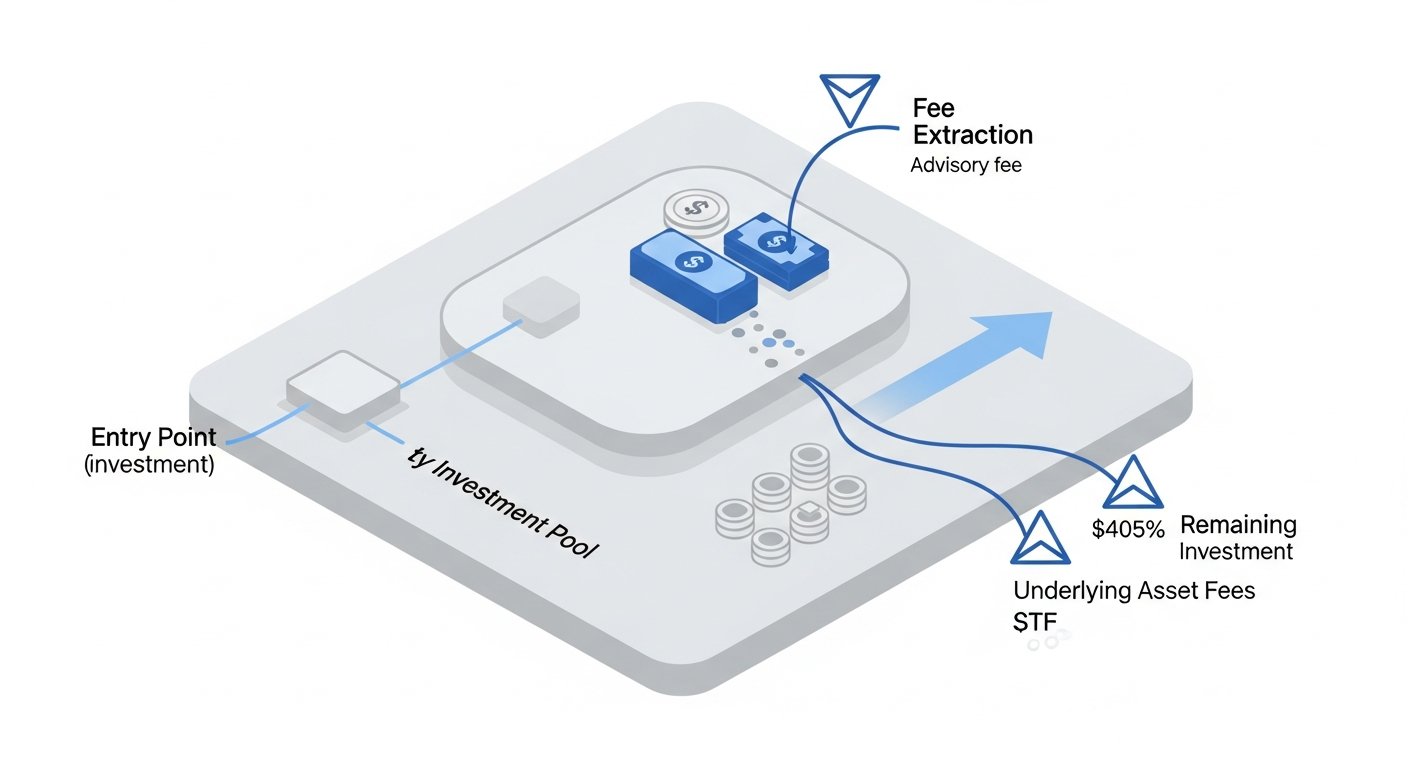
While the advertised management fee is a significant factor in your decision, a thorough understanding of robo-advisor fees requires looking beyond the headline numbers. Several less obvious costs can impact your overall returns. Being aware of these can prevent unpleasant surprises and help you accurately compare different platforms.
Cash Drag and Opportunity Cost
Some robo-advisors, most notably Schwab Intelligent Portfolios, maintain a significant cash allocation within their portfolios, even in periods where market returns might outperform cash. While this can provide a buffer during downturns, it can also lead to “cash drag,” meaning your money isn’t fully invested and therefore isn’t earning market returns. While not a direct fee, this represents an opportunity cost – the returns you forgo by holding cash instead of investments. Always examine a robo-advisor’s cash allocation strategy and understand its potential impact on your overall performance.
Spread on ETFs
When you buy or sell an ETF, there’s a small difference between the highest price a buyer is willing to pay (bid) and the lowest price a seller is willing to accept (ask). This “bid-ask spread” is a small transaction cost that effectively reduces your return when you trade. For highly liquid ETFs used by most robo-advisors, this spread is often negligible, but it’s an inherent cost of trading that technically exists. Most robo-advisors don’t explicitly charge for this, but it’s part of the broader transaction ecosystem.
Rebalancing Frequencies and Efficiency
Robo-advisors automatically rebalance your portfolio to maintain your target asset allocation. While beneficial for risk management, frequent or inefficient rebalancing could potentially incur higher trading costs (if commissions are charged, though rare now) or trigger more capital gains events in taxable accounts. While most robo-advisors are smart about tax-efficient rebalancing, it’s worth understanding their approach. Some use “corridor rebalancing” only when asset allocations drift beyond a certain threshold, which can be more tax-efficient than time-based rebalancing.
Tax-Loss Harvesting Limitations and Effectiveness
Many robo-advisors offer tax-loss harvesting, a strategy to sell investments at a loss to offset capital gains and potentially reduce taxable income. While highly beneficial, its effectiveness can vary.
- Account Minimums: Some platforms only offer tax-loss harvesting for accounts above a certain threshold (e.g., $50,000).
- Wash-Sale Rule: Robo-advisors are generally adept at avoiding wash sales (buying a substantially identical security within 30 days before or after selling one at a loss), but investors managing multiple brokerage accounts outside the robo-advisor need to be careful to avoid violating this rule themselves.
- Benefits May Diminish: The benefits of tax-loss harvesting tend to be greater in the early years of investing or during market downturns. As portfolios grow and mature, its impact might lessen relative to the overall portfolio value.
Fees for Human Financial Advice
As noted earlier, hybrid models that include access to human financial advisors often come with a significantly higher fee. While this access can be invaluable for complex financial situations or major life events, it’s a premium service. Ensure you understand what level of access you’re paying for – is it unlimited calls, a few scheduled sessions, or just email support? Is the advisor a CFP®? Evaluate if the increased cost justifies the level of human interaction you truly need. For some, the added cost is worth it for peace of mind or specialized advice, while others prefer the pure automation.
Account Closing and Transfer Fees
Should you decide to move your assets from one robo-advisor to another, or to a traditional brokerage, you might encounter fees. These can include:
- Outgoing ACATS (Automated Customer Account Transfer Service) Fee: Many brokerages charge a fee, often ranging from $50 to $100, to transfer your entire account to another institution.
- Account Termination Fees: Some platforms might charge a small fee to close an account, though this is becoming less common.
- Partial Transfer Fees: If you only transfer a portion of your assets, separate fees might apply per security or for processing.
While these are one-time fees, they can add up, especially if you foresee needing to transfer assets frequently. Always check the platform’s fee schedule for these less common but potentially impactful charges. The key takeaway is to read the fine print, understand all potential charges, and evaluate them against the services you receive. A seemingly low management fee might conceal other costs that, when combined, make the total expense less competitive than you initially thought.
Learn more about the tax implications of automated investing.
The Value Proposition: When are Robo-Advisor Fees Worth It?
Given the various fees involved, a natural question arises: when are robo-advisor fees truly a worthwhile investment? The answer largely depends on an individual’s financial situation, investment goals, risk tolerance, and their need for personalized advice versus automated efficiency. Robo-advisors aren’t for everyone, but for many, they offer significant value.
Cost-Effectiveness Compared to Traditional Advisors
One of the primary advantages of robo-advisors is their cost-effectiveness. Traditional human financial advisors typically charge 1% to 2% (or more) of AUM annually, often with higher minimum investment requirements. Even at the higher end of robo-advisor management fees (e.g., 0.50% for premium services), the total cost is significantly lower. This difference of just 0.5% to 1.5% might seem small annually, but over decades, compounded returns lost to higher fees can amount to hundreds of thousands of dollars.
- For Small Portfolios: For investors with modest portfolios (e.g., under $100,000), a human advisor might be prohibitively expensive or simply unavailable. Robo-advisors provide professional management at a fraction of the cost, making investing accessible.
- For Hands-Off Investors: If you prefer a set-it-and-forget-it approach and trust algorithms to manage your portfolio, the fees for automated rebalancing, diversification, and potentially tax-loss harvesting are a good value for the time and effort saved.
Benefits of Automation and Discipline
The value of a robo-advisor extends beyond just lower fees. The automated nature helps investors avoid common pitfalls:
- Emotional Investing: Robo-advisors remove emotions from investment decisions, preventing panic selling during market downturns or chasing hot stocks during bull runs. This disciplined approach often leads to better long-term outcomes.
- Consistent Rebalancing: Portfolios are automatically rebalanced to maintain target asset allocations, ensuring your risk profile remains consistent without you needing to monitor it manually.
- Tax Efficiency: Features like tax-loss harvesting, while sometimes limited, can genuinely save investors money on their tax bill, partially offsetting the management fees.
When a Higher Fee Might Be Justified
While minimizing fees is generally advisable, a slightly higher robo-advisor fee might be justified under certain circumstances:
- Hybrid Models with Human Access: If you have complex financial situations (e.g., high net worth, specific tax planning needs, estate planning, business ownership) but still want the automated benefits, a hybrid model offering access to human CFPs can be an excellent middle ground. The extra cost provides peace of mind and tailored advice when needed.
- Advanced Planning Tools: Some robo-advisors offer sophisticated planning tools that go beyond basic retirement projections, such as scenario analysis for major life events. If these tools genuinely help you plan more effectively, the incremental fee might be worth it.
- Unique Investment Strategies: A few robo-advisors offer specialized portfolios (e.g., socially responsible investing, smart beta strategies) that might come with a slightly higher fee but align better with your personal values or investment philosophy.
Ultimately, the “worth” of robo-advisor fees is subjective. It’s about weighing the explicit costs against the implicit benefits of convenience, automation, diversification, and disciplined investing. For many, especially those new to investing or with simpler financial needs, robo-advisors offer an unparalleled blend of professional management and affordability.
Compare robo-advisors versus traditional financial advisors.
Factors Influencing Robo-Advisor Fees and Service Tiers
The landscape of robo-advisor fees is not monolithic. Instead, fees are often influenced by a range of factors, which in turn dictate the level of service and features you receive. Understanding these determinants can help you navigate the options and choose a platform that offers the right balance of cost and benefit for your specific needs.
Account Balance (Assets Under Management – AUM)
This is perhaps the most significant factor influencing fees. Most robo-advisors use a tiered percentage-based fee structure:
- Lower Balances: Some platforms offer free management for very small balances (e.g., under $5,000 or $10,000) to attract new investors, or charge a flat monthly fee that benefits smaller accounts proportionally. Others have a standard percentage from the first dollar.
- Mid-Range Balances: The common annual percentage fee (e.g., 0.25% – 0.50%) typically applies here.
- Higher Balances: Many robo-advisors offer reduced percentage fees for larger portfolios (e.g., 0.20% for AUM over $1 million). This incentive acknowledges that managing a larger portfolio doesn’t necessarily cost the provider proportionally more.
Minimum investment requirements also play a role, as some premium services or features only unlock at higher AUM thresholds.
Level of Human Advisor Access
The extent to which you can interact with a human financial advisor directly correlates with higher fees. Robo-advisors have evolved beyond pure automation to offer hybrid models:
- Pure Robo (Lowest Fees): No direct human interaction beyond basic customer support. All advice and portfolio management are automated.
- Limited Human Access (Mid-Range Fees): Access to a human advisor for specific questions or scheduled review sessions, usually at higher balance tiers or as part of a premium plan.
- Unlimited Human Access (Highest Fees): Full access to a dedicated or team of CFPs, often for balances exceeding $100,000 or $250,000, and commanding fees closer to 0.40% – 0.50% of AUM. This bridges the gap between traditional and automated advice.
Range and Sophistication of Features
The complexity and breadth of services offered by a robo-advisor also dictate its fee structure:
- Basic Portfolio Management: Simple, diversified portfolios with automatic rebalancing and dividend reinvestment typically come with the lowest fees.
- Advanced Tax Strategies: Platforms offering advanced tax-loss harvesting, asset location, or tax-efficient withdrawals may charge slightly more, reflecting the added algorithmic complexity and potential tax savings.
- Comprehensive Financial Planning: Services that include goal-based planning across multiple objectives (retirement, college, home, etc.), debt management tools, or integration with external accounts often fall into higher-fee tiers.
- Banking & Lending Integration: Some fintech platforms offer integrated banking, high-yield savings accounts, or even lending products alongside their investment services. While these separate services may not incur direct robo-advisor fees, they contribute to the overall value proposition and often justify the platform’s overall pricing strategy.
Investment Options and Portfolio Customization
While most robo-advisors use globally diversified ETF portfolios, some offer greater customization or access to specific investment types:
- Standard ETFs: The lowest-cost option, utilizing broad market index ETFs.
- Socially Responsible Investing (SRI) / ESG Portfolios: Often available at the same fee, but sometimes with slightly higher underlying ETF expense ratios due to the specialized nature of these funds.
- Smart Beta or Factor-Based Investing: More sophisticated strategies that aim to outperform market cap-weighted indices might come with higher fees or utilize ETFs with higher expense ratios.
- Individual Stock/Bond Access: A few hybrid platforms might allow for some degree of individual stock selection, which could influence overall fees or trading costs if not within the commission-free framework.
When selecting a robo-advisor, it’s not merely about finding the absolute lowest fee. It’s about finding the lowest fee for the package of services, features, and accessibility that genuinely meets your individual financial planning and investment management needs. A cheap option that lacks essential features might be a false economy, just as an expensive option with features you’ll never use is a waste.
Strategies to Minimize Robo-Advisor Fees
Even with competitive pricing, every dollar saved on fees is a dollar that stays invested and compounds over time. While robo-advisor fees are generally lower than traditional alternatives, smart strategies can help you further minimize your costs and maximize your returns. Here are actionable tips:
1. Understand the Total Cost, Not Just the Management Fee
As discussed, the management fee is only one piece of the puzzle. Always factor in the underlying ETF expense ratios. A robo-advisor with a slightly higher management fee but significantly lower ETF expense ratios might actually be cheaper in total. For example, a 0.20% management fee + 0.05% ETF ER (total 0.25%) is cheaper than a 0.15% management fee + 0.15% ETF ER (total 0.30%).
2. Consolidate Accounts (Where Appropriate)
Some robo-advisors offer tiered pricing where fees decrease as your AUM increases. If you have multiple investment accounts spread across different platforms, consolidating them into one robo-advisor might push you into a lower fee bracket. Ensure the benefits of consolidation (lower fees, simplified management) outweigh any potential transfer fees or loss of specific features from your current accounts.
3. Leverage Free or Low-Cost Tiers for Smaller Balances
If you’re just starting with a small investment, look for robo-advisors that offer 0% management fees for balances under a certain threshold (e.g., Fidelity Go under $25,000) or those with no minimums and no management fees (e.g., SoFi Invest Automated Investing, Schwab Intelligent Portfolios). This allows your initial investments to grow unburdened by recurring fees.
4. Evaluate the Need for Human Advisor Access
Hybrid models offering human financial advice come with a premium. Honestly assess if you genuinely need this level of interaction. For many, especially those with straightforward financial situations, a pure robo-advisor provides sufficient guidance. If you only need occasional advice, consider platforms that offer one-off planning sessions for a flat fee rather than a higher ongoing AUM charge.
5. Be Mindful of Cash Allocations
While some cash can be prudent, excessive cash allocations, especially those that earn the platform interest (as with some zero-fee robo-advisors), can drag down your returns. Compare different platforms’ cash strategies and consider the opportunity cost. If you prefer a minimal cash allocation, opt for a robo-advisor that keeps cash levels low and fully invested.
6. Utilize Tax-Loss Harvesting
If your taxable account meets the minimum for tax-loss harvesting, ensure this feature is enabled. The tax savings generated can effectively reduce your overall investing costs, often offsetting a portion of the management fees. Be aware of its limitations and ensure you understand how it works.
7. Understand Portfolio Customization vs. Standard Portfolios
While customization can be appealing, specialized portfolios (e.g., highly niche ESG funds, active strategies) sometimes come with higher underlying fund expense ratios or separate fees. For most long-term investors, a standard, globally diversified, low-cost index ETF portfolio managed by a robo-advisor is the most cost-effective and efficient approach.
8. Shop Around and Re-evaluate Periodically
The robo-advisor market is dynamic. Fees and features can change, and new competitors emerge. It’s wise to periodically review your current robo-advisor’s fees against what’s available in the market. While frequent switching can incur transfer fees, being informed ensures you’re always getting competitive value.
By diligently applying these strategies, you can significantly reduce the impact of robo-advisor fees on your investment portfolio, allowing more of your money to work for you and contribute to your long-term financial success.
The Future of Robo-Advisor Fees and Industry Trends
The landscape of personal finance technology is constantly evolving, and robo-advisor fees are at the forefront of this transformation. As we look towards the future from 2026, several key trends are shaping how these platforms charge for their services and what value they deliver to investors.
Continued Downward Pressure on Management Fees
The intense competition in the fintech space, coupled with the “race to zero” in investing fees driven by large players like Vanguard and Fidelity, is likely to continue exerting downward pressure on management fees. We may see more robo-advisors offering:
- Zero-Fee Tiers: Expanding on current models, more platforms might offer entirely free management for basic portfolios, especially for smaller balances or as a loss leader to attract users to other paid services (like banking, lending, or premium advice).
- Subscription-Based Models: Moving away from AUM-based fees towards flat monthly or annual subscription fees could become more prevalent, particularly for platforms offering a wider ecosystem of financial tools beyond just investing. This can be more transparent and predictable for users, especially those with higher balances who might benefit from a capped fee.
- Performance-Based Fees: While less common in the retail robo-advisor space due to regulatory complexities, a future where some advanced robo-advisors experiment with performance-based fees (e.g., a percentage of profits above a benchmark) could emerge, aligning the advisor’s success with the client’s.
Enhanced Value Beyond Basic Portfolio Management
As management fees compress, robo-advisors will increasingly differentiate themselves by offering a broader array of value-added services. This means clients will get more for their fees, or justify higher fees for premium tiers:
- Holistic Financial Planning: Expect more sophisticated tools for budgeting, debt management, insurance analysis, estate planning, and even tax preparation, moving beyond just investment management to become true digital financial hubs.
- Personalized Human Touch: Hybrid models are here to stay and will likely become more integrated and nuanced. Robo-advisors might offer different tiers of human access – from on-demand video calls with a CFP to dedicated advisors for ultra-high-net-worth clients – all with corresponding fee structures.
- Advanced Investment Strategies: Beyond standard passive index investing, robo-advisors might incorporate more personalized factor investing, thematic portfolios, direct indexing (where individual stocks mimic an index for greater tax-loss harvesting opportunities), or even alternative investments for accredited investors.
Increased Use of AI and Machine Learning for Hyper-Personalization
Artificial intelligence and machine learning are already fundamental to robo-advisors, but their application will deepen. This could lead to:
- Dynamic Portfolio Optimization: AI could allow portfolios to adapt more rapidly and intelligently to changing market conditions, personal goals, and life events, potentially justifying specialized fees.
- Predictive Financial Guidance: AI-driven insights could offer proactive advice on spending habits, savings rates, and potential financial risks, turning robo-advisors into predictive financial coaches.
- Behavioral Nudges: AI could be used to provide personalized nudges and educational content tailored to an individual’s financial behavior, helping them stay on track with their goals.
Greater Transparency and Regulatory Scrutiny
As robo-advisors become more ubiquitous, regulatory bodies are likely to increase their scrutiny, particularly concerning fee transparency and disclosure. This could lead to:
- Standardized Fee Disclosures: Clearer, more standardized ways of presenting total costs, including underlying fund expense ratios and any hidden fees, making comparisons easier for consumers.
- Enhanced Fiduciary Standards: A renewed focus on ensuring robo-advisors always act in the client’s best interest, aligning with fiduciary duties.
In conclusion, the future of robo-advisor fees will likely see a push-pull dynamic: continued pressure to lower basic management fees, balanced by the introduction of new, more sophisticated services and personalized advice tiers that command a premium. Investors in 2026 and beyond will need to be increasingly discerning, evaluating not just the percentage charged, but the comprehensive value and technological innovation offered by these evolving platforms.
Conclusion: Making an Informed Decision on Robo-Advisor Fees
Navigating the world of automated investing requires a clear understanding of its costs. While robo-advisors undeniably offer a compelling, cost-effective alternative to traditional financial planning, the true expense goes beyond a simple annual management fee. It encompasses underlying investment expense ratios, potential trading costs, and charges for premium features or human advice.
As you’ve learned, comparing robo-advisor fees effectively means looking at the total cost of ownership. This includes the management fee, the average expense ratios of the ETFs or mutual funds within the portfolio, and any additional charges for services like tax-loss harvesting, human advisor access, or account transfers. Platforms like Fidelity Go leverage 0% expense ratio funds, while others like Schwab Intelligent Portfolios offer 0% management fees but utilize cash allocations that can impact returns. Vanguard Digital Advisor and Wealthfront strike a balance with competitive management fees and ultra-low underlying fund costs.
The value proposition of robo-advisors is significant: accessible, diversified, and professionally managed portfolios at a fraction of the cost of traditional advisors. They enforce investment discipline, automate rebalancing, and offer tax-efficient strategies that can genuinely benefit long-term wealth accumulation. However, your decision should always align with your specific financial goals, risk tolerance, and whether you require the simplicity of pure automation or the added comfort of a hybrid model with human guidance.
In 2026, the market offers a diverse range of options, each with its unique blend of features and fee structures. By asking the right questions, scrutinizing the fine print, and understanding the total cost, you can confidently choose a robo-advisor that helps you achieve your financial aspirations while keeping your expenses in check. Remember, every dollar saved on fees is a dollar that remains invested, compounding its way towards your future financial freedom.
Frequently Asked Questions
Q1: What is the average robo-advisor fee in 2026?
A1: In 2026, the average annual
Robo-Advisor Fees: Unpacking the True Cost of Automated Investing in 2026
Affiliate disclosure: This article may contain affiliate links. Recommendations are independent and editorially driven.
In the rapidly evolving landscape of personal finance, robo-advisors have emerged as a powerful, accessible, and often cost-effective alternative to traditional human financial advisors. Offering automated, algorithm-driven portfolio management, they’ve democratized investing, making professional-grade financial planning available to a broader audience. However, while often marketed as “low-cost,” the concept of robo-advisor fees can be more nuanced than a single percentage might suggest. Understanding these fees is paramount for any investor looking to maximize returns and minimize expenses.
As we navigate 2026, the competition among robo-advisors is fiercer than ever, leading to a diverse range of fee structures. From straightforward management fees to complex expense ratios, trading costs, and even premium service charges, discerning the true cost requires a careful look under the hood. This comprehensive guide will dissect the various components of robo-advisor fees, illuminate potential hidden costs, compare popular platforms, and equip you with the knowledge to make an informed decision that aligns with your financial objectives.
Demystifying Robo-Advisors: Beyond the Buzzwords
Before diving deep into the specifics of fees, it’s crucial to understand what robo-advisors are and how they operate. At their core, robo-advisors are digital platforms that provide automated, algorithm-driven financial planning services with little to no human intervention. They leverage technology to build, manage, and rebalance investment portfolios based on an investor’s goals, risk tolerance, and timeline.
How Robo-Advisors Work
The process typically begins with an online questionnaire designed to assess your financial situation, investment objectives (e.g., retirement, home purchase, general wealth accumulation), and your comfort level with risk. Based on your responses, the robo-advisor’s algorithms recommend a diversified portfolio, usually consisting of exchange-traded funds (ETFs) and mutual funds, designed to match your profile. Once funded, the platform automatically invests your money, rebalances your portfolio periodically to maintain the target asset allocation, and often employs strategies like tax-loss harvesting to optimize tax efficiency.
The Value Proposition of Automated Investing
Robo-advisors offer several compelling advantages: they are generally more affordable than traditional human advisors, require lower minimum investments, provide easy access to diversified portfolios, and operate with transparency. Their automation also removes much of the emotional decision-making from investing, which can lead to more disciplined wealth accumulation over time. However, these benefits come with associated costs, which form the crux of our discussion on robo-advisor fees.
For many, the appeal lies in their simplicity and efficiency. They can be an excellent entry point for new investors or a convenient solution for experienced investors seeking a hands-off approach. Yet, it is precisely because of their automated nature that understanding the fee structure is so critical. Every basis point paid in fees directly impacts your long-term returns, making due diligence on costs an indispensable part of your investment strategy.
[INLINE IMAGE 1: place after second H2 | alt=”robo-advisor fees concept illustration”]
Understanding the Core Components of Robo-Advisor Fee Structures
When you sign up for a robo-advisor, you’ll encounter several types of charges. It’s essential to differentiate between them to accurately compare services and identify the true cost of managing your investments. The primary components of robo-advisor fees generally include management fees, underlying investment expense ratios, and sometimes trading fees or additional service charges.
Management Fees (Advisory Fees)
This is perhaps the most visible fee and what most people think of when they consider robo-advisor costs. The management fee is typically an annual percentage of the assets under management (AUM). For example, a 0.25% management fee on a $100,000 portfolio would equate to $250 per year. These fees usually cover the cost of portfolio creation, automated rebalancing, dividend reinvestment, and potentially access to basic planning tools or customer support.
- Range: Management fees can vary significantly, from 0% for some basic accounts (often with limitations or requiring a linked bank account) to 0.50% or more for platforms offering premium features or hybrid models with human advisor access.
- Tiered Structures: Some robo-advisors employ tiered fee structures, where the percentage decreases as your AUM increases, rewarding larger balances with lower effective rates.
- Flat Fees: A few platforms might charge a flat monthly or annual fee, which can be advantageous for investors with larger portfolios where a percentage-based fee would be higher.
Underlying Investment Expense Ratios (ETFs and Mutual Funds)
This is a crucial but often overlooked component of robo-advisor fees. Robo-advisors typically invest your money into a portfolio of low-cost Exchange-Traded Funds (ETFs) or mutual funds. Each of these underlying funds has its own annual operating expenses, known as the expense ratio. This ratio is expressed as a percentage of the fund’s assets and is deducted from the fund’s total return before it reaches your account.
- Impact: While often small (e.g., 0.05% to 0.20%), these expense ratios are separate from the robo-advisor’s management fee and accumulate over time. A portfolio of ETFs with an average expense ratio of 0.15% will cost you an additional $150 per year on a $100,000 portfolio, independent of the robo-advisor’s fee.
- Transparency: Reputable robo-advisors will clearly disclose the average expense ratio of the funds they use. Look for platforms that prioritize low-cost index ETFs.
Trading Fees and Transaction Costs
Most modern robo-advisors strive to minimize or eliminate direct trading commissions for transactions within your managed portfolio. However, it’s worth verifying:
- Commission-Free ETFs: Many platforms exclusively use commission-free ETFs.
- Spread Costs: While not a direct fee, there’s always a bid-ask spread when buying or selling securities. For highly liquid ETFs typically used by robo-advisors, this impact is minimal but exists.
- Fund-Specific Trading Fees: Very rarely, some niche funds might have transaction fees, but these are generally avoided by mainstream robo-advisors.
Miscellaneous and Premium Service Fees
Beyond the core fees, some robo-advisors offer premium services that come with additional charges:
- Human Financial Advisor Access: Many platforms now offer hybrid models, allowing scheduled calls or unlimited access to certified financial planners for an elevated fee. This can range from an extra 0.10% to 0.25% of AUM, or a higher overall management fee.
- Advanced Planning Tools: Some services provide sophisticated planning tools for specific goals (e.g., estate planning, college savings projections) that might be part of a higher-tier package.
- Account Transfer Fees: If you decide to transfer your account to another institution, you might incur outbound transfer fees (e.g., ACATS fees).
- Expedited Services: Requesting expedited checks or wire transfers could also lead to small charges.
When evaluating robo-advisor fees, it’s crucial to sum up all these potential costs to get a complete picture of what you’ll truly be paying annually. A platform advertising a 0.25% management fee might effectively cost 0.40% or more once underlying ETF expense ratios are factored in, and even higher with premium services.
Explore our guide to understanding ETF expense ratios.
Comparing Popular Robo-Advisors and Their Fees in 2026
The robo-advisor market is vibrant and competitive, with each platform attempting to differentiate itself through features, target audience, and, critically, fee structures. Understanding how leading platforms stack up is key to finding the best fit for your financial journey in 2026. Here, we’ll compare some of the most prominent players, focusing on their typical robo-advisor fees and the value they offer.
Wealthfront
Wealthfront is known for its robust automated features, including advanced tax-loss harvesting, automated rebalancing, and sophisticated financial planning tools like Path, which helps users plan for retirement, home purchases, and more. It typically appeals to hands-off investors who appreciate technology-driven optimization.
- Management Fee: Generally around 0.25% of AUM annually.
- Underlying ETF Expense Ratios: Low, often averaging 0.07% to 0.15%, depending on the portfolio.
- Minimum Investment: $500 for a taxable account, $1 for a 529 plan.
- Additional Features: Offers a high-yield cash account, automated bond ladders, and fractional shares. No direct human advisor access in its basic tier.
Betterment
Betterment is one of the pioneers in the robo-advisor space, renowned for its user-friendly interface, goal-based investing, and a suite of features like tax-loss harvesting, flexible portfolios, and charitable giving tools. It caters to a broad spectrum of investors.
- Digital Plan Management Fee: 0.25% of AUM annually for balances under $100,000.
- Premium Plan Management Fee: 0.40% of AUM annually for balances over $100,000, which includes unlimited access to human financial advisors for significant life events.
- Underlying ETF Expense Ratios: Typically low, ranging from 0.05% to 0.15%.
- Minimum Investment: $0 to open an account, but requires a $10 deposit for investing or recurring deposits. Premium plan requires $100,000 minimum.
- Additional Features: Offers a high-yield cash reserve, checking account, and access to certified financial planners for an additional cost (or included in Premium).
Fidelity Go
Fidelity Go offers a streamlined robo-advisor experience backed by a well-established financial institution. It focuses on simplicity and low costs, making it attractive for those who prefer an integrated approach with their existing Fidelity accounts.
- Management Fee: 0% for balances under $25,000. 0.35% of AUM annually for balances over $25,000.
- Underlying Fidelity Flex ETF Expense Ratios: Fidelity Go invests exclusively in Fidelity Flex® ETFs, which have 0% expense ratios. This is a significant differentiator.
- Minimum Investment: $0 to open, but $0 minimum to start investing for accounts under $25,000 (though most will need at least $10 to get diverse ETFs), and $25,000 for accounts subject to the advisory fee.
- Additional Features: No tax-loss harvesting at the basic level, but offers automatic rebalancing. Human advisor access is available through other Fidelity services, not directly integrated into Fidelity Go.
Schwab Intelligent Portfolios
Charles Schwab offers a unique value proposition: a robo-advisor with no advisory fees on its basic tier. It’s an excellent option for investors looking for professional portfolio management without recurring management charges, provided they meet certain conditions.
- Management Fee: 0% for the basic Schwab Intelligent Portfolios.
- Schwab Intelligent Portfolios Premium: A one-time planning fee of $300 and a $30 monthly advisory fee for balances over $25,000. This tier provides unlimited one-on-one guidance from a Schwab CFP®.
- Underlying ETF Expense Ratios: Relatively low, but users should be aware that a significant portion of the portfolio is often allocated to cash (which earns Schwab interest), and a portion goes into Schwab’s own ETFs. Average ETF expense ratios vary but are generally competitive.
- Minimum Investment: $5,000 for the basic service. $25,000 for Premium.
- Additional Features: Automated rebalancing, tax-loss harvesting for taxable accounts with $50,000 or more. The cash allocation strategy can impact returns, a point of discussion for many investors.
Vanguard Digital Advisor
As a leader in low-cost investing, Vanguard’s robo-advisor leverages its own highly regarded, low-cost index ETFs and mutual funds. It aims to provide a simple, cost-effective solution for long-term investors already familiar with Vanguard’s philosophy.
- Management Fee: Approximately 0.15% of AUM annually for accounts over $3,000. The first $3,000 is managed free for the first 90 days, then 0.15% after that.
- Underlying Vanguard ETF Expense Ratios: Extremely low, averaging around 0.06% to 0.08%.
- Minimum Investment: $3,000 for Digital Advisor.
- Additional Features: Offers tax-loss harvesting for taxable accounts, automatic rebalancing, and personalized financial plans. Limited direct access to human advisors at this tier, but customers can upgrade to Vanguard Personal Advisor Services for a higher fee (0.30% of AUM) if they have $50,000 or more.
Comparison Table: Key Robo-Advisor Fees (2026 Snapshot)
| Robo-Advisor | Management Fee (Annual AUM) | Typical Underlying ETF ER | Minimum Investment | Human Advisor Access |
|---|---|---|---|---|
| Wealthfront | 0.25% | 0.07% – 0.15% | $500 | No (Standard) |
| Betterment (Digital) | 0.25% | 0.05% – 0.15% | $0 (Invest with $10) | Limited (Premium: 0.40%) |
| Fidelity Go | 0% (under $25k), 0.35% (over $25k) | 0% (Fidelity Flex ETFs) | $0 (Invest with $10) | No (Direct) |
| Schwab Intelligent Portfolios | 0% | Varies (incl. cash allocation) | $5,000 | Premium: $300 + $30/month |
| Vanguard Digital Advisor | 0.15% | 0.06% – 0.08% | $3,000 | Limited (Upgrade to Personal Advisor) |
| Sofi Invest (Automated Investing) | 0% | 0.09% – 0.20% | $0 | Yes (Included, subject to availability) |
Note: Fees and features are subject to change. Always verify the most current details directly on the robo-advisor’s official website. “Typical Underlying ETF ER” is an average estimate and can vary based on portfolio allocation. Some platforms might offer promotional rates or specific account types with different fee structures.
[INLINE IMAGE 2: place after fourth H2 | alt=”robo-advisor fees comparison illustration”]
Hidden Costs and What to Watch Out For
While the advertised management fee is a significant factor in your decision, a thorough understanding of robo-advisor fees requires looking beyond the headline numbers. Several less obvious costs can impact your overall returns. Being aware of these can prevent unpleasant surprises and help you accurately compare different platforms.
Cash Drag and Opportunity Cost
Some robo-advisors, most notably Schwab Intelligent Portfolios, maintain a significant cash allocation within their portfolios, even in periods where market returns might outperform cash. While this can provide a buffer during downturns, it can also lead to “cash drag,” meaning your money isn’t fully invested and therefore isn’t earning market returns. While not a direct fee, this represents an opportunity cost – the returns you forgo by holding cash instead of investments. Always examine a robo-advisor’s cash allocation strategy and understand its potential impact on your overall performance.
Spread on ETFs
When you buy or sell an ETF, there’s a small difference between the highest price a buyer is willing to pay (bid) and the lowest price a seller is willing to accept (ask). This “bid-ask spread” is a small transaction cost that effectively reduces your return when you trade. For highly liquid ETFs used by most robo-advisors, this spread is often negligible, but it’s an inherent cost of trading that technically exists. Most robo-advisors don’t explicitly charge for this, but it’s part of the broader transaction ecosystem.
Rebalancing Frequencies and Efficiency
Robo-advisors automatically rebalance your portfolio to maintain your target asset allocation. While beneficial for risk management, frequent or inefficient rebalancing could potentially incur higher trading costs (if commissions are charged, though rare now) or trigger more capital gains events in taxable accounts. While most robo-advisors are smart about tax-efficient rebalancing, it’s worth understanding their approach. Some use “corridor rebalancing” only when asset allocations drift beyond a certain threshold, which can be more tax-efficient than time-based rebalancing.
Tax-Loss Harvesting Limitations and Effectiveness
Many robo-advisors offer tax-loss harvesting, a strategy to sell investments at a loss to offset capital gains and potentially reduce taxable income. While highly beneficial, its effectiveness can vary.
- Account Minimums: Some platforms only offer tax-loss harvesting for accounts above a certain threshold (e.g., $50,000).
- Wash-Sale Rule: Robo-advisors are generally adept at avoiding wash sales (buying a substantially identical security within 30 days before or after selling one at a loss), but investors managing multiple brokerage accounts outside the robo-advisor need to be careful to avoid violating this rule themselves.
- Benefits May Diminish: The benefits of tax-loss harvesting tend to be greater in the early years of investing or during market downturns. As portfolios grow and mature, its impact might lessen relative to the overall portfolio value.
Fees for Human Financial Advice
As noted earlier, hybrid models that include access to human financial advisors often come with a significantly higher fee. While this access can be invaluable for complex financial situations or major life events, it’s a premium service. Ensure you understand what level of access you’re paying for – is it unlimited calls, a few scheduled sessions, or just email support? Is the advisor a CFP®? Evaluate if the increased cost justifies the level of human interaction you truly need. For some, the added cost is worth it for peace of mind or specialized advice, while others prefer the pure automation.
Account Closing and Transfer Fees
Should you decide to move your assets from one robo-advisor to another, or to a traditional brokerage, you might encounter fees. These can include:
- Outgoing ACATS (Automated Customer Account Transfer Service) Fee: Many brokerages charge a fee, often ranging from $50 to $100, to transfer your entire account to another institution.
- Account Termination Fees: Some platforms might charge a small fee to close an account, though this is becoming less common.
- Partial Transfer Fees: If you only transfer a portion of your assets, separate fees might apply per security or for processing.
While these are one-time fees, they can add up, especially if you foresee needing to transfer assets frequently. Always check the platform’s fee schedule for these less common but potentially impactful charges. The key takeaway is to read the fine print, understand all potential charges, and evaluate them against the services you receive. A seemingly low management fee might conceal other costs that, when combined, make the total expense less competitive than you initially thought.
Learn more about the tax implications of automated investing.
The Value Proposition: When are Robo-Advisor Fees Worth It?
Given the various fees involved, a natural question arises: when are robo-advisor fees truly a worthwhile investment? The answer largely depends on an individual’s financial situation, investment goals, risk tolerance, and their need for personalized advice versus automated efficiency. Robo-advisors aren’t for everyone, but for many, they offer significant value.
Cost-Effectiveness Compared to Traditional Advisors
One of the primary advantages of robo-advisors is their cost-effectiveness. Traditional human financial advisors typically charge 1% to 2% (or more) of AUM annually, often with higher minimum investment requirements. Even at the higher end of robo-advisor management fees (e.g., 0.50% for premium services), the total cost is significantly lower. This difference of just 0.5% to 1.5% might seem small annually, but over decades, compounded returns lost to higher fees can amount to hundreds of thousands of dollars.
- For Small Portfolios: For investors with modest portfolios (e.g., under $100,000), a human advisor might be prohibitively expensive or simply unavailable. Robo-advisors provide professional management at a fraction of the cost, making investing accessible.
- For Hands-Off Investors: If you prefer a set-it-and-forget-it approach and trust algorithms to manage your portfolio, the fees for automated rebalancing, diversification, and potentially tax-loss harvesting are a good value for the time and effort saved.
Benefits of Automation and Discipline
The value of a robo-advisor extends beyond just lower fees. The automated nature helps investors avoid common pitfalls:
- Emotional Investing: Robo-advisors remove emotions from investment decisions, preventing panic selling during market downturns or chasing hot stocks during bull runs. This disciplined approach often leads to better long-term outcomes.
- Consistent Rebalancing: Portfolios are automatically rebalanced to maintain target asset allocations, ensuring your risk profile remains consistent without you needing to monitor it manually.
- Tax Efficiency: Features like tax-loss harvesting, while sometimes limited, can genuinely save investors money on their tax bill, partially offsetting the management fees.
When a Higher Fee Might Be Justified
While minimizing fees is generally advisable, a slightly higher robo-advisor fee might be justified under certain circumstances:
- Hybrid Models with Human Access: If you have complex financial situations (e.g., high net worth, specific tax planning needs, estate planning, business ownership) but still want the automated benefits, a hybrid model offering access to human CFPs can be an excellent middle ground. The extra cost provides peace of mind and tailored advice when needed.
- Advanced Planning Tools: Some robo-advisors offer sophisticated planning tools that go beyond basic retirement projections, such as scenario analysis for major life events. If these tools genuinely help you plan more effectively, the incremental fee might be worth it.
- Unique Investment Strategies: A few robo-advisors offer specialized portfolios (e.g., socially responsible investing, smart beta strategies) that might come with a slightly higher fee but align better with your personal values or investment philosophy.
Ultimately, the “worth” of robo-advisor fees is subjective. It’s about weighing the explicit costs against the implicit benefits of convenience, automation, diversification, and disciplined investing. For many, especially those new to investing or with simpler financial needs, robo-advisors offer an unparalleled blend of professional management and affordability.
Compare robo-advisors versus traditional financial advisors.
Factors Influencing Robo-Advisor Fees and Service Tiers
The landscape of robo-advisor fees is not monolithic. Instead, fees are often influenced by a range of factors, which in turn dictate the level of service and features you receive. Understanding these determinants can help you navigate the options and choose a platform that offers the right balance of cost and benefit for your specific needs.
Account Balance (Assets Under Management – AUM)
This is perhaps the most significant factor influencing fees. Most robo-advisors use a tiered percentage-based fee structure:
- Lower Balances: Some platforms offer free management for very small balances (e.g., under $5,000 or $10,000) to attract new investors, or charge a flat monthly fee that benefits smaller accounts proportionally. Others have a standard percentage from the first dollar.
- Mid-Range Balances: The common annual percentage fee (e.g., 0.25% – 0.50%) typically applies here.
- Higher Balances: Many robo-advisors offer reduced percentage fees for larger portfolios (e.g., 0.20% for AUM over $1 million). This incentive acknowledges that managing a larger portfolio doesn’t necessarily cost the provider proportionally more.
Minimum investment requirements also play a role, as some premium services or features only unlock at higher AUM thresholds.
Level of Human Advisor Access
The extent to which you can interact with a human financial advisor directly correlates with higher fees. Robo-advisors have evolved beyond pure automation to offer hybrid models:
- Pure Robo (Lowest Fees): No direct human interaction beyond basic customer support. All advice and portfolio management are automated.
- Limited Human Access (Mid-Range Fees): Access to a human advisor for specific questions or scheduled review sessions, usually at higher balance tiers or as part of a premium plan.
- Unlimited Human Access (Highest Fees): Full access to a dedicated or team of CFPs, often for balances exceeding $100,000 or $250,000, and commanding fees closer to 0.40% – 0.50% of AUM. This bridges the gap between traditional and automated advice.
Range and Sophistication of Features
The complexity and breadth of services offered by a robo-advisor also dictate its fee structure:
- Basic Portfolio Management: Simple, diversified portfolios with automatic rebalancing and dividend reinvestment typically come with the lowest fees.
- Advanced Tax Strategies: Platforms offering advanced tax-loss harvesting, asset location, or tax-efficient withdrawals may charge slightly more, reflecting the added algorithmic complexity and potential tax savings.
- Comprehensive Financial Planning: Services that include goal-based planning across multiple objectives (retirement, college, home, etc.), debt management tools, or integration with external accounts often fall into higher-fee tiers.
- Banking & Lending Integration: Some fintech platforms offer integrated banking, high-yield savings accounts, or even lending products alongside their investment services. While these separate services may not incur direct robo-advisor fees, they contribute to the overall value proposition and often justify the platform’s overall pricing strategy.
Investment Options and Portfolio Customization
While most robo-advisors use globally diversified ETF portfolios, some offer greater customization or access to specific investment types:
- Standard ETFs: The lowest-cost option, utilizing broad market index ETFs.
- Socially Responsible Investing (SRI) / ESG Portfolios: Often available at the same fee, but sometimes with slightly higher underlying ETF expense ratios due to the specialized nature of these funds.
- Smart Beta or Factor-Based Investing: More sophisticated strategies that aim to outperform market cap-weighted indices might come with higher fees or utilize ETFs with higher expense ratios.
- Individual Stock/Bond Access: A few hybrid platforms might allow for some degree of individual stock selection, which could influence overall fees or trading costs if not within the commission-free framework.
When selecting a robo-advisor, it’s not merely about finding the absolute lowest fee. It’s about finding the lowest fee for the package of services, features, and accessibility that genuinely meets your individual financial planning and investment management needs. A cheap option that lacks essential features might be a false economy, just as an expensive option with features you’ll never use is a waste.
Strategies to Minimize Robo-Advisor Fees
Even with competitive pricing, every dollar saved on fees is a dollar that stays invested and compounds over time. While robo-advisor fees are generally lower than traditional alternatives, smart strategies can help you further minimize your costs and maximize your returns. Here are actionable tips:
1. Understand the Total Cost, Not Just the Management Fee
As discussed, the management fee is only one piece of the puzzle. Always factor in the underlying ETF expense ratios. A robo-advisor with a slightly higher management fee but significantly lower ETF expense ratios might actually be cheaper in total. For example, a 0.20% management fee + 0.05% ETF ER (total 0.25%) is cheaper than a 0.15% management fee + 0.15% ETF ER (total 0.30%).
2. Consolidate Accounts (Where Appropriate)
Some robo-advisors offer tiered pricing where fees decrease as your AUM increases. If you have multiple investment accounts spread across different platforms, consolidating them into one robo-advisor might push you into a lower fee bracket. Ensure the benefits of consolidation (lower fees, simplified management) outweigh any potential transfer fees or loss of specific features from your current accounts.
3. Leverage Free or Low-Cost Tiers for Smaller Balances
If you’re just starting with a small investment, look for robo-advisors that offer 0% management fees for balances under a certain threshold (e.g., Fidelity Go under $25,000) or those with no minimums and no management fees (e.g., SoFi Invest Automated Investing, Schwab Intelligent Portfolios). This allows your initial investments to grow unburdened by recurring fees.
4. Evaluate the Need for Human Advisor Access
Hybrid models offering human financial advice come with a premium. Honestly assess if you genuinely need this level of interaction. For many, especially those with straightforward financial situations, a pure robo-advisor provides sufficient guidance. If you only need occasional advice, consider platforms that offer one-off planning sessions for a flat fee rather than a higher ongoing AUM charge.
5. Be Mindful of Cash Allocations
While some cash can be prudent, excessive cash allocations, especially those that earn the platform interest (as with some zero-fee robo-advisors), can drag down your returns. Compare different platforms’ cash strategies and consider the opportunity cost. If you prefer a minimal cash allocation, opt for a robo-advisor that keeps cash levels low and fully invested.
6. Utilize Tax-Loss Harvesting
If your taxable account meets the minimum for tax-loss harvesting, ensure this feature is enabled. The tax savings generated can effectively reduce your overall investing costs, often offsetting a portion of the management fees. Be aware of its limitations and ensure you understand how it works.
7. Understand Portfolio Customization vs. Standard Portfolios
While customization can be appealing, specialized portfolios (e.g., highly niche ESG funds, active strategies) sometimes come with higher underlying fund expense ratios or separate fees. For most long-term investors, a standard, globally diversified, low-cost index ETF portfolio managed by a robo-advisor is the most cost-effective and efficient approach.
8. Shop Around and Re-evaluate Periodically
The robo-advisor market is dynamic. Fees and features can change, and new competitors emerge. It’s wise to periodically review your current robo-advisor’s fees against what’s available in the market. While frequent switching can incur transfer fees, being informed ensures you’re always getting competitive value.
By diligently applying these strategies, you can significantly reduce the impact of robo-advisor fees on your investment portfolio, allowing more of your money to work for you and contribute to your long-term financial success.
The Future of Robo-Advisor Fees and Industry Trends
The landscape of personal finance technology is constantly evolving, and robo-advisor fees are at the forefront of this transformation. As we look towards the future from 2026, several key trends are shaping how these platforms charge for their services and what value they deliver to investors.
Continued Downward Pressure on Management Fees
The intense competition in the fintech space, coupled with the “race to zero” in investing fees driven by large players like Vanguard and Fidelity, is likely to continue exerting downward pressure on management fees. We may see more robo-advisors offering:
- Zero-Fee Tiers: Expanding on current models, more platforms might offer entirely free management for basic portfolios, especially for smaller balances or as a loss leader to attract users to other paid services (like banking, lending, or premium advice).
- Subscription-Based Models: Moving away from AUM-based fees towards flat monthly or annual subscription fees could become more prevalent, particularly for platforms offering a wider ecosystem of financial tools beyond just investing. This can be more transparent and predictable for users, especially those with higher balances who might benefit from a capped fee.
- Performance-Based Fees: While less common in the retail robo-advisor space due to regulatory complexities, a future where some advanced robo-advisors experiment with performance-based fees (e.g., a percentage of profits above a benchmark) could emerge, aligning the advisor’s success with the client’s.
Enhanced Value Beyond Basic Portfolio Management
As management fees compress, robo-advisors will increasingly differentiate themselves by offering a broader array of value-added services. This means clients will get more for their fees, or justify higher fees for premium tiers:
- Holistic Financial Planning: Expect more sophisticated tools for budgeting, debt management, insurance analysis, estate planning, and even tax preparation, moving beyond just investment management to become true digital financial hubs.
- Personalized Human Touch: Hybrid models are here to stay and will likely become more integrated and nuanced. Robo-advisors might offer different tiers of human access – from on-demand video calls with a CFP to dedicated advisors for ultra-high-net-worth clients – all with corresponding fee structures.
- Advanced Investment Strategies: Beyond standard passive index investing, robo-advisors might incorporate more personalized factor investing, thematic portfolios, direct indexing (where individual stocks mimic an index for greater tax-loss harvesting opportunities), or even alternative investments for accredited investors.
Increased Use of AI and Machine Learning for Hyper-Personalization
Artificial intelligence and machine learning are already fundamental to robo-advisors, but their application will deepen. This could lead to:
- Dynamic Portfolio Optimization: AI could allow portfolios to adapt more rapidly and intelligently to changing market conditions, personal goals, and life events, potentially justifying specialized fees.
- Predictive Financial Guidance: AI-driven insights could offer proactive advice on spending habits, savings rates, and potential financial risks, turning robo-advisors into predictive financial coaches.
- Behavioral Nudges: AI could be used to provide personalized nudges and educational content tailored to an individual’s financial behavior, helping them stay on track with their goals.
Greater Transparency and Regulatory Scrutiny
As robo-advisors become more ubiquitous, regulatory bodies are likely to increase their scrutiny, particularly concerning fee transparency and disclosure. This could lead to:
- Standardized Fee Disclosures: Clearer, more standardized ways of presenting total costs, including underlying fund expense ratios and any hidden fees, making comparisons easier for consumers.
- Enhanced Fiduciary Standards: A renewed focus on ensuring robo-advisors always act in the client’s best interest, aligning with fiduciary duties.
In conclusion, the future of robo-advisor fees will likely see a push-pull dynamic: continued pressure to lower basic management fees, balanced by the introduction of new, more sophisticated services and personalized advice tiers that command a premium. Investors in 2026 and beyond will need to be increasingly discerning, evaluating not just the percentage charged, but the comprehensive value and technological innovation offered by these evolving platforms.
Conclusion: Making an Informed Decision on Robo-Advisor Fees
Navigating the world of automated investing requires a clear understanding of its costs. While robo-advisors undeniably offer a compelling, cost-effective alternative to traditional financial planning, the true expense goes beyond a simple annual management fee. It encompasses underlying investment expense ratios, potential trading costs, and charges for premium features or human advice.
As you’ve learned, comparing robo-advisor fees effectively means looking at the total cost of ownership. This includes the management fee, the average expense ratios of the ETFs or mutual funds within the portfolio, and any additional charges for services like tax-loss harvesting, human advisor access, or account transfers. Platforms like Fidelity Go leverage 0% expense ratio funds, while others like Schwab Intelligent Portfolios offer 0% management fees but utilize cash allocations that can impact returns. Vanguard Digital Advisor and Wealthfront strike a balance with competitive management fees and ultra-low underlying fund costs.
The value proposition of robo-advisors is significant: accessible, diversified, and professionally managed portfolios at a fraction of the cost of traditional advisors. They enforce investment discipline, automate rebalancing, and offer tax-efficient strategies that can genuinely benefit long-term wealth accumulation. However, your decision should always align with your specific financial goals, risk tolerance, and whether you require the simplicity of pure automation or the added comfort of a hybrid model with human guidance.
In 2026, the market offers a diverse range of options, each with its unique blend of features and fee structures. By asking the right questions, scrutinizing the fine print, and understanding the total cost, you can confidently choose a robo-advisor that helps you achieve your financial aspirations while keeping your expenses in check. Remember, every dollar saved on fees is a dollar that remains invested, compounding its way towards your future financial freedom.
Frequently Asked Questions
Q1: What is the average robo-advisor fee in 2026?
A1: In 2026, the average annual