



Robo-Advisors for Retirement: Your Essential Guide to Automated Investing in 2026
Affiliate disclosure: This article may contain affiliate links. Recommendations are independent and editorially driven.
Planning for retirement is arguably one of the most critical financial endeavors an individual undertakes. The traditional landscape of retirement planning often involved complex spreadsheets, hourly fees for human financial advisors, and a significant amount of self-education to navigate market intricacies. However, the advent of financial technology, or fintech, has revolutionized how we approach long-term savings. Among these innovations, robo-advisors for retirement have emerged as powerful, accessible, and often more affordable tools, democratizing sophisticated investment strategies for a broader audience.
In 2026, the notion of retirement is evolving. People are living longer, healthcare costs are rising, and the traditional pension system is largely a relic of the past for many. This shift places a greater onus on individuals to proactively manage their retirement nest egg. This is where robo-advisors step in, offering an automated, data-driven approach to investment management that can help you build and maintain a robust portfolio tailored to your unique retirement goals.
This comprehensive guide from fin3go will delve deep into the world of robo-advisors, specifically through the lens of retirement planning. We will explore what they are, how they work, their myriad benefits, and potential drawbacks. We’ll compare leading platforms, discuss how to choose the right one for your needs, and outline strategies to maximize your retirement savings. Whether you’re just starting your career or nearing your golden years, understanding how robo-advisors can integrate into your financial strategy is crucial for a secure and prosperous future.
Understanding Robo-Advisors: A Primer for Retirement Planners
Before diving into the specifics of using robo-advisors for retirement, it’s essential to grasp the fundamental concepts of what a robo-advisor is and how this technology has reshaped the financial advisory landscape.
What is a Robo-Advisor?
At its core, a robo-advisor is a digital platform that provides automated, algorithm-driven financial planning services with little to no human supervision. These platforms leverage advanced algorithms and machine learning to construct, manage, and rebalance investment portfolios based on a client’s specific financial goals, risk tolerance, and time horizon. The process typically begins with an online questionnaire designed to gather crucial information about your financial situation, investment objectives, and comfort level with risk.
Based on your responses, the robo-advisor recommends and then automatically manages a diversified portfolio, often consisting of low-cost exchange-traded funds (ETFs) and mutual funds. These investments typically span various asset classes, including stocks, bonds, real estate investment trusts (REITs), and sometimes even alternative investments, providing broad market exposure and inherent diversification.
How Do Robo-Advisors Work?
The operational mechanism of a robo-advisor is deceptively simple yet incredibly powerful. Here’s a breakdown of the typical workflow:
- Onboarding Questionnaire: You start by answering a series of questions about your age, income, existing assets, debts, financial goals (e.g., retirement, buying a home, saving for college), investment time horizon, and your emotional response to market fluctuations (risk tolerance).
- Portfolio Recommendation: The platform’s algorithm processes this data to recommend an appropriate investment portfolio. This portfolio is designed to align with your risk profile – aggressive for those comfortable with higher risk and longer time horizons, or conservative for those nearing retirement or with lower risk tolerance.
- Account Funding: Once you accept the recommended portfolio, you link your bank account to fund your investment account. Most robo-advisors allow for recurring deposits, which is a key feature for consistent retirement savings.
- Automated Investing: Your funds are automatically invested into the selected ETFs or mutual funds. The underlying principle is often rooted in Modern Portfolio Theory (MPT), which emphasizes diversification to maximize returns for a given level of risk.
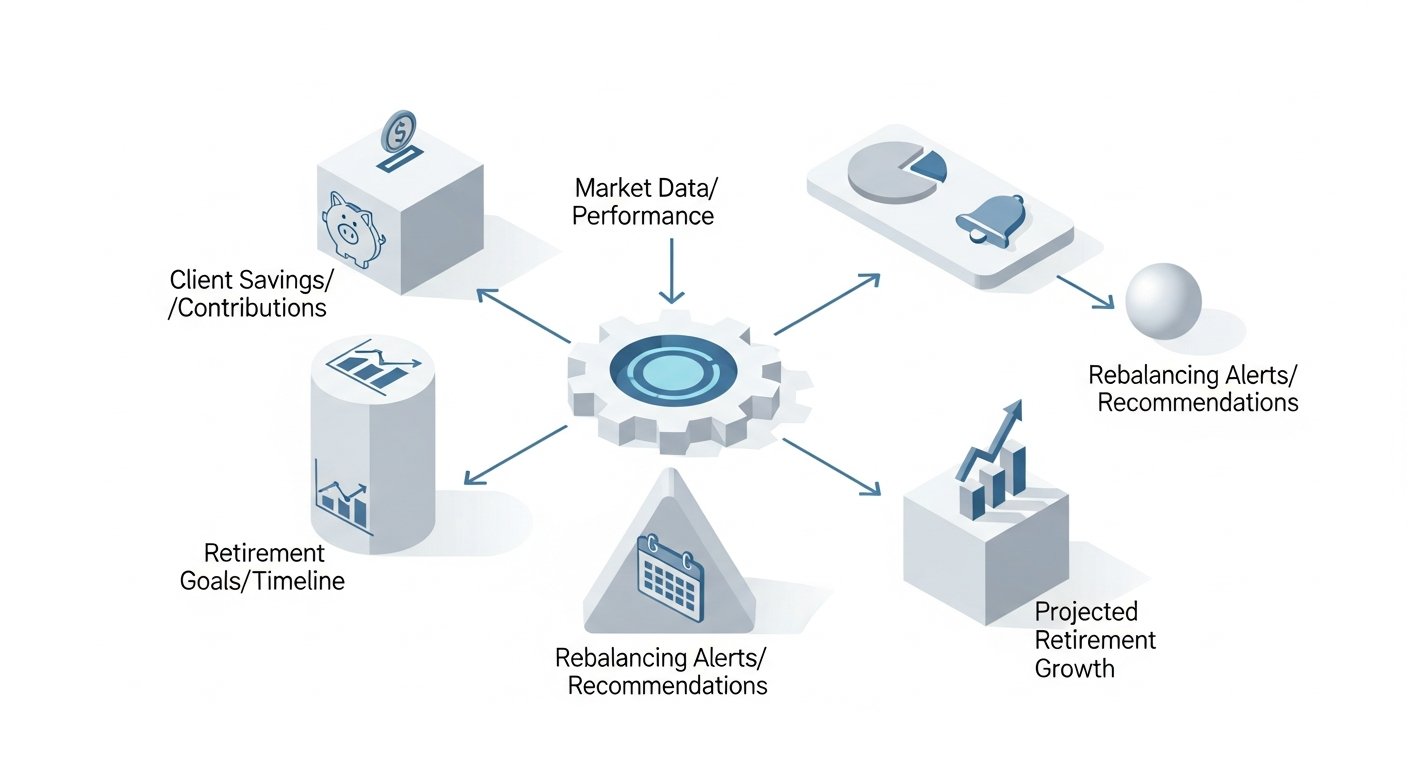
- Ongoing Management and Rebalancing: This is where the “robo” truly shines. The platform continuously monitors your portfolio. Over time, market movements can cause your asset allocation to drift from its target. Robo-advisors automatically rebalance your portfolio, selling assets that have performed well and buying those that have underperformed, bringing it back to your desired allocation without any manual intervention from you.
- Tax-Loss Harvesting (for taxable accounts): Many advanced robo-advisors also offer automated tax-loss harvesting, a strategy where investments sold at a loss are used to offset capital gains and even a limited amount of ordinary income, potentially lowering your tax bill. While less critical for tax-advantaged retirement accounts, it can still play a role in supplementary taxable savings.
The Evolution of Digital Wealth Management
Robo-advisors first gained prominence in the early 2010s, primarily as a disruptive force challenging traditional financial advisory models. Initially, they were perceived as solutions for younger, tech-savvy investors with smaller account balances. However, as the technology matured and platforms added more sophisticated features, their appeal broadened significantly. Today, they cater to a wide spectrum of investors, including those with substantial assets and complex retirement planning needs. The growth of fintech has made professional-grade investment management accessible, moving it from exclusive boardrooms to personal devices.
Key Benefits of Robo-Advisors for Retirement
For individuals focusing on retirement, robo-advisors offer several compelling advantages:
- Cost-Effectiveness: Typically, robo-advisors charge lower management fees (often 0.25% to 0.50% of assets under management) compared to human advisors (who might charge 1% or more, or flat fees). Over decades of retirement saving, these lower fees can translate into significantly larger nest eggs.
- Accessibility: They often have low or no minimum investment requirements, making professional investing accessible to individuals who are just starting to save for retirement.
- Automation and Discipline: The automated rebalancing and consistent investment strategy help investors avoid emotional decisions during market volatility, ensuring their portfolio stays on track for their long-term goals.
- Diversification: By investing in broad-market ETFs and mutual funds, robo-advisors inherently provide diversification across different asset classes, geographies, and industries, reducing single-stock risk.
- Tax Efficiency: Automated tax-loss harvesting, where applicable, can enhance after-tax returns, particularly beneficial for taxable accounts supplementing retirement savings.
Potential Drawbacks to Consider
While advantageous, robo-advisors are not without their limitations:
- Limited Human Interaction: For those who prefer personalized, one-on-one advice for complex financial situations (e.g., estate planning, business succession), pure robo-advisors might fall short. However, hybrid models now offer access to human advisors.
- Less Customization: While portfolios are tailored to your risk profile, they generally offer less customization than working with a human advisor who can incorporate unique circumstances or specific investment preferences.
- No Holistic Financial Planning (pure robos): Some basic robo-advisors focus solely on investment management and may not offer comprehensive financial planning encompassing budgeting, debt management, insurance, or estate planning. More advanced platforms are integrating these features.
- Lack of Behavioral Coaching: A human advisor can provide psychological support during market downturns, preventing impulsive decisions. Robos, by their nature, cannot offer this direct emotional coaching.
Weighing these pros and cons is crucial as you consider incorporating robo-advisors into your retirement strategy, especially as your financial life becomes more intricate.
[INLINE IMAGE 1: place after second H2 | alt=”robo-advisors for retirement concept illustration”]
Why Choose Robo-Advisors for Your Retirement Goals?


The decision to utilize robo-advisors for retirement planning is often driven by a confluence of practical, financial, and psychological factors. In a rapidly evolving economic landscape, their unique value proposition addresses many common challenges faced by modern savers.
Accessibility and Low Barriers to Entry
One of the most transformative aspects of robo-advisors is their unprecedented accessibility. Historically, professional financial advice was often reserved for individuals with substantial assets, requiring minimums of $100,000 or more. Robo-advisors have shattered this barrier, with many platforms requiring minimal or even no initial deposit to open an account. This makes sophisticated, diversified investing available to young professionals, those just starting their careers, or individuals with limited savings who might otherwise feel priced out of quality financial guidance. For retirement, this means even small, consistent contributions from an early age can be professionally managed, harnessing the power of compound interest over decades.
Cost-Effectiveness: Lower Fees, Higher Savings
The cost savings associated with robo-advisors are perhaps their most widely celebrated benefit. Traditional financial advisors typically charge an annual fee ranging from 0.8% to 1.5% of assets under management (AUM), sometimes more. Robo-advisors, on the other hand, often charge between 0.25% and 0.50% AUM. While these percentages may seem small, the difference compounds dramatically over the 30-40 years of a typical retirement saving timeline. For example, an investor with $500,000 might save an extra $2,500 to $5,000 annually in fees, which could translate into hundreds of thousands of dollars more in their retirement account by the time they retire. These savings directly contribute to a larger nest egg, allowing for a more comfortable retirement.
Diversification and Risk Management
A cornerstone of prudent retirement planning is diversification. Putting all your eggs in one basket, or even a few, exposes your retirement savings to undue risk. Robo-advisors excel at building globally diversified portfolios across various asset classes (e.g., U.S. equities, international equities, developed market bonds, emerging market bonds, real estate). They typically use low-cost ETFs and mutual funds to achieve this broad exposure efficiently. Furthermore, their algorithms are designed to align your portfolio’s risk level with your stated risk tolerance and time horizon. As you age and approach retirement, the algorithms can automatically shift your asset allocation from more aggressive (higher stock exposure) to more conservative (higher bond exposure), a strategy known as “glide path” investing, ensuring your portfolio’s risk profile remains appropriate for your stage of life.
Automation and Rebalancing for Hands-Off Investing
The “robo” in robo-advisor implies automation, and this is a significant advantage for long-term retirement planning. One of the biggest challenges for individual investors is maintaining their desired asset allocation. Market fluctuations inevitably cause some assets to grow faster than others, leading to portfolio drift. An equity-heavy portfolio might become even more so during a bull market, or a bond-heavy portfolio might lose its balance during a fixed-income rally. Manually rebalancing requires discipline and action. Robo-advisors automatically rebalance your portfolio at predetermined intervals or when certain thresholds are met, ensuring your investments consistently reflect your risk tolerance and financial goals without any effort on your part. This hands-off approach is invaluable for busy individuals who prefer to set it and forget it, while still benefiting from professional management.
Emotional Discipline in Investing
Human psychology is often the biggest enemy of successful long-term investing. During market downturns, panic can lead investors to sell low, locking in losses and missing subsequent rebounds. Conversely, during bull markets, euphoria can lead to overly aggressive investing. Robo-advisors remove the emotional component from investment decisions. They adhere strictly to the predetermined investment strategy, rebalancing and staying the course regardless of market sentiment. This algorithmic discipline can lead to significantly better long-term returns compared to emotionally driven human decisions, which is particularly critical for the multi-decade horizon of retirement savings.
Tax Efficiency Strategies (Tax-Loss Harvesting)
For individuals utilizing taxable brokerage accounts to supplement their retirement savings (beyond their IRA or 401(k) contributions), tax efficiency is paramount. Many leading robo-advisors offer automated tax-loss harvesting. This strategy involves selling investments that have declined in value to realize a capital loss, which can then be used to offset capital gains and up to $3,000 of ordinary income annually. The proceeds from the sale are then reinvested into a similar, but not identical, investment to maintain market exposure and diversification. This sophisticated technique, often difficult and time-consuming for individual investors, is seamlessly handled by robo-advisors, potentially saving investors thousands of dollars in taxes over their lifetime and allowing those funds to be reinvested for greater growth towards retirement.
These compelling advantages highlight why robo-advisors have become an indispensable tool for anyone serious about building a secure and prosperous retirement future in 2026.
Types of Retirement Accounts Supported by Robo-Advisors
Understanding which retirement accounts robo-advisors can manage is crucial for effectively integrating them into your overall financial plan. While robo-advisors shine in their automated investment management, their utility for retirement planning is magnified by their ability to handle various tax-advantaged accounts.
Traditional IRAs and Roth IRAs
Individual Retirement Arrangements (IRAs) are a cornerstone of personal retirement savings. Robo-advisors are exceptionally adept at managing both Traditional and Roth IRAs. These accounts offer significant tax benefits, and robo-advisors can help you optimize your investment strategy within them:
- Traditional IRA: Contributions are often tax-deductible in the year they are made, and investments grow tax-deferred until retirement, when withdrawals are taxed as ordinary income. Robo-advisors help you invest these pre-tax dollars into a diversified portfolio, automatically rebalancing to keep it aligned with your risk profile and time horizon.
- Roth IRA: Contributions are made with after-tax dollars, but qualified withdrawals in retirement are entirely tax-free. This offers immense benefits, particularly for younger investors who anticipate being in a higher tax bracket in retirement. Robo-advisors manage the investments within your Roth IRA, ensuring your after-tax contributions are working as hard as possible towards a tax-free future.
For both Traditional and Roth IRAs, the automated nature of robo-advisors ensures consistent investing and disciplined management, crucial for long-term growth within these vital retirement vehicles.
401(k) Rollovers and Other Employer-Sponsored Plans
While robo-advisors cannot directly manage an active 401(k) plan (as these are employer-sponsored), they become incredibly valuable when you change jobs. When you leave an employer, you typically have several options for your old 401(k) balance:
- Leave it with your former employer (if allowed).
- Cash it out (generally not recommended due to taxes and penalties).
- Roll it over into your new employer’s 401(k).
- Roll it over into an IRA.
It is this last option, the 401(k) rollover into an IRA (often referred to as a “rollover IRA”), where robo-advisors excel. Many individuals prefer rolling over their old 401(k) into an IRA managed by a robo-advisor because it offers:
- More Investment Options: Employer-sponsored plans often have a limited menu of investment choices. An IRA managed by a robo-advisor typically provides access to a much wider array of low-cost ETFs and diversified portfolios.
- Lower Fees: The expense ratios of funds within employer plans can sometimes be higher, and administrative fees might apply. Robo-advisors generally offer lower overall costs.
- Consolidation: Rolling multiple old 401(k)s into a single IRA makes it easier to track and manage your retirement savings.
Some robo-advisors also offer guidance or tools to help you manage your existing 401(k) by analyzing your current plan’s investment options and recommending the best choices within that limited selection, though they can’t directly manage the account.
Taxable Brokerage Accounts (as Supplementary Retirement Savings)
While IRAs and 401(k)s are primary retirement vehicles, many individuals also use taxable brokerage accounts to save extra for retirement, especially if they’ve maxed out their tax-advantaged contributions. Robo-advisors can manage these accounts just as effectively. For taxable accounts, the sophisticated tax-loss harvesting capabilities offered by many robo-advisors become a significant advantage. By strategically realizing losses to offset gains, they can enhance your after-tax returns, allowing more of your investment growth to contribute to your overall retirement wealth.
SEP IRAs and SIMPLE IRAs for Small Business Owners
Small business owners and self-employed individuals also have excellent options through robo-advisors. Robo-advisors can manage:
- SEP IRA (Simplified Employee Pension IRA): This is a retirement plan for self-employed individuals and small business owners. It allows for much higher contribution limits than a Traditional or Roth IRA. Robo-advisors can manage these accounts, providing a hands-off approach to investing these substantial contributions.
- SIMPLE IRA (Savings Incentive Match Plan for Employees IRA): Another retirement plan designed for small businesses, offering both employee and employer contributions. While slightly more complex, some robo-advisors can accommodate SIMPLE IRA investments.
These plans enable business owners to save significantly for their own retirement and often for their employees, with robo-advisors simplifying the investment management aspect.
Trust Accounts for Estate Planning (some advanced platforms)
For individuals with more complex estate planning needs, some advanced robo-advisors and hybrid platforms are beginning to offer management of trust accounts. While not universally available, this shows the growing sophistication of these platforms, extending their utility beyond basic personal retirement accounts to more intricate wealth management strategies.
The flexibility of robo-advisors to handle a diverse range of retirement accounts makes them a versatile and powerful tool for nearly any individual looking to automate and optimize their long-term savings strategy.
Key Features to Look For in a Retirement Robo-Advisor
Choosing the right robo-advisor for your retirement savings is a critical decision. With a growing number of platforms available in 2026, understanding the key features and differentiators can help you select one that perfectly aligns with your financial goals, risk tolerance, and personal preferences.
Investment Philosophy and Portfolio Construction
Different robo-advisors employ varying investment philosophies. Most are rooted in Modern Portfolio Theory (MPT) and passively invest in diversified, low-cost ETFs. However, some distinctions exist:
- Diversification Breadth: How broadly diversified are the portfolios? Do they include U.S. and international stocks, bonds, real estate (via REITs), and potentially commodities or other alternatives?
- Asset Allocation Models: How do they determine your initial asset allocation, and how does it adjust over time? Look for platforms that offer “glide path” investing, gradually shifting to more conservative allocations as you approach retirement.
- Specific ETFs/Funds: While most use low-cost ETFs, some platforms might favor specific fund providers (e.g., Vanguard’s own ETFs) or offer a curated selection.
- Socially Responsible Investing (SRI) / ESG Options: If investing according to your values is important, check if the robo-advisor offers portfolios focused on environmental, social, and governance (ESG) factors.
- Thematic Investing: A few platforms offer specialized thematic portfolios (e.g., clean energy, disruptive technology), though these are generally considered supplementary rather than core retirement investments.
Understand the underlying philosophy to ensure it aligns with your long-term investment beliefs.
Fee Structure: Management Fees, Expense Ratios, Hidden Costs
Fees are one of the most impactful factors on your retirement nest egg over decades. It’s crucial to understand the full cost:
- Management Fee: This is the annual percentage charged by the robo-advisor for managing your portfolio (e.g., 0.25% – 0.50% AUM). Some platforms might have tiered fees, with lower percentages for larger balances.
- Expense Ratios of Underlying ETFs/Funds: This is the cost charged by the fund providers themselves, separate from the robo-advisor’s management fee. Robo-advisors typically use ETFs with very low expense ratios (e.g., 0.03% – 0.20%), but these still add up. Always consider the combined cost.
- Trading Fees: Most robo-advisors offer commission-free trading for the ETFs they use, but always verify.
- Account Transfer Fees: Be aware of potential fees for transferring funds out of the platform if you decide to move your account later.
Always seek transparency in fees. Lower fees generally mean more money stays invested and compounds for your retirement.
Account Minimums and Funding Options
Consider the minimum initial investment required, as well as any minimums for subsequent deposits. This is particularly important for those just starting their retirement savings journey. Some platforms have no minimums, making them highly accessible, while others might require $500, $5,000, or even more. Also, check for flexible funding options, such as automated recurring deposits (crucial for consistent retirement saving) and easy links to external bank accounts.
Financial Planning Tools and Projections
A good robo-advisor for retirement should offer more than just investment management. Look for robust financial planning tools:
- Retirement Calculators and Projectors: Tools that help you visualize your retirement readiness, project your future account balance, and estimate how much income your savings will provide.
- Goal-Based Planning: The ability to set specific retirement goals (e.g., “retire at 65 with $2 million”) and track progress towards them.
- “What If” Scenarios: Tools that let you model the impact of different contributions, market returns, or retirement ages on your projected outcomes.
- Spending Analysis: Some platforms integrate with external accounts to provide a holistic view of your finances, including spending and budgeting, which indirectly supports retirement savings.
Access to Human Advisors (Hybrid Models)
For many, the ideal solution for retirement planning lies in a hybrid model – the efficiency and low cost of automation combined with the personalized touch of a human financial advisor. If you anticipate needing guidance on complex topics like estate planning, insurance, concentrated stock positions, or simply want a sounding board for major financial decisions, look for platforms that offer:
- Advisor Access: Is it unlimited, or appointment-based?
- Advisor Qualifications: Are they Certified Financial Planners (CFPs)?
- Cost of Access: Is it included in the standard management fee, or is there an additional charge?
Hybrid models can provide peace of mind and expert guidance when pure automation isn’t enough.
Tax-Loss Harvesting and Other Advanced Strategies
While often associated with taxable accounts, these strategies can indirectly benefit your overall retirement wealth by optimizing non-retirement savings. Automated tax-loss harvesting is a significant value-add. Other advanced features might include:
- Smart Rebalancing: Beyond simple rebalancing, some platforms optimize for tax implications during rebalancing.
- Direct Indexing: For very large accounts, some platforms offer direct indexing, which can provide enhanced tax-loss harvesting opportunities.
- Portfolio Lines of Credit: A few platforms offer lines of credit against your investment portfolio, which can be useful for liquidity needs without selling investments (though this comes with its own risks).
Customer Support and User Experience
Even with automated platforms, good customer support is vital. Check for:
- Availability: Phone, email, chat support, and hours of operation.
- Responsiveness: How quickly do they address issues or questions?
- Educational Resources: Does the platform offer articles, webinars, or tools to help you become a more informed investor?
- Intuitive Interface: A clean, easy-to-navigate dashboard and mobile app can significantly enhance your experience.
Security and Regulatory Compliance
Your retirement savings are paramount, so security is non-negotiable. Ensure the robo-advisor is:
- SIPC Insured: Your investments should be protected up to $500,000 by the Securities Investor Protection Corporation (SIPC) against the failure of the brokerage firm (though not against market losses).
- SEC Registered: They should be registered with the U.S. Securities and Exchange Commission (SEC) and subject to regulatory oversight.
- Robust Data Security: Look for features like two-factor authentication, encryption, and other cybersecurity measures to protect your personal and financial information.
By carefully evaluating these features, you can confidently select a robo-advisor that will serve as a strong partner in achieving your retirement dreams.
[INLINE IMAGE 2: place after fourth H2 | alt=”robo-advisors for retirement comparison illustration”]
Top Robo-Advisors for Retirement Planning in 2026
The market for robo-advisors has matured significantly, offering a diverse range of platforms suitable for various investor needs, especially those focused on retirement. In 2026, several key players stand out for their features, cost-effectiveness, and suitability for long-term retirement planning. This section provides an overview of leading robo-advisors and includes a comparison table to help you make an informed decision.
Vanguard Digital Advisor
As a pioneer in low-cost investing, Vanguard’s robo-advisor offering, Vanguard Digital Advisor, is a natural choice for many retirement savers. Leveraging Vanguard’s proprietary ETFs, it focuses on extreme cost-efficiency. It offers goal-based planning for retirement, wealth accumulation, and even debt management. While primarily algorithmic, it does offer access to human advisors at a slightly higher tier. Its fee structure is among the lowest in the industry, making it highly attractive for those prioritizing cost over extensive human interaction. Vanguard’s strong reputation for indexing and long-term investing aligns perfectly with retirement goals.
Fidelity Go
Fidelity Go caters to a wide range of investors, offering professionally managed portfolios with no advisory fee for balances under $25,000, and a flat 0.35% for balances over that amount. This fee covers both advisory services and the underlying Fidelity Flex® mutual funds, which have no expense ratios. Fidelity Go provides a user-friendly experience and integrates seamlessly with other Fidelity accounts, making it a strong contender for those already banking or investing with Fidelity. Its portfolios are built using a mix of Fidelity’s own funds and iShares ETFs, optimized for broad market exposure and diversification.
Schwab Intelligent Portfolios
Schwab Intelligent Portfolios stands out by offering commission-free investing with no advisory fees. This sounds too good to be true, but Schwab generates revenue through cash allocations in portfolios and by offering their own proprietary ETFs. While attractive, the cash allocation can sometimes be higher than other robo-advisors, which could slightly drag down returns in strong bull markets. However, for those seeking robust diversification and significant cost savings, it’s a compelling option. Schwab Intelligent Portfolios Premium offers unlimited access to Certified Financial Planners (CFPs) for a monthly subscription fee, providing a strong hybrid model for more complex retirement planning needs.
Betterment
Betterment is one of the original independent robo-advisors and continues to be a leader in the space. It offers sophisticated features like automated tax-loss harvesting (for taxable accounts), diversified portfolios using low-cost ETFs, and goal-based planning. Betterment’s core offering, Digital, charges 0.25% AUM and includes personalized advice on financial decisions. Its Premium tier, at 0.40% AUM, provides unlimited phone and email access to a team of Certified Financial Planners for more personalized guidance, making it a strong hybrid choice for retirement savers with evolving needs.
Wealthfront
Wealthfront is another highly regarded independent robo-advisor, known for its advanced features and a focus on comprehensive financial planning. It offers sophisticated tax-loss harvesting (including daily TLH), direct indexing for larger taxable accounts, and a compelling cash management account with a competitive interest rate. Wealthfront charges a flat 0.25% AUM. While it does not offer direct access to human advisors in the same way Betterment or Schwab Premium does, its detailed financial planning tools, including retirement planning and college savings projections, are incredibly robust and cater to proactive users who prefer a highly automated and optimized experience.
Empower (formerly Personal Capital)
Empower offers a unique blend of free financial tracking tools and paid human-advised wealth management services. While its primary service for balances over $100,000 is a hybrid model with dedicated human advisors, its free dashboard is an invaluable tool for retirement planning. It allows users to link all their financial accounts (401ks, IRAs, bank accounts, credit cards) to get a holistic view of their net worth, analyze their portfolio for fees and diversification, and project their retirement readiness. For those who want active human guidance alongside sophisticated digital tools, Empower’s paid advisory service (starting at 0.89% for assets up to $1 million) is a strong option.
Other Notable Platforms
- M1 Finance: A unique platform that combines automated investing with DIY flexibility. Investors create “Pies” (custom portfolios) of stocks and ETFs, and M1 Finance automatically rebalances and invests new deposits according to these Pies. It’s commission-free and has no management fees for its basic service, making it highly appealing for those who want more control over their investments while still benefiting from automation.
- Ellevest: Tailored specifically for women, Ellevest offers personalized portfolios, goal-based planning, and coaching, considering factors like women’s longer lifespans and unique career trajectories.
- Axos Invest (formerly WiseBanyan): One of the few truly free robo-advisors, with no management fees. It focuses on basic diversified portfolios and is ideal for beginners with small balances.
Explore more detailed reviews of robo-advisors and their features.
Comparison Table: Leading Robo-Advisors for Retirement in 2026
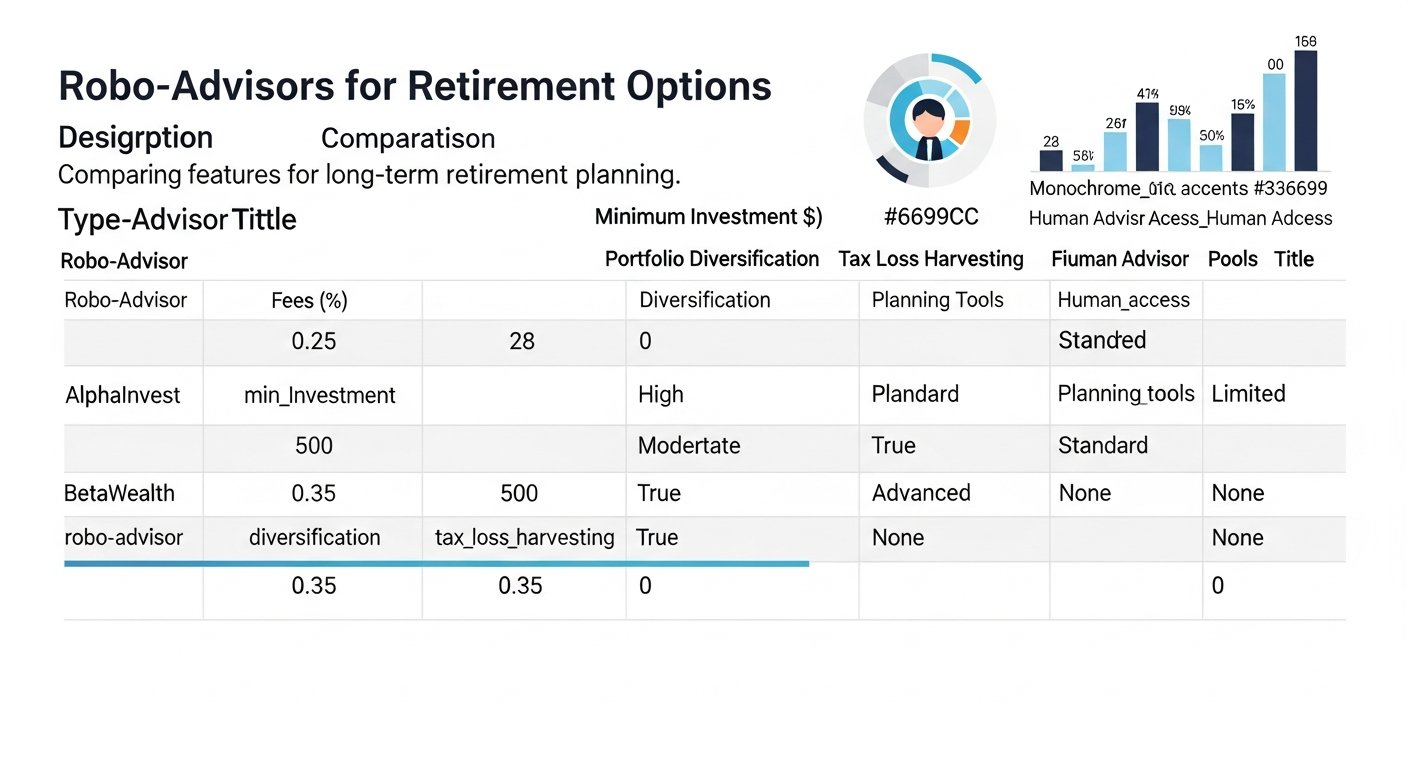
Here’s a quick comparison of some of the top robo-advisors for retirement planning:
| Robo-Advisor | Minimum to Start | Advisory Fee (AUM) | Human Advisor Access | Tax-Loss Harvesting | Retirement Account Support | Notable Feature |
|---|---|---|---|---|---|---|
| Vanguard Digital Advisor | $3,000 | 0.15% (first $50k) | Premium Tier Only | Yes (for taxable accounts) | IRA, Rollover IRA, Taxable | Extremely low fees with Vanguard’s ETFs |
| Fidelity Go | $0 ($0 advisory fee under $25k) | 0.35% (over $25k) | Limited phone/chat | No | IRA, Rollover IRA, Taxable | No advisory fee for smaller balances |
| Schwab Intelligent Portfolios | $5,000 | $0 (Premium: $30/month + $300 one-time) | Premium Tier Only (CFP) | Yes (for taxable accounts) | IRA, Rollover IRA, Taxable | No advisory fee (cash drag consideration) |
| Betterment | $0 | 0.25% (Digital), 0.40% (Premium) | Premium Tier (CFP team) | Yes (for taxable accounts) | IRA, Rollover IRA, SEP IRA, Taxable | Goal-based planning, advanced TLH |
| Wealthfront | $500 | 0.25% | No direct human advice | Yes (advanced, daily TLH) | IRA, Rollover IRA, SEP IRA, Taxable | Automated financial planning suite, Cash Account |
| Empower (Advisory) | $100,000 | 0.89% (for up to $1M) | Dedicated CFP | Yes | IRA, 401(k) Guidance, Trust, Taxable | Free financial dashboard, holistic planning |
| M1 Finance | $100 (invest), $500 (IRA) | $0 (M1 Plus: $125/year for advanced features) | No | No (but custom pies) | IRA, Rollover IRA, SEP IRA, Taxable | “Pies” for custom portfolio automation |
Note: Fees and features are subject to change. Always verify current offerings directly with the provider.
Setting Up Your Retirement Portfolio with a Robo-Advisor
The process of initiating your retirement journey with a robo-advisor is designed to be straightforward, yet it involves crucial steps to ensure your investments are appropriately aligned with your long-term goals. Here’s a practical guide to getting started.
Assessing Your Risk Tolerance and Time Horizon
This is arguably the most critical initial step. When you sign up for a robo-advisor, you’ll be prompted to complete a questionnaire. Be honest and thoughtful in your responses, as they directly influence your portfolio’s asset allocation:
- Risk Tolerance: This measures your comfort level with market fluctuations. Can you stomach significant drops in value for potentially higher long-term gains, or do you prefer a smoother, albeit potentially slower, growth trajectory? Factors like your personality, financial stability, and emotional resilience play a role.
- Time Horizon: This refers to the number of years until you plan to retire and begin drawing on your investments. For someone 30 years old planning to retire at 65, the time horizon is 35 years, allowing for a more aggressive, growth-oriented portfolio. Someone five years from retirement would have a much shorter time horizon, necessitating a more conservative approach
Robo-Advisors for Retirement: Your Essential Guide to Automated Investing in 2026
Affiliate disclosure: This article may contain affiliate links. Recommendations are independent and editorially driven.
Planning for retirement is arguably one of the most critical financial endeavors an individual undertakes. The traditional landscape of retirement planning often involved complex spreadsheets, hourly fees for human financial advisors, and a significant amount of self-education to navigate market intricacies. However, the advent of financial technology, or fintech, has revolutionized how we approach long-term savings. Among these innovations, robo-advisors for retirement have emerged as powerful, accessible, and often more affordable tools, democratizing sophisticated investment strategies for a broader audience.
In 2026, the notion of retirement is evolving. People are living longer, healthcare costs are rising, and the traditional pension system is largely a relic of the past for many. This shift places a greater onus on individuals to proactively manage their retirement nest egg. This is where robo-advisors step in, offering an automated, data-driven approach to investment management that can help you build and maintain a robust portfolio tailored to your unique retirement goals.
This comprehensive guide from fin3go will delve deep into the world of robo-advisors, specifically through the lens of retirement planning. We will explore what they are, how they work, their myriad benefits, and potential drawbacks. We’ll compare leading platforms, discuss how to choose the right one for your needs, and outline strategies to maximize your retirement savings. Whether you’re just starting your career or nearing your golden years, understanding how robo-advisors can integrate into your financial strategy is crucial for a secure and prosperous future.
Understanding Robo-Advisors: A Primer for Retirement Planners
Before diving into the specifics of using robo-advisors for retirement, it’s essential to grasp the fundamental concepts of what a robo-advisor is and how this technology has reshaped the financial advisory landscape.
What is a Robo-Advisor?
At its core, a robo-advisor is a digital platform that provides automated, algorithm-driven financial planning services with little to no human supervision. These platforms leverage advanced algorithms and machine learning to construct, manage, and rebalance investment portfolios based on a client’s specific financial goals, risk tolerance, and time horizon. The process typically begins with an online questionnaire designed to gather crucial information about your financial situation, investment objectives, and comfort level with risk.
Based on your responses, the robo-advisor recommends and then automatically manages a diversified portfolio, often consisting of low-cost exchange-traded funds (ETFs) and mutual funds. These investments typically span various asset classes, including stocks, bonds, real estate investment trusts (REITs), and sometimes even alternative investments, providing broad market exposure and inherent diversification.
How Do Robo-Advisors Work?
The operational mechanism of a robo-advisor is deceptively simple yet incredibly powerful. Here’s a breakdown of the typical workflow:
- Onboarding Questionnaire: You start by answering a series of questions about your age, income, existing assets, debts, financial goals (e.g., retirement, buying a home, saving for college), investment time horizon, and your emotional response to market fluctuations (risk tolerance).
- Portfolio Recommendation: The platform’s algorithm processes this data to recommend an appropriate investment portfolio. This portfolio is designed to align with your risk profile – aggressive for those comfortable with higher risk and longer time horizons, or conservative for those nearing retirement or with lower risk tolerance.
- Account Funding: Once you accept the recommended portfolio, you link your bank account to fund your investment account. Most robo-advisors allow for recurring deposits, which is a key feature for consistent retirement savings.
- Automated Investing: Your funds are automatically invested into the selected ETFs or mutual funds. The underlying principle is often rooted in Modern Portfolio Theory (MPT), which emphasizes diversification to maximize returns for a given level of risk.
- Ongoing Management and Rebalancing: This is where the “robo” truly shines. The platform continuously monitors your portfolio. Over time, market movements can cause your asset allocation to drift from its target. Robo-advisors automatically rebalance your portfolio, selling assets that have performed well and buying those that have underperformed, bringing it back to your desired allocation without any manual intervention from you.
- Tax-Loss Harvesting (for taxable accounts): Many advanced robo-advisors also offer automated tax-loss harvesting, a strategy where investments sold at a loss are used to offset capital gains and even a limited amount of ordinary income, potentially lowering your tax bill. While less critical for tax-advantaged retirement accounts, it can still play a role in supplementary taxable savings.
The Evolution of Digital Wealth Management
Robo-advisors first gained prominence in the early 2010s, primarily as a disruptive force challenging traditional financial advisory models. Initially, they were perceived as solutions for younger, tech-savvy investors with smaller account balances. However, as the technology matured and platforms added more sophisticated features, their appeal broadened significantly. Today, they cater to a wide spectrum of investors, including those with substantial assets and complex retirement planning needs. The growth of fintech has made professional-grade investment management accessible, moving it from exclusive boardrooms to personal devices.
Key Benefits of Robo-Advisors for Retirement
For individuals focusing on retirement, robo-advisors offer several compelling advantages:
- Cost-Effectiveness: Typically, robo-advisors charge lower management fees (often 0.25% to 0.50% of assets under management) compared to human advisors (who might charge 1% or more, or flat fees). Over decades of retirement saving, these lower fees can translate into significantly larger nest eggs.
- Accessibility: They often have low or no minimum investment requirements, making professional investing accessible to individuals who are just starting to save for retirement.
- Automation and Discipline: The automated rebalancing and consistent investment strategy help investors avoid emotional decisions during market volatility, ensuring their portfolio stays on track for their long-term goals.
- Diversification: By investing in broad-market ETFs and mutual funds, robo-advisors inherently provide diversification across different asset classes, geographies, and industries, reducing single-stock risk.
- Tax Efficiency: Automated tax-loss harvesting, where applicable, can enhance after-tax returns, particularly beneficial for taxable accounts supplementing retirement savings.
Potential Drawbacks to Consider
While advantageous, robo-advisors are not without their limitations:
- Limited Human Interaction: For those who prefer personalized, one-on-one advice for complex financial situations (e.g., estate planning, business succession), pure robo-advisors might fall short. However, hybrid models now offer access to human advisors.
- Less Customization: While portfolios are tailored to your risk profile, they generally offer less customization than working with a human advisor who can incorporate unique circumstances or specific investment preferences.
- No Holistic Financial Planning (pure robos): Some basic robo-advisors focus solely on investment management and may not offer comprehensive financial planning encompassing budgeting, debt management, insurance, or estate planning. More advanced platforms are integrating these features.
- Lack of Behavioral Coaching: A human advisor can provide psychological support during market downturns, preventing impulsive decisions. Robos, by their nature, cannot offer this direct emotional coaching.
Weighing these pros and cons is crucial as you consider incorporating robo-advisors into your retirement strategy, especially as your financial life becomes more intricate.
[INLINE IMAGE 1: place after second H2 | alt=”robo-advisors for retirement concept illustration”]
Why Choose Robo-Advisors for Your Retirement Goals?
The decision to utilize robo-advisors for retirement planning is often driven by a confluence of practical, financial, and psychological factors. In a rapidly evolving economic landscape, their unique value proposition addresses many common challenges faced by modern savers.
Accessibility and Low Barriers to Entry
One of the most transformative aspects of robo-advisors is their unprecedented accessibility. Historically, professional financial advice was often reserved for individuals with substantial assets, requiring minimums of $100,000 or more. Robo-advisors have shattered this barrier, with many platforms requiring minimal or even no initial deposit to open an account. This makes sophisticated, diversified investing available to young professionals, those just starting their careers, or individuals with limited savings who might otherwise feel priced out of quality financial guidance. For retirement, this means even small, consistent contributions from an early age can be professionally managed, harnessing the power of compound interest over decades.
Cost-Effectiveness: Lower Fees, Higher Savings
The cost savings associated with robo-advisors are perhaps their most widely celebrated benefit. Traditional financial advisors typically charge an annual fee ranging from 0.8% to 1.5% of assets under management (AUM), sometimes more. Robo-advisors, on the other hand, often charge between 0.25% and 0.50% AUM. While these percentages may seem small, the difference compounds dramatically over the 30-40 years of a typical retirement saving timeline. For example, an investor with $500,000 might save an extra $2,500 to $5,000 annually in fees, which could translate into hundreds of thousands of dollars more in their retirement account by the time they retire. These savings directly contribute to a larger nest egg, allowing for a more comfortable retirement.
Diversification and Risk Management
A cornerstone of prudent retirement planning is diversification. Putting all your eggs in one basket, or even a few, exposes your retirement savings to undue risk. Robo-advisors excel at building globally diversified portfolios across various asset classes (e.g., U.S. equities, international equities, developed market bonds, emerging market bonds, real estate). They typically use low-cost ETFs and mutual funds to achieve this broad exposure efficiently. Furthermore, their algorithms are designed to align your portfolio’s risk level with your stated risk tolerance and time horizon. As you age and approach retirement, the algorithms can automatically shift your asset allocation from more aggressive (higher stock exposure) to more conservative (higher bond exposure), a strategy known as “glide path” investing, ensuring your portfolio’s risk profile remains appropriate for your stage of life.
Automation and Rebalancing for Hands-Off Investing
The “robo” in robo-advisor implies automation, and this is a significant advantage for long-term retirement planning. One of the biggest challenges for individual investors is maintaining their desired asset allocation. Market fluctuations inevitably cause some assets to grow faster than others, leading to portfolio drift. An equity-heavy portfolio might become even more so during a bull market, or a bond-heavy portfolio might lose its balance during a fixed-income rally. Manually rebalancing requires discipline and action. Robo-advisors automatically rebalance your portfolio at predetermined intervals or when certain thresholds are met, ensuring your investments consistently reflect your risk tolerance and financial goals without any effort on your part. This hands-off approach is invaluable for busy individuals who prefer to set it and forget it, while still benefiting from professional management.
Emotional Discipline in Investing
Human psychology is often the biggest enemy of successful long-term investing. During market downturns, panic can lead investors to sell low, locking in losses and missing subsequent rebounds. Conversely, during bull markets, euphoria can lead to overly aggressive investing. Robo-advisors remove the emotional component from investment decisions. They adhere strictly to the predetermined investment strategy, rebalancing and staying the course regardless of market sentiment. This algorithmic discipline can lead to significantly better long-term returns compared to emotionally driven human decisions, which is particularly critical for the multi-decade horizon of retirement savings.
Tax Efficiency Strategies (Tax-Loss Harvesting)
For individuals utilizing taxable brokerage accounts to supplement their retirement savings (beyond their IRA or 401(k) contributions), tax efficiency is paramount. Many leading robo-advisors offer automated tax-loss harvesting. This strategy involves selling investments that have declined in value to realize a capital loss, which can then be used to offset capital gains and up to $3,000 of ordinary income annually. The proceeds from the sale are then reinvested into a similar, but not identical, investment to maintain market exposure and diversification. This sophisticated technique, often difficult and time-consuming for individual investors, is seamlessly handled by robo-advisors, potentially saving investors thousands of dollars in taxes over their lifetime and allowing those funds to be reinvested for greater growth towards retirement.
These compelling advantages highlight why robo-advisors have become an indispensable tool for anyone serious about building a secure and prosperous retirement future in 2026.
Types of Retirement Accounts Supported by Robo-Advisors
Understanding which retirement accounts robo-advisors can manage is crucial for effectively integrating them into your overall financial plan. While robo-advisors shine in their automated investment management, their utility for retirement planning is magnified by their ability to handle various tax-advantaged accounts.
Traditional IRAs and Roth IRAs
Individual Retirement Arrangements (IRAs) are a cornerstone of personal retirement savings. Robo-advisors are exceptionally adept at managing both Traditional and Roth IRAs. These accounts offer significant tax benefits, and robo-advisors can help you optimize your investment strategy within them:
- Traditional IRA: Contributions are often tax-deductible in the year they are made, and investments grow tax-deferred until retirement, when withdrawals are taxed as ordinary income. Robo-advisors help you invest these pre-tax dollars into a diversified portfolio, automatically rebalancing to keep it aligned with your risk profile and time horizon.
- Roth IRA: Contributions are made with after-tax dollars, but qualified withdrawals in retirement are entirely tax-free. This offers immense benefits, particularly for younger investors who anticipate being in a higher tax bracket in retirement. Robo-advisors manage the investments within your Roth IRA, ensuring your after-tax contributions are working as hard as possible towards a tax-free future.
For both Traditional and Roth IRAs, the automated nature of robo-advisors ensures consistent investing and disciplined management, crucial for long-term growth within these vital retirement vehicles.
401(k) Rollovers and Other Employer-Sponsored Plans
While robo-advisors cannot directly manage an active 401(k) plan (as these are employer-sponsored), they become incredibly valuable when you change jobs. When you leave an employer, you typically have several options for your old 401(k) balance:
- Leave it with your former employer (if allowed).
- Cash it out (generally not recommended due to taxes and penalties).
- Roll it over into your new employer’s 401(k).
- Roll it over into an IRA.
It is this last option, the 401(k) rollover into an IRA (often referred to as a “rollover IRA”), where robo-advisors excel. Many individuals prefer rolling over their old 401(k) into an IRA managed by a robo-advisor because it offers:
- More Investment Options: Employer-sponsored plans often have a limited menu of investment choices. An IRA managed by a robo-advisor typically provides access to a much wider array of low-cost ETFs and diversified portfolios.
- Lower Fees: The expense ratios of funds within employer plans can sometimes be higher, and administrative fees might apply. Robo-advisors generally offer lower overall costs.
- Consolidation: Rolling multiple old 401(k)s into a single IRA makes it easier to track and manage your retirement savings.
Some robo-advisors also offer guidance or tools to help you manage your existing 401(k) by analyzing your current plan’s investment options and recommending the best choices within that limited selection, though they can’t directly manage the account.
Taxable Brokerage Accounts (as Supplementary Retirement Savings)
While IRAs and 401(k)s are primary retirement vehicles, many individuals also use taxable brokerage accounts to save extra for retirement, especially if they’ve maxed out their tax-advantaged contributions. Robo-advisors can manage these accounts just as effectively. For taxable accounts, the sophisticated tax-loss harvesting capabilities offered by many robo-advisors become a significant advantage. By strategically realizing losses to offset gains, they can enhance your after-tax returns, allowing more of your investment growth to contribute to your overall retirement wealth.
SEP IRAs and SIMPLE IRAs for Small Business Owners
Small business owners and self-employed individuals also have excellent options through robo-advisors. Robo-advisors can manage:
- SEP IRA (Simplified Employee Pension IRA): This is a retirement plan for self-employed individuals and small business owners. It allows for much higher contribution limits than a Traditional or Roth IRA. Robo-advisors can manage these accounts, providing a hands-off approach to investing these substantial contributions.
- SIMPLE IRA (Savings Incentive Match Plan for Employees IRA): Another retirement plan designed for small businesses, offering both employee and employer contributions. While slightly more complex, some robo-advisors can accommodate SIMPLE IRA investments.
These plans enable business owners to save significantly for their own retirement and often for their employees, with robo-advisors simplifying the investment management aspect.
Trust Accounts for Estate Planning (some advanced platforms)
For individuals with more complex estate planning needs, some advanced robo-advisors and hybrid platforms are beginning to offer management of trust accounts. While not universally available, this shows the growing sophistication of these platforms, extending their utility beyond basic personal retirement accounts to more intricate wealth management strategies.
The flexibility of robo-advisors to handle a diverse range of retirement accounts makes them a versatile and powerful tool for nearly any individual looking to automate and optimize their long-term savings strategy.
Key Features to Look For in a Retirement Robo-Advisor
Choosing the right robo-advisor for your retirement savings is a critical decision. With a growing number of platforms available in 2026, understanding the key features and differentiators can help you select one that perfectly aligns with your financial goals, risk tolerance, and personal preferences.
Investment Philosophy and Portfolio Construction
Different robo-advisors employ varying investment philosophies. Most are rooted in Modern Portfolio Theory (MPT) and passively invest in diversified, low-cost ETFs. However, some distinctions exist:
- Diversification Breadth: How broadly diversified are the portfolios? Do they include U.S. and international stocks, bonds, real estate (via REITs), and potentially commodities or other alternatives?
- Asset Allocation Models: How do they determine your initial asset allocation, and how does it adjust over time? Look for platforms that offer “glide path” investing, gradually shifting to more conservative allocations as you approach retirement.
- Specific ETFs/Funds: While most use low-cost ETFs, some platforms might favor specific fund providers (e.g., Vanguard’s own ETFs) or offer a curated selection.
- Socially Responsible Investing (SRI) / ESG Options: If investing according to your values is important, check if the robo-advisor offers portfolios focused on environmental, social, and governance (ESG) factors.
- Thematic Investing: A few platforms offer specialized thematic portfolios (e.g., clean energy, disruptive technology), though these are generally considered supplementary rather than core retirement investments.
Understand the underlying philosophy to ensure it aligns with your long-term investment beliefs.
Fee Structure: Management Fees, Expense Ratios, Hidden Costs
Fees are one of the most impactful factors on your retirement nest egg over decades. It’s crucial to understand the full cost:
- Management Fee: This is the annual percentage charged by the robo-advisor for managing your portfolio (e.g., 0.25% – 0.50% AUM). Some platforms might have tiered fees, with lower percentages for larger balances.
- Expense Ratios of Underlying ETFs/Funds: This is the cost charged by the fund providers themselves, separate from the robo-advisor’s management fee. Robo-advisors typically use ETFs with very low expense ratios (e.g., 0.03% – 0.20%), but these still add up. Always consider the combined cost.
- Trading Fees: Most robo-advisors offer commission-free trading for the ETFs they use, but always verify.
- Account Transfer Fees: Be aware of potential fees for transferring funds out of the platform if you decide to move your account later.
Always seek transparency in fees. Lower fees generally mean more money stays invested and compounds for your retirement.
Account Minimums and Funding Options
Consider the minimum initial investment required, as well as any minimums for subsequent deposits. This is particularly important for those just starting their retirement savings journey. Some platforms have no minimums, making them highly accessible, while others might require $500, $5,000, or even more. Also, check for flexible funding options, such as automated recurring deposits (crucial for consistent retirement saving) and easy links to external bank accounts.
Financial Planning Tools and Projections
A good robo-advisor for retirement should offer more than just investment management. Look for robust financial planning tools:
- Retirement Calculators and Projectors: Tools that help you visualize your retirement readiness, project your future account balance, and estimate how much income your savings will provide.
- Goal-Based Planning: The ability to set specific retirement goals (e.g., “retire at 65 with $2 million”) and track progress towards them.
- “What If” Scenarios: Tools that let you model the impact of different contributions, market returns, or retirement ages on your projected outcomes.
- Spending Analysis: Some platforms integrate with external accounts to provide a holistic view of your finances, including spending and budgeting, which indirectly supports retirement savings.
Access to Human Advisors (Hybrid Models)
For many, the ideal solution for retirement planning lies in a hybrid model – the efficiency and low cost of automation combined with the personalized touch of a human financial advisor. If you anticipate needing guidance on complex topics like estate planning, insurance, concentrated stock positions, or simply want a sounding board for major financial decisions, look for platforms that offer:
- Advisor Access: Is it unlimited, or appointment-based?
- Advisor Qualifications: Are they Certified Financial Planners (CFPs)?
- Cost of Access: Is it included in the standard management fee, or is there an additional charge?
Hybrid models can provide peace of mind and expert guidance when pure automation isn’t enough.
Tax-Loss Harvesting and Other Advanced Strategies
While often associated with taxable accounts, these strategies can indirectly benefit your overall retirement wealth by optimizing non-retirement savings. Automated tax-loss harvesting is a significant value-add. Other advanced features might include:
- Smart Rebalancing: Beyond simple rebalancing, some platforms optimize for tax implications during rebalancing.
- Direct Indexing: For very large accounts, some platforms offer direct indexing, which can provide enhanced tax-loss harvesting opportunities.
- Portfolio Lines of Credit: A few platforms offer lines of credit against your investment portfolio, which can be useful for liquidity needs without selling investments (though this comes with its own risks).
Customer Support and User Experience
Even with automated platforms, good customer support is vital. Check for:
- Availability: Phone, email, chat support, and hours of operation.
- Responsiveness: How quickly do they address issues or questions?
- Educational Resources: Does the platform offer articles, webinars, or tools to help you become a more informed investor?
- Intuitive Interface: A clean, easy-to-navigate dashboard and mobile app can significantly enhance your experience.
Security and Regulatory Compliance
Your retirement savings are paramount, so security is non-negotiable. Ensure the robo-advisor is:
- SIPC Insured: Your investments should be protected up to $500,000 by the Securities Investor Protection Corporation (SIPC) against the failure of the brokerage firm (though not against market losses).
- SEC Registered: They should be registered with the U.S. Securities and Exchange Commission (SEC) and subject to regulatory oversight.
- Robust Data Security: Look for features like two-factor authentication, encryption, and other cybersecurity measures to protect your personal and financial information.
By carefully evaluating these features, you can confidently select a robo-advisor that will serve as a strong partner in achieving your retirement dreams.
[INLINE IMAGE 2: place after fourth H2 | alt=”robo-advisors for retirement comparison illustration”]
Top Robo-Advisors for Retirement Planning in 2026
The market for robo-advisors has matured significantly, offering a diverse range of platforms suitable for various investor needs, especially those focused on retirement. In 2026, several key players stand out for their features, cost-effectiveness, and suitability for long-term retirement planning. This section provides an overview of leading robo-advisors and includes a comparison table to help you make an informed decision.
Vanguard Digital Advisor
As a pioneer in low-cost investing, Vanguard’s robo-advisor offering, Vanguard Digital Advisor, is a natural choice for many retirement savers. Leveraging Vanguard’s proprietary ETFs, it focuses on extreme cost-efficiency. It offers goal-based planning for retirement, wealth accumulation, and even debt management. While primarily algorithmic, it does offer access to human advisors at a slightly higher tier. Its fee structure is among the lowest in the industry, making it highly attractive for those prioritizing cost over extensive human interaction. Vanguard’s strong reputation for indexing and long-term investing aligns perfectly with retirement goals.
Fidelity Go
Fidelity Go caters to a wide range of investors, offering professionally managed portfolios with no advisory fee for balances under $25,000, and a flat 0.35% for balances over that amount. This fee covers both advisory services and the underlying Fidelity Flex® mutual funds, which have no expense ratios. Fidelity Go provides a user-friendly experience and integrates seamlessly with other Fidelity accounts, making it a strong contender for those already banking or investing with Fidelity. Its portfolios are built using a mix of Fidelity’s own funds and iShares ETFs, optimized for broad market exposure and diversification.
Schwab Intelligent Portfolios
Schwab Intelligent Portfolios stands out by offering commission-free investing with no advisory fees. This sounds too good to be true, but Schwab generates revenue through cash allocations in portfolios and by offering their own proprietary ETFs. While attractive, the cash allocation can sometimes be higher than other robo-advisors, which could slightly drag down returns in strong bull markets. However, for those seeking robust diversification and significant cost savings, it’s a compelling option. Schwab Intelligent Portfolios Premium offers unlimited access to Certified Financial Planners (CFPs) for a monthly subscription fee, providing a strong hybrid model for more complex retirement planning needs.
Betterment
Betterment is one of the original independent robo-advisors and continues to be a leader in the space. It offers sophisticated features like automated tax-loss harvesting (for taxable accounts), diversified portfolios using low-cost ETFs, and goal-based planning. Betterment’s core offering, Digital, charges 0.25% AUM and includes personalized advice on financial decisions. Its Premium tier, at 0.40% AUM, provides unlimited phone and email access to a team of Certified Financial Planners for more personalized guidance, making it a strong hybrid choice for retirement savers with evolving needs.
Wealthfront
Wealthfront is another highly regarded independent robo-advisor, known for its advanced features and a focus on comprehensive financial planning. It offers sophisticated tax-loss harvesting (including daily TLH), direct indexing for larger taxable accounts, and a compelling cash management account with a competitive interest rate. Wealthfront charges a flat 0.25% AUM. While it does not offer direct access to human advisors in the same way Betterment or Schwab Premium does, its detailed financial planning tools, including retirement planning and college savings projections, are incredibly robust and cater to proactive users who prefer a highly automated and optimized experience.
Empower (formerly Personal Capital)
Empower offers a unique blend of free financial tracking tools and paid human-advised wealth management services. While its primary service for balances over $100,000 is a hybrid model with dedicated human advisors, its free dashboard is an invaluable tool for retirement planning. It allows users to link all their financial accounts (401ks, IRAs, bank accounts, credit cards) to get a holistic view of their net worth, analyze their portfolio for fees and diversification, and project their retirement readiness. For those who want active human guidance alongside sophisticated digital tools, Empower’s paid advisory service (starting at 0.89% for assets up to $1 million) is a strong option.
Other Notable Platforms
- M1 Finance: A unique platform that combines automated investing with DIY flexibility. Investors create “Pies” (custom portfolios) of stocks and ETFs, and M1 Finance automatically rebalances and invests new deposits according to these Pies. It’s commission-free and has no management fees for its basic service, making it highly appealing for those who want more control over their investments while still benefiting from automation.
- Ellevest: Tailored specifically for women, Ellevest offers personalized portfolios, goal-based planning, and coaching, considering factors like women’s longer lifespans and unique career trajectories.
- Axos Invest (formerly WiseBanyan): One of the few truly free robo-advisors, with no management fees. It focuses on basic diversified portfolios and is ideal for beginners with small balances.
Explore more detailed reviews of robo-advisors and their features.
Comparison Table: Leading Robo-Advisors for Retirement in 2026
Here’s a quick comparison of some of the top robo-advisors for retirement planning:
Robo-Advisor Minimum to Start Advisory Fee (AUM) Human Advisor Access Tax-Loss Harvesting Retirement Account Support Notable Feature Vanguard Digital Advisor $3,000 0.15% (first $50k) Premium Tier Only Yes (for taxable accounts) IRA, Rollover IRA, Taxable Extremely low fees with Vanguard’s ETFs Fidelity Go $0 ($0 advisory fee under $25k) 0.35% (over $25k) Limited phone/chat No IRA, Rollover IRA, Taxable No advisory fee for smaller balances Schwab Intelligent Portfolios $5,000 $0 (Premium: $30/month + $300 one-time) Premium Tier Only (CFP) Yes (for taxable accounts) IRA, Rollover IRA, Taxable No advisory fee (cash drag consideration) Betterment $0 0.25% (Digital), 0.40% (Premium) Premium Tier (CFP team) Yes (for taxable accounts) IRA, Rollover IRA, SEP IRA, Taxable Goal-based planning, advanced TLH Wealthfront $500 0.25% No direct human advice Yes (advanced, daily TLH) IRA, Rollover IRA, SEP IRA, Taxable Automated financial planning suite, Cash Account Empower (Advisory) $100,000 0.89% (for up to $1M) Dedicated CFP Yes IRA, 401(k) Guidance, Trust, Taxable Free financial dashboard, holistic planning M1 Finance $100 (invest), $500 (IRA) $0 (M1 Plus: $125/year for advanced features) No No (but custom pies) IRA, Rollover IRA, SEP IRA, Taxable “Pies” for custom portfolio automation Note: Fees and features are subject to change. Always verify current offerings directly with the provider.
Setting Up Your Retirement Portfolio with a Robo-Advisor
The process of initiating your retirement journey with a robo-advisor is designed to be straightforward, yet it involves crucial steps to ensure your investments are appropriately aligned with your long-term goals. Here’s a practical guide to getting started.
Assessing Your Risk Tolerance and Time Horizon
This is arguably the most critical initial step. When you sign up for a robo-advisor, you’ll be prompted to complete a questionnaire. Be honest and thoughtful in your responses, as they directly influence your portfolio’s asset allocation:
- Risk Tolerance: This measures your comfort level with market fluctuations. Can you stomach significant drops in value for potentially higher long-term gains, or do you prefer a smoother, albeit potentially slower, growth trajectory? Factors like your personality, financial stability, and emotional resilience play a role.
- Time Horizon: This refers to the number of years until you plan to retire and begin drawing on your investments. For someone 30 years old planning to retire at 65, the time horizon is 35 years, allowing for a more aggressive, growth-oriented portfolio. Someone five years from retirement would have a much shorter time horizon, necessitating a more conservative approach