


Self-Employment Tax vs. Income Tax Explained: A 2026 Guide to Keeping More of Your Money
By Fin3go Editorial Team — Financial writers covering personal finance, banking, and consumer protection.
Transitioning from a traditional W-2 job to the world of self-employment is an exhilarating milestone. Whether you are launching a freelance consulting business, driving for a ride-share app, or scaling a boutique e-commerce brand, you are finally the captain of your own ship. However, that newfound freedom comes with a significant shift in how the IRS views your earnings. For most new entrepreneurs, the first “tax season” provides a jarring wake-up call: the dreaded “double tax.” While W-2 employees only see a portion of their taxes deducted from their paychecks, self-employed individuals are responsible for both the employee and employer portions of Social Security and Medicare, on top of standard federal and state income taxes.
Understanding the nuance between self-employment tax and income tax is not just about compliance; it is about survival and profitability. Without a clear strategy, you could inadvertently lose nearly 40% of your gross revenue to various tax authorities. In this comprehensive guide, we will break down the mechanics of these taxes using 2026 projections, provide actionable strategies to lower your liability, and help you navigate the quarterly payment system so you can focus on what you do best—growing your business.
1. The Dual Tax Burden: Defining the Difference
To master your finances, you must first distinguish between the two distinct taxes you owe on your business profit.
**Income Tax** is the progressive tax everyone pays on their total annual earnings. Whether you earn money from a salary, dividends, or business profits, it all gets lumped into your total taxable income. Your income tax rate depends on your “bracket,” which ranges from 10% to 37% (depending on the legislative landscape in 2026). This tax funds general government operations, from infrastructure to national defense.
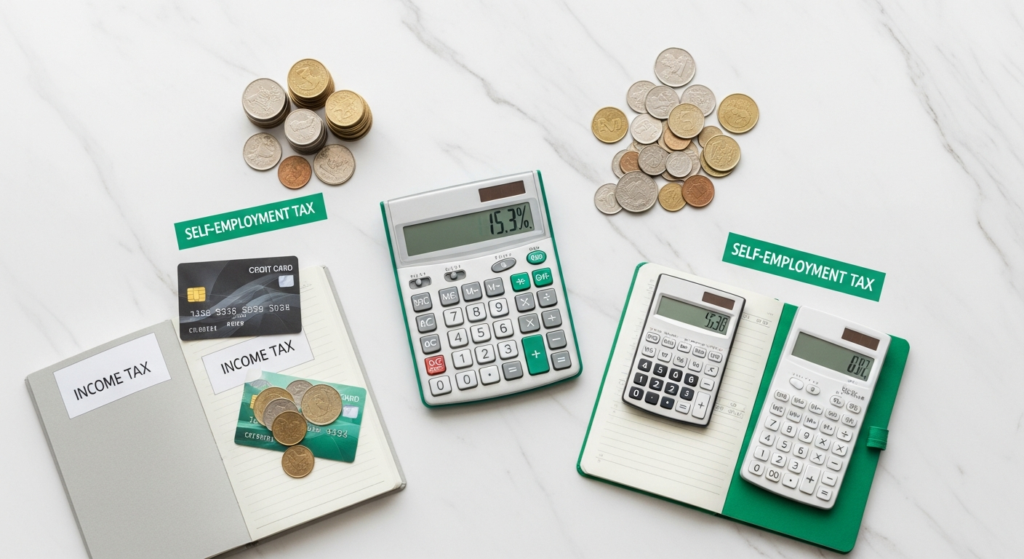
**Self-Employment (SE) Tax**, on the other hand, is specifically designed to cover your contributions to Social Security and Medicare. When you work for a company, your employer pays half of these taxes (7.65%), and you pay the other half via payroll deduction. When you are the boss, the IRS views you as both the employer and the employee. Therefore, you are responsible for the full 15.3% SE tax rate. This tax is calculated on your *net* business profit, not your gross revenue.
**Actionable Tip:** Always set aside 25-30% of every payment you receive into a high-yield savings account. This “tax bucket” ensures you aren’t scrambling for cash when the IRS comes calling.
2. Breaking Down the 15.3%: The Math of SE Tax in 2026
As of 2026, the self-employment tax rate remains a combined 15.3%. Here is the breakdown:
* **12.4% for Social Security:** This applies to the first $170,000+ of your earnings (this “wage base” typically increases annually with inflation; by 2026, it is projected to be significantly higher than previous years).
* **2.9% for Medicare:** This applies to all of your net earnings, with no cap.
It is important to note that the IRS offers a small “consolation prize.” You only pay SE tax on 92.35% of your net earnings. Furthermore, you can deduct 50% of your total self-employment tax from your gross income when calculating your federal income tax. This “above-the-line” deduction effectively lowers your total income tax bill.
**Real-World Example:**
Imagine you are a freelance graphic designer in 2026 with a net profit of $100,000.
1. **Calculate SE Taxable Income:** $100,000 x 0.9235 = $92,350.
2. **Calculate SE Tax:** $92,350 x 15.3% = **$14,129.55**.
3. **Income Tax Deduction:** You get to deduct $7,064.77 (half of your SE tax) from your $100,000 income before you even start calculating your federal income tax brackets.
3. Federal Income Tax Brackets: The Progressive Climb
While the SE tax is a relatively flat 15.3%, federal income tax is progressive. This means as you earn more, the “next dollar” you earn is taxed at a higher rate. In 2026, many tax professionals are watching for the potential expiration of the Tax Cuts and Jobs Act (TCJA) provisions, which could see a return to higher individual rates (e.g., the 12% bracket returning to 15%, or the 22% bracket returning to 25%).
Regardless of the specific percentages, the strategy remains the same: **Lower your Adjusted Gross Income (AGI).**
Your AGI is the number the IRS uses to determine your tax bracket. By contributing to a SEP-IRA or a Solo 401(k), you can deduct those contributions directly from your income. For 2026, the contribution limits for a Solo 401(k) are projected to allow for significant tax deferral, often up to $69,000 or more depending on your income level.
**Actionable Tip:** If you expect to be in a higher tax bracket in 2026, consider accelerating business purchases (like a new laptop or software subscriptions) into the current year to reduce your taxable income.
4. Maximizing Schedule C Deductions to Lower Both Taxes
The beauty of being self-employed is that you only pay taxes on your **profit**, not your **revenue**. Every dollar you legitimately spend on your business reduces both your SE tax and your income tax.
To maximize your take-home pay, you must be meticulous with Schedule C deductions. Common overlooked expenses include:
* **Home Office Deduction:** If you use a portion of your home *exclusively* for business, you can deduct a percentage of your rent/mortgage, utilities, and insurance.
* **Health Insurance Premiums:** If you are self-employed and not eligible for a plan through a spouse’s employer, you can often deduct 100% of your health insurance premiums.
* **Education and Subscriptions:** Any courses, books, or software used to maintain or improve your skills in your current trade are fully deductible.
* **Marketing and Advertising:** SEO services, Facebook ads, and even the cost of business cards.
**Practical Example:** If you earn $10,000 in revenue but spend $3,000 on software and advertising, you only pay taxes on $7,000. At a combined tax rate of roughly 30%, those deductions just saved you $900 in actual cash.
5. The Quarterly Estimated Payment System
One of the biggest pitfalls for the self-employed is the “Underpayment Penalty.” The IRS operates on a “pay-as-you-go” system. Since you don’t have an employer withholding taxes for you, you must send the IRS a check four times a year.
The 2026 deadlines for estimated taxes are typically:
* **April 15** (Q1: Jan–March)
* **June 15** (Q2: April–May)
* **September 15** (Q3: June–August)
* **January 15 of the following year** (Q4: Sept–Dec)
To avoid penalties, you generally need to pay at least 90% of your current year’s tax liability or 100% of last year’s tax liability (110% if your AGI was over $150,000). This “Safe Harbor” rule is your best friend. Even if your business explodes and you earn double what you did last year, paying 100% of last year’s total tax bill protects you from penalties.
**Actionable Tip:** Use the “Safe Harbor” method to calculate your payments. Divide your total tax from last year’s return by four and pay that amount each quarter. This keeps you compliant while allowing you to keep extra cash in your business longer.
6. Strategic Entity Structure: The S-Corp Advantage
Once your business reaches a certain level of profitability—usually around $60,000 to $80,000 in net profit—it may be time to consider an S-Corp election.
In a standard Sole Proprietorship, you pay the 15.3% SE tax on the *entirety* of your profit. In an S-Corp, you split your income into two categories:
1. **A Reasonable Salary:** You pay yourself a W-2 salary, on which you pay the 15.3% payroll tax (half as employee, half as employer).
2. **Distributions:** The remaining profit is passed through to you as a distribution, which is **not** subject to the 15.3% self-employment tax.
**Example for 2026:**
If your business clears $120,000 in profit:
* **As a Sole Prop:** You pay 15.3% on nearly the full $120k (approx. $17,000+ in SE tax).
* **As an S-Corp:** You pay yourself a “reasonable salary” of $70,000. You pay the 15.3% tax on that $70k (approx. $10,710). The remaining $50,000 is taken as a distribution. You save roughly $6,000 in SE taxes.
*Note: S-Corps come with higher administrative costs, including payroll processing and more complex tax filings, so ensure the tax savings outweigh the overhead.*
—
FAQ: Navigating Self-Employment Taxes
**Q1: Do I have to pay self-employment tax if my business lost money this year?**
No. Self-employment tax is based on *net profit*. If your business expenses exceeded your income, you have a net loss and do not owe SE tax. In fact, you may be able to use that loss to offset other income (like a spouse’s salary) to lower your overall income tax bill.
**Q2: What is the minimum income threshold to start paying SE tax?**
The threshold is $400. If your net earnings from self-employment are $400 or more, you must file a tax return and pay self-employment tax, even if you are already retired or have another full-time job.
**Q3: Can I deduct my 2026 health insurance even if I don’t itemize?**
Yes. The self-employed health insurance deduction is an “adjustment to income,” not an itemized deduction. You can take this even if you claim the Standard Deduction.
**Q4: Is the 20% Qualified Business Income (QBI) deduction still available in 2026?**
This is a critical question. Under current law, the Section 199A QBI deduction is set to expire at the end of 2025. Unless Congress extends it, self-employed individuals may not have access to this 20% deduction in 2026. This makes finding other deductions and retirement contributions even more vital.
**Q5: How do state taxes factor into this?**
State taxes are separate. Most states do not have a specific “self-employment tax” like the federal government, but they do tax your business profit as personal income. Some states (like California or New York) have specific fees for LLCs or higher tax rates for high earners. Always check your specific state’s 2026 tax tables.
—
Conclusion: Take Control of Your Tax Future
The difference between a struggling freelancer and a thriving entrepreneur often comes down to tax literacy. Understanding that **Self-Employment Tax** is your contribution to the social safety net (Social Security/Medicare) while **Income Tax** is your contribution to the federal budget is the first step.
As you move through 2026, keep these four takeaways in mind:
1. **Track Everything:** Use accounting software to capture every deduction on Schedule C.
2. **The 30% Rule:** Never treat your gross revenue as “your” money. 30% belongs to the government; park it in a separate account immediately.
3. **Optimize Your Entity:** If your profits are consistently high, consult a CPA about switching to an S-Corp to save thousands in SE taxes.
4. **Stay Ahead of Deadlines:** Use the Safe Harbor rule to make quarterly payments and avoid unnecessary penalties and interest.
By treating your taxes as a strategic business expense rather than a seasonal surprise, you ensure that your self-employment journey remains both personally fulfilling and financially sustainable.