


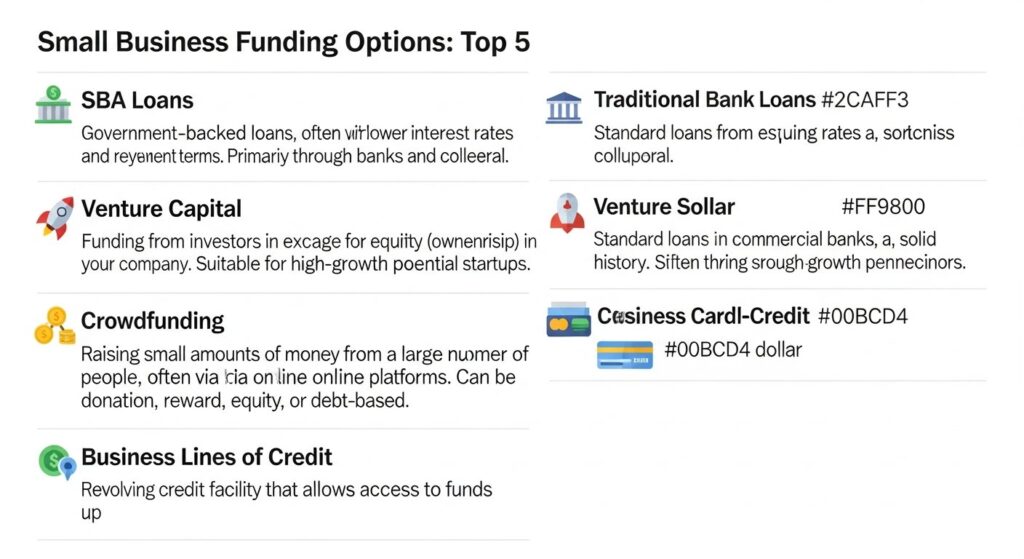
Small Business Funding Options: Your Comprehensive Guide to Securing Capital
Navigating the complex landscape of small business funding options is a critical step for any entrepreneur aiming for sustainable growth and long-term success. From the nascent stages of a startup to the expansion phases of an established enterprise, securing the right capital is paramount. This article aims to demystify the diverse array of financing solutions available, ranging from traditional bank loans and government-backed programs to innovative fintech alternatives and equity investments. The “best” option is rarely universal; instead, it meticulously aligns with your business’s current stage, specific needs, and overarching Personal Financial Planning goals. We will serve as your essential guide to understanding, evaluating, and ultimately selecting the optimal funding path, emphasizing the importance of informed Fintech Management in today’s dynamic financial ecosystem. Making strategic financial decisions at this juncture can significantly impact your business’s financial health and trajectory.
Understanding these choices integrates seamlessly with broader Personal Financial Planning principles, ensuring your business’s financial health contributes positively to your overall wealth management. Key concepts explored include debt financing (traditional, government-backed, alternative), equity financing (dilutive vs. non-dilutive), alternative/niche funding mechanisms, and the crucial role of risk assessment and financial health indicators like your business credit score and cash flow management. We will also highlight how modern Fintech solutions are reshaping access to capital for small businesses.
Summary of Funding Options:
- SBA Loans: Government-Backed Financing
- Business Lines of Credit: Flexible Capital Access
- Traditional Term Loans: Structured Debt Financing
- Venture Capital: High-Growth Equity Investment
- Angel Investors: Early-Stage Equity Partners
- Crowdfunding: Harnessing Collective Power
- Small Business Grants: Non-Dilutive Funding
- Invoice Factoring & Merchant Cash Advances: Fast, Short-Term Capital
1. SBA Loans: Government-Backed Financing
SBA loans are a cornerstone of small business financing, offering favorable terms and lower down payments than many traditional loans. These aren’t direct loans from the government; instead, the Small Business Administration (SBA) guarantees a portion of loans made by banks and other lenders, significantly reducing the risk for the lender. This government backing makes it easier for small businesses to qualify for capital they might not otherwise obtain.
What are SBA Loans?
SBA loans are debt financing options backed by the U.S. Small Business Administration, which sets guidelines for the loans but does not lend money directly. Instead, it reduces risk for lenders, making them more willing to provide capital to small businesses. The primary goal of SBA loan programs is to stimulate economic growth by supporting small businesses, which are vital job creators. These loans typically come with lower interest_rates, longer repayment_periods, and smaller down payments compared to conventional business loans, making them highly attractive.
Eligibility Requirements for SBA Loans
To qualify for an SBA loan, businesses must meet specific criteria designed to ensure they are genuinely “small” and financially viable. Key eligibility_criteria include operating for profit, doing business in the U.S., having reasonable owner equity, and demonstrating a need for the funds. The specific requirements can vary by program (e.g., SBA 7(a), 504, Microloan), but generally, lenders will assess the business’s business credit score, cash flow projections, and the owner’s personal credit history. Collateral requirements exist but are often less stringent than conventional loans, with the SBA typically requiring a personal guarantee from owners.
- For-Profit Business: Must operate as a for-profit entity.
- U.S. Operations: Must be physically located and operate in the United States or its territories.
- Owner Equity: Owners must have invested their own equity into the business.
- Inability to Obtain Credit Elsewhere: The business must demonstrate it cannot obtain financing on reasonable terms from other sources.
- Strong Business Plan: A well-articulated business plan is crucial, detailing how the funds will be used and how repayment will occur.
Pros and Cons of SBA Financing
SBA loans offer numerous advantages but also come with certain trade-offs. Understanding these can aid in your strategic financial decision-making.
- Pros:
- Favorable Terms: Lower interest rates (often prime rate + a margin), longer repayment periods (up to 10 years for working capital, 25 years for real estate), and lower down payments.
- Larger Loan Amounts: Can secure substantial capital, up to $5 million for 7(a) loans.
- Versatile Use: Funds can be used for various purposes, including working capital, equipment purchase, real estate, and refinancing.
- Reduced Risk for Lenders: Government guarantee encourages lenders to approve loans for businesses they might otherwise deem too risky.
- Cons:
- Complex Application Process: The application_process_complexity is generally higher than other loans, requiring extensive documentation and a detailed business plan.
- Longer Approval Times: The speed_of_funding can be slower, often taking weeks or months from application to disbursement.
- Personal Guarantee: Most SBA loans require a personal guarantee from owners, placing personal assets at risk.
- Collateral Requirements: While less stringent, collateral is often required, and a lien may be placed on business assets.
Is an SBA Loan Right for Your Business?
An SBA loan is often an excellent choice for established small businesses with a solid operating history, strong financial health, and a clear need for significant capital that they might struggle to secure through conventional avenues. If your business has good credit, a robust business plan, and patience for the application_process_complexity, the favorable interest_rates and repayment_periods can offer significant financial advantages. However, for startups or businesses needing extremely rapid access to capital, the extended speed_of_funding might be a drawback. It represents a long-term debt financing commitment, so assessing your ability to meet regular payments is crucial for your Personal Financial Planning.
2. Business Lines of Credit: Flexible Capital Access
A business line of credit offers unparalleled flexibility for managing day-to-day operational needs or seizing sudden growth opportunities. Unlike a lump-sum loan, it provides access to a revolving pool of funds up to a certain limit, which businesses can draw upon as needed. This type of financing is particularly beneficial for businesses experiencing fluctuating cash flow or needing a safety net for unexpected expenses, integrating well with proactive Fintech Management strategies for agile capital access.
How Do Business Lines of Credit Work?
A business line of credit functions much like a credit card, but for your business. A lender approves a maximum borrowing amount, and you can draw funds from it, repaying the borrowed amount plus interest_rate. As you repay, the funds become available again, creating a continuous source of accessible capital. Interest is typically only charged on the amount drawn, not the full credit limit, making it a cost-effective solution for short-term liquidity needs. This revolving nature makes it distinct from a traditional term loan, where a lump sum is borrowed and repaid over a fixed schedule.
Key Benefits of a Business Line of Credit
The flexibility of a business line of credit makes it a highly advantageous tool for specific financial scenarios.
- Flexibility: Draw funds as needed, up to your credit limit, and repay them to replenish your available balance. This makes it ideal for managing variable cash flow or unforeseen expenses.
- Cost-Effectiveness: Interest is typically only paid on the amount you borrow, not the entire credit line, reducing the overall cost_of_capital compared to a full loan if you don’t need all the funds immediately.
- Working Capital Management: Excellent for bridging gaps in accounts receivable, covering payroll during slow periods, or managing inventory purchases.
- Fast Access to Funds: Once approved, the speed_of_funding for subsequent draws is usually very fast, often within days or even hours, which is crucial for agile Fintech Management.
- Builds Business Credit: Responsible use and timely repayment can positively impact your business credit score.
Potential Drawbacks and Considerations
While beneficial, lines of credit also have considerations that impact their suitability.
- Variable Interest Rates: Many lines of credit have variable interest_rates, meaning your repayment costs can fluctuate with market changes.
- Risk of Over-Reliance: The ease of access can lead to over-reliance if not managed carefully, potentially accumulating debt.
- Collateral Requirements: While some lines of credit are unsecured, larger limits or lower credit scores may require collateral_requirements, such as accounts receivable or inventory.
- Fees: Lenders may charge annual fees, draw fees, or inactivity fees.
Best Use Cases for a Business Line of Credit
A business line of credit is best suited for scenarios demanding flexibility and short-term capital. Typical typical_use_cases include managing seasonal inventory fluctuations, covering unexpected operational expenses, bridging gaps in accounts receivable, or having a financial safety net. It’s particularly valuable for businesses with predictable cycles but unpredictable timing of income and expenses, enabling robust cash flow management without committing to a long-term loan.
[INLINE IMAGE 1: An infographic comparing the flexibility of a business line of credit (revolving access) vs. a traditional term loan (lump sum, fixed payments).]
3. Traditional Term Loans: Structured Debt Financing
Traditional term loans represent one of the most common and straightforward small business funding options. They involve borrowing a fixed sum of money upfront, which is then repaid over a predetermined repayment_period with regular installments, typically monthly, including both principal and interest_rate. This structured approach offers predictability, making it suitable for significant, one-time investments that align with long-term Personal Financial Planning goals.
Understanding Business Term Loans
A business term loan is a lump-sum financing option provided by banks, credit unions, and some fintech lenders. The loan comes with a fixed or variable interest_rate and a set repayment schedule, often ranging from 1 to 5 years, though longer terms are available for larger assets like real estate. Funds are disbursed all at once, and the business commits to fixed payments over the repayment_period. This type of loan is a clear form of debt financing, requiring no dilution of ownership, contrasting with equity financing like venture capital.
Typical Interest Rates and Repayment Terms
Interest_rates for traditional term loans vary widely based on factors such as the lender, the business’s business credit score, industry, and the loan’s term and amount. They can range from 6% to 30% APR or more, with established businesses with strong credit profiles receiving the most favorable rates. Repayment_periods are typically structured for monthly payments, ensuring predictable cash outflow, which is vital for effective cash flow management. Longer terms result in lower monthly payments but higher overall interest paid. Collateral_requirements are common, often requiring business assets, and a personal guarantee may also be requested.
- Interest Rates: Typically range from 6% to 30% APR, influenced by creditworthiness and loan terms.
- Repayment Terms: Most commonly 1 to 5 years for general purposes, up to 10 years for equipment, and 20-25 years for real estate.
- Payment Frequency: Usually monthly, providing stable and predictable financial obligations.
When to Consider a Term Loan
A traditional term loan is ideal when your business has a clear, one-time need for capital for a specific purpose and can demonstrate a reliable revenue stream to support fixed repayments. Typical_use_cases include purchasing major equipment, financing an expansion project, acquiring another business, or making significant leasehold improvements. It’s suitable for businesses with a stable operating history and good credit, as these factors influence the eligibility_criteria and the interest_rates offered. For businesses prioritizing fixed financial obligations and avoiding equity dilution, a term loan is a strong contender, offering a structured approach to managing business finances.
4. Venture Capital: High-Growth Equity Investment
Venture Capital (VC) is a form of equity financing that typically targets high-growth startups and businesses with significant potential for scalability. Unlike debt financing, VC investors provide capital in exchange for an ownership stake (equity) in the company. This dilutive form of funding can fuel rapid expansion but comes with a shift in ownership and strategic influence. It’s a critical option for businesses looking for more than just money, seeking strategic guidance and industry connections, aligning with ambitious Personal Financial Planning for high-risk, high-reward ventures.
What is Venture Capital?
Venture Capital is a type of private equity financing that is provided by venture capitalists (VCs) to startup companies, small businesses, and growing companies that have been deemed to have high growth potential or which have demonstrated high growth. VCs take an equity stake in the company, becoming partial owners, and often seek a significant return on their investment when the company is eventually sold or goes public (an IPO). It’s a long-term investment that provides not just capital but also mentorship, strategic advice, and access to a broad network, making it a powerful tool for accelerating market penetration and innovation.
The Role of Venture Capital in Business Growth
Venture capital plays a transformative role for businesses capable of rapid scale. VCs provide substantial capital, allowing companies to invest heavily in product development, market expansion, and talent acquisition. Beyond the financial injection, venture capitalists bring expertise, industry connections, and strategic oversight, often taking a board seat. This active involvement can significantly de-risk the growth process for a startup, helping it navigate complex challenges and achieve milestones faster. However, this also means the founders’ control and ownership are diluted, a key consideration for impact_on_ownership.
Pros and Cons of VC Funding
Considering venture capital involves weighing significant benefits against substantial trade-offs, especially concerning equity dilution.
- Pros:
- Significant Capital: Provides substantial capital for rapid growth and expansion that traditional lenders might not offer.
- Expertise and Network: VCs bring invaluable industry knowledge, mentorship, strategic guidance, and access to a vast network of contacts.
- Validation: Securing VC funding can serve as a strong validation of your business model and growth potential, attracting further investment and talent.
- No Debt Repayment: As it’s equity financing, there are no monthly debt payments, easing cash flow burdens in the early stages.
- Cons:
- Dilution of Ownership: The most significant drawback is the dilution of ownership, meaning founders give up a portion of their company.
- Loss of Control: VCs often require board seats and have significant influence over strategic decisions, which can impact founder autonomy.
- High Expectations: VCs expect high returns, typically 5-10x their investment, placing immense pressure on the business for aggressive growth.
- Difficult to Obtain: The application_process_complexity is extremely high, with VCs investing in only a tiny fraction of businesses that pitch them, primarily those with extreme growth potential.
Is Venture Capital Suitable for Your Startup?
Venture capital is primarily suitable for startups and businesses operating in high-growth, scalable markets (e.g., tech, biotech, advanced manufacturing) with a clear path to becoming a large, dominant player. It’s for founders who are comfortable giving up a portion of their company and some control in exchange for significant capital and strategic support to achieve hyper-growth. If your business has a revolutionary product, a huge market opportunity, and a strong, experienced team, VC might be your fastest path to scale. However, if you prioritize full ownership and steady, organic growth, or if your business model isn’t designed for exponential returns, other funding options would be more appropriate. The risk_level for VCs is high, mirroring the high reward they seek.
[INLINE IMAGE 2: A diagram illustrating the venture capital funding stages (Seed, Series A, B, C) and the typical growth trajectory of a startup.]
5. Angel Investors: Early-Stage Equity Partners
Angel investors represent another vital source of equity financing, often serving as the first external capital a startup receives. These individuals, typically wealthy experienced entrepreneurs, provide seed funding in exchange for an ownership stake. Their investments are crucial for early-stage companies that are too nascent for venture capital and often too risky for traditional debt financing, making them valuable partners in the initial phase of your Personal Financial Planning journey for your business.
Who are Angel Investors?
Angel investors are high-net-worth individuals who provide financial backing for small startups or entrepreneurs, typically in exchange for ownership equity in the company. Unlike venture capitalists who manage institutional funds, angels invest their own money. They often have a personal interest in the startup’s success, providing not only capital but also mentorship, industry connections, and strategic advice, drawing on their own entrepreneurial experience. Their involvement can significantly de-risk a startup and open doors to future funding rounds.
Finding and Pitching to Angel Investors
Connecting with angel investors requires strategic networking and a compelling pitch. You can find angels through online platforms (e.g., AngelList, Gust), local angel networks, industry events, incubators, accelerators, and referrals. Your pitch must clearly articulate your business idea, market opportunity, team, and how you plan to achieve significant returns. The application_process_complexity is less formal than VC but requires robust preparation, including a detailed business plan and financial projections. Emphasis should be placed on the problem you’re solving, your unique solution, and your team’s ability to execute.
- Networking: Attend industry events, pitch competitions, and entrepreneurial meetups.
- Online Platforms: Utilize dedicated angel investor platforms and databases.
- Referrals: Seek introductions from mentors, advisors, and other entrepreneurs.
- Compelling Pitch: Clearly articulate your value proposition, market, team, and financial projections.
Angel vs. Venture Capital: Key Differences
While both angels and VCs provide equity financing, they target different stages and have distinct characteristics.
- Stage of Investment: Angels typically invest in the seed or early startup stage when businesses are still developing their product and market fit. VCs generally invest in later stages (Series A, B, C) once a business has demonstrated traction and significant growth potential.
- Investment Size: Angel investments are usually smaller, ranging from tens of thousands to a few million dollars. VC rounds are much larger, often starting at several million and going up to hundreds of millions.
- Source of Funds: Angels invest their personal wealth. VCs manage institutional funds from limited partners.
- Involvement: Both can be involved, but angels often provide more personal, hands-on mentorship, while VCs typically bring more structured strategic oversight and board representation.
- Return Expectations: Both expect high returns, but VCs often have higher, more formalized return thresholds due to the nature of their funds.
6. Crowdfunding: Harnessing Collective Power
Crowdfunding has emerged as a democratic and accessible small business funding option, allowing entrepreneurs to raise capital from a large number of individuals, typically via online platforms. This method bypasses traditional financial institutions, leveraging the collective power of a community or the general public to fund projects, products, or businesses. It’s an innovative approach that often intertwines with marketing and community building, reflecting modern Fintech Management trends.
Types of Crowdfunding for Small Businesses
Crowdfunding is broadly categorized into several types, each with its unique structure and implications for businesses:
- Reward-Based Crowdfunding: The most common type, where individuals contribute money in exchange for a non-financial reward, such as the product itself, early access, or exclusive merchandise. Platforms like Kickstarter and Indiegogo are prominent examples. This is non-dilutive.
- Donation-Based Crowdfunding: Typically used for charitable causes or non-profit projects, where contributions are made with no expectation of financial return or material reward. Less common for for-profit small businesses directly.
- Equity Crowdfunding: This allows businesses to raise capital by selling small equity stakes to a large number of investors, often individuals who are not accredited investors. This is a dilutive option, similar to angel or venture capital, but with a broader investor base. Platforms operate under regulations like Reg CF (Regulation Crowdfunding) in the US.
- Debt Crowdfunding (P2P Lending): Also known as peer-to-peer lending, individuals lend money to businesses with the expectation of repayment plus interest. This is a form of debt financing, similar to a loan but sourced from multiple individuals.
Benefits and Challenges of Crowdfunding
Crowdfunding offers unique advantages, but also presents its own set of hurdles.
- Benefits:
- Access to Capital: Democratizes access to funding, especially for businesses overlooked by traditional lenders or VCs.
- Market Validation: A successful campaign can prove market interest and validate your product or business idea before launch.
- Marketing and Community Building: Campaigns generate buzz and build a loyal customer base early on.
- Flexibility: Different types cater to various business needs (non-dilutive rewards, dilutive equity, debt).
- Challenges:
- Intense Preparation: Requires significant effort in campaign creation, marketing, and community engagement.
- All-or-Nothing (for some platforms): Many reward-based platforms are “all-or-nothing,” meaning if you don’t hit your goal, you get nothing.
- Legal and Regulatory Complexity (Equity/Debt): Equity and debt crowdfunding are subject to strict securities regulations, increasing application_process_complexity and compliance costs.
- High Competition: The crowdfunding landscape is crowded, requiring a unique and compelling offering to stand out.
- Fulfillment Risks: For reward-based campaigns, failing to deliver rewards on time can damage reputation.
Launching a Successful Crowdfunding Campaign
A successful crowdfunding campaign is more than just posting a project; it’s a strategic marketing and community engagement effort. Key steps include developing a compelling story, creating high-quality visuals and videos, setting a realistic funding goal, offering attractive rewards (for reward-based), and actively promoting your campaign across social media and other channels. Building an audience pre-launch is crucial, as early momentum often dictates overall success. Consider the platform carefully, as each has different fees and target audiences. Effective Fintech Management involves leveraging the chosen platform’s tools and analytics.
7. Small Business Grants: Non-Dilutive Funding
Small business grants are highly sought-after small business funding options because they provide capital that does not need to be repaid. Unlike loans, grants are essentially free money, but they come with specific eligibility_criteria and are often tied to particular industries, research areas, or community benefits. Securing a grant is a non-dilutive form of financing, meaning you retain full ownership of your business, which is a significant advantage for your Personal Financial Planning.
What are Small Business Grants?
Small business grants are sums of money awarded to businesses by government agencies, corporations, foundations, or non-profit organizations. The funds are typically provided to achieve a specific public purpose, such as fostering innovation, supporting minority-owned businesses, promoting sustainable practices, or contributing to economic development in a particular region. Recipients are generally not expected to repay the grant, nor do they give up equity. This makes grants an incredibly attractive, non-dilutive source of capital, contrasting sharply with debt financing or equity financing.
How to Find and Apply for Grants
Finding grants can be challenging due to their specific nature and often limited availability. Begin by identifying government sources (e.g., Grants.gov, SBA.gov, state and local economic development agencies), corporate foundations, and non-profit organizations that align with your business’s mission or industry. The application_process_complexity for grants is often extensive, requiring detailed proposals, budgets, and clear articulation of how your project aligns with the grant’s objectives. Many grant applications demand significant time and effort, making thorough research and preparation essential.
- Research: Utilize government databases (e.g., Grants.gov, SBA.gov), state economic development websites, and foundation directories.
- Identify Alignment: Focus on grants whose objectives closely match your business’s activities or community impact.
- Understand Requirements: Carefully read all eligibility_criteria and application guidelines.
- Craft a Strong Proposal: Develop a compelling narrative, detailed budget, and clear objectives.
- Proofread and Submit: Ensure your application is error-free and submitted before the deadline.
Eligibility and Competition for Grants
Grant eligibility_criteria are typically very specific, often focusing on factors like industry, geographic location, minority or women ownership, specific technological innovation, or job creation potential. For example, federal grants might target businesses engaged in scientific research (SBIR/STTR programs), while local grants might support businesses revitalizing downtown areas. Due to the “free money” aspect, competition_level for grants is extremely high. Successful applicants usually demonstrate a unique value proposition, a strong track record, and a clear vision for how the grant funds will be used to meet the grant provider’s goals, showcasing a high level of preparedness and detailed strategic financial decision-making.
8. Invoice Factoring & Merchant Cash Advances: Fast, Short-Term Capital
For businesses needing rapid access to capital to bridge short-term cash flow gaps, invoice factoring and merchant cash advances (MCAs) offer quick solutions. These are generally considered alternative, short-term small business funding options, often characterized by higher costs but significantly faster speed_of_funding than traditional loans. They are particularly relevant for businesses with immediate liquidity needs that may not qualify for conventional financing, making them a crucial part of agile Fintech Management.
Understanding Invoice Factoring
Invoice factoring is the process of selling your accounts receivable (unpaid invoices) to a third-party company (the “factor”) at a discount in exchange for immediate cash. The factor typically advances 70-90% of the invoice value upfront and collects the full amount from your customer. Once the customer pays, the factor remits the remaining balance to you, minus their fee. This is not a loan, but rather a sale of assets, meaning no debt is incurred. It’s an effective way to improve cash flow for businesses with long payment terms, transforming future income into immediate working capital without increasing debt or diluting ownership.
How Merchant Cash Advances Work
A Merchant Cash Advance (MCA) involves receiving a lump sum of cash in exchange for a percentage of your future debit and credit card sales. It’s technically not a loan but an advance on future revenue. Repayment is typically made daily or weekly, either as a fixed withdrawal from your bank account or a percentage of your daily credit card sales. The cost_of_capital for MCAs is usually expressed as a “factor rate” (e.g., 1.2, meaning you repay $1.20 for every $1 borrowed), which can translate to a very high APR. MCAs are known for their extremely fast speed_of_funding and less stringent eligibility_criteria compared to traditional loans, making them accessible even to businesses with lower credit scores.
When to Use Short-Term Funding Solutions
Invoice factoring and merchant cash advances are best utilized for short-term, urgent capital needs. Typical_use_cases include covering immediate payroll, purchasing inventory for a sudden large order, or bridging a temporary cash flow gap. Invoice factoring is ideal for B2B businesses with healthy invoices and slow-paying clients, offering immediate liquidity without taking on debt. MCAs are often a last resort for businesses needing very fast capital, perhaps due to a low business credit score or lack of collateral, and whose primary revenue comes from credit card sales. However, due to their higher interest_rates (or factor rates), these options should be used judiciously and with a clear exit strategy to avoid long-term financial strain, a critical aspect of responsible Personal Financial Planning.
How to Choose the Right Small Business Funding Option?
Selecting the optimal small business funding option is a strategic decision that goes beyond simply finding available capital. It requires a holistic assessment of your business’s specific circumstances, future aspirations, and alignment with your Personal Financial Planning objectives. This section provides a framework for informed decision-making.
Assessing Your Business Stage and Needs
The life stage of your business significantly dictates suitable funding avenues. A startup will have different capital needs and risk profiles than a mature business seeking expansion. Understanding your current position—whether you’re in the ideation, startup, growth, or expansion phase—is critical. For instance, early-stage businesses might lean towards angel investors or crowdfunding, while established companies might access SBA loans or traditional term loans for larger projects. Aligning the funding to your business’s lifecycle and specific capital requirements (e.g., working capital, equipment, real estate) is a cornerstone of effective strategic financial decision-making.
- Startup Phase: Often requires seed funding, small grants, angel investors, or reward-based crowdfunding. High risk_level for lenders.
- Growth Phase: May seek SBA loans, venture capital (for high-growth), or expanded business lines of credit. Focus on scaling.
- Expansion Phase: Typically uses traditional term loans, SBA 504 loans for real estate, or further equity financing for market acquisition.
Evaluating the Cost of Capital and Repayment Terms
The cost_of_capital encompasses more than just the interest_rate; it includes fees, origination charges, and the potential equity dilution. Debt financing requires fixed repayment_periods and interest, impacting cash flow. Equity financing, while not requiring repayments, means giving up a share of future profits and ownership. Consider the true cost over the life of the funding, and how the repayment_period aligns with your projected income and ability to generate revenue. High-cost options like merchant cash advances should be carefully evaluated against their rapid speed_of_funding and urgent need for funds.
Understanding Your Business Credit Score
Your business credit score is a crucial indicator of financial health and creditworthiness, heavily influencing your access to and the cost of debt financing. Lenders use scores from business credit bureaus like Dun & Bradstreet, Experian Business, and Equifax Business to assess risk_level. A strong score can unlock lower interest_rates and more favorable repayment_periods for options like SBA loans and traditional term loans. Conversely, a poor score might limit you to higher-cost alternative lending options. Regularly monitoring and improving your business credit is a vital component of proactive Personal Financial Planning and Fintech Management.
For more detailed insights, explore our article on “How to Improve Your Business Credit Score.”
The Role of a Solid Business Plan and Financial Projections
A comprehensive business plan and realistic financial projections are non-negotiable for almost all small business funding options, especially for debt and equity financing. Your plan should clearly articulate your business model, market analysis, management team, and how the funds will be used. Financial projections, including cash flow statements, income statements, and balance sheets, demonstrate your ability to repay debt or generate returns for investors. These documents prove your business’s viability and your capacity for sound strategic financial decision-making, instilling confidence in potential lenders or investors.
For guidance on crafting effective plans, see our article on “Creating a Robust Business Plan.”
Table 1: Small Business Funding Options Comparison
| Funding Option | Type | Typical Cost/Interest Rate | Repayment Terms | Speed of Funding | Ownership Impact | Eligibility Factors (Brief) | Best For (Use Cases) |
|---|---|---|---|---|---|---|---|
| SBA Loan | Debt (Government-backed) | 6-10% APR (fixed/variable) | 5-25 years | Weeks to Months | None (requires personal guarantee) | Good credit, established business, strong plan | Large purchases, expansion, working capital |
| Business Line of Credit | Debt (Revolving) | 7-25% APR (variable) | Flexible, ongoing | Days to Weeks | None | Good credit, stable cash flow | Working capital, inventory, emergency funds |
| Traditional Term Loan | Debt (Structured) | 6-30% APR (fixed/variable) | 1-5 years (longer for assets) | Weeks | None (often requires collateral) | Good credit, stable revenue | Equipment, real estate, business acquisition |
| Venture Capital | Equity | Equity stake (significant dilution) | No repayment | Months | Significant dilution, board influence | High-growth, scalable startups | Rapid scaling, product development, market expansion |
| Angel Investors | Equity | Equity stake (moderate dilution) | No repayment | Weeks to Months | Moderate dilution, mentorship | Early-stage, high-potential startups | Seed funding, product development, market validation |
| Crowdfunding | Reward/Equity/Debt | 0-15% platform fees (Reward), Equity/Interest (Equity/Debt) | Campaign-dependent | Weeks to Months | None (Reward), Dilution (Equity), Debt (P2P) | Innovative products, community support | Product launch, market validation, niche projects |
| Small Business Grants | Non-Dilutive | $0 | No repayment | Months to Years | None | Specific criteria (industry, location, mission) | R&D, specific community projects, innovation |
| Invoice Factoring & Merchant Cash Advance | Alternative (Asset Sale/Advance) | 1.2-1.5 factor rate (MCA), 1-5% fee/invoice (Factoring) | Short-term (weeks-months) | Days | None | High revenue (MCA), high-quality invoices (Factoring) | Immediate cash flow gaps, urgent inventory needs |
Table 2: Key Considerations for Funding Selection
| Factor | Description/Question | Relevant Funding Options |
|---|---|---|
| Business Stage | Are you a startup, growing, or an established business? | Startups: Angel, Crowdfunding (Reward/Equity). Growing: SBA, VC, Term Loans. Established: Term Loans, Lines of Credit. |
| Capital Needed | How much capital do you require? For what specific purpose? | Small amounts: Crowdfunding, Microloans. Large amounts: SBA, Term Loans, VC. Urgent: MCA, Factoring. |
| Risk Tolerance | How comfortable are you with debt obligations or giving up equity? | Low debt/equity risk: Grants, Reward Crowdfunding. Moderate: SBA, Term Loans. High: VC, Angel, MCA. |
| Control Preference | Do you want to retain full ownership and decision-making authority? | Full control: Debt (Loans, Lines of Credit), Grants, Reward Crowdfunding. Partial control: VC, Angel, Equity Crowdfunding. |
| Credit Score | What is your personal and business credit score? | Good credit: SBA, Term Loans, Lines of Credit. Fair/Poor: MCA, Factoring, some Crowdfunding. |
| Speed of Funding | How quickly do you need the funds? | Very fast: MCA, Factoring. Moderate: Lines of Credit, some Term Loans. Slow: SBA, Grants, VC (can take months). |
| Repayment Capacity | Can your current and projected cash flow comfortably support repayments? | Strong, predictable cash flow: Term Loans, SBA. Variable cash flow: Lines of Credit, Factoring (if B2B). |
| Collateral Availability | Do you have assets to offer as security? | Required: Some Term Loans, SBA (may have personal guarantee). Less common: Unsecured Lines of Credit, Factoring (invoices act as collateral). |
Common Mistakes to Avoid When Seeking Small Business Funding
Even with a clear understanding of the options, missteps in the funding process can be costly. Avoiding these common mistakes is crucial for successful small business funding and maintaining robust Personal Financial Planning.
Neglecting Your Business Credit Score
Many business owners focus solely on their personal credit, overlooking the critical importance of their business credit score. Lenders evaluate this score to assess the risk_level of providing capital. Neglecting to build or monitor your business credit can severely limit your access to favorable debt financing terms, forcing you into higher-cost alternatives. Consistent on-time payments, diverse credit lines, and registering with business credit bureaus are essential. A poor score not only raises your interest_rates but can also lead to rejection from preferred lenders, undermining your strategic financial decision-making.
Learn more about proactive management in our guide: “Managing Cash Flow for Small Businesses.”
Underestimating Capital Needs
A common pitfall is underestimating the actual amount of capital required, leading to a “cash crunch” midway through a project or growth phase. This often happens due to inadequate financial projections or failing to account for unexpected expenses. Always build a buffer into your funding request. Running out of money can halt operations, damage credibility, and force you into desperate, high-interest funding options. Accurate budgeting and a clear understanding of your capital_requirements are vital to prevent this, ensuring the health_benefits of sustained funding.
Failing to Research All Options
Rushing into the first available funding option without thoroughly researching all alternatives can lead to unfavorable terms, higher costs, or an ill-fitting financial solution. Each funding type has distinct advantages and disadvantages, specific eligibility_criteria, and varying impact_on_ownership. Dedicate time to understanding the nuances of SBA loans, lines of credit, equity investments, and alternative lending. Comparing interest_rates, repayment_periods, collateral_requirements, and the speed_of_funding across different options ensures you select the most suitable and cost-effective path for your business, reflecting prudent Fintech Management.
Securing the right small business funding options is a dynamic and multifaceted process, essential for the health and growth of your enterprise. By comprehensively understanding the various types of capital available—from government-backed SBA loans and flexible business lines of credit to transformative venture capital and accessible crowdfunding—you empower yourself to make informed decisions. Remember that each option carries unique implications for your cost_of_capital, repayment_period, impact_on_ownership, and overall risk level.
Your journey to securing capital should always be anchored in sound Personal Financial Planning and agile Fintech Management. This involves diligently assessing your business’s stage and needs, thoroughly evaluating the true cost_of_capital, nurturing a strong business credit score, and developing a robust business plan with realistic financial projections. By avoiding common mistakes and leveraging comparison tools like the tables provided, you can navigate the complexities with confidence.
Ultimately, the goal is not merely to obtain funding but to secure the capital that best supports your strategic objectives, fosters sustainable growth, and aligns with your vision for the future. The landscape of small business funding options is rich and evolving, particularly with advances in fintech platforms offering increasingly tailored and efficient solutions. Choose wisely, plan meticulously, and position your business for long-term financial stability and success in 2026 and beyond.