
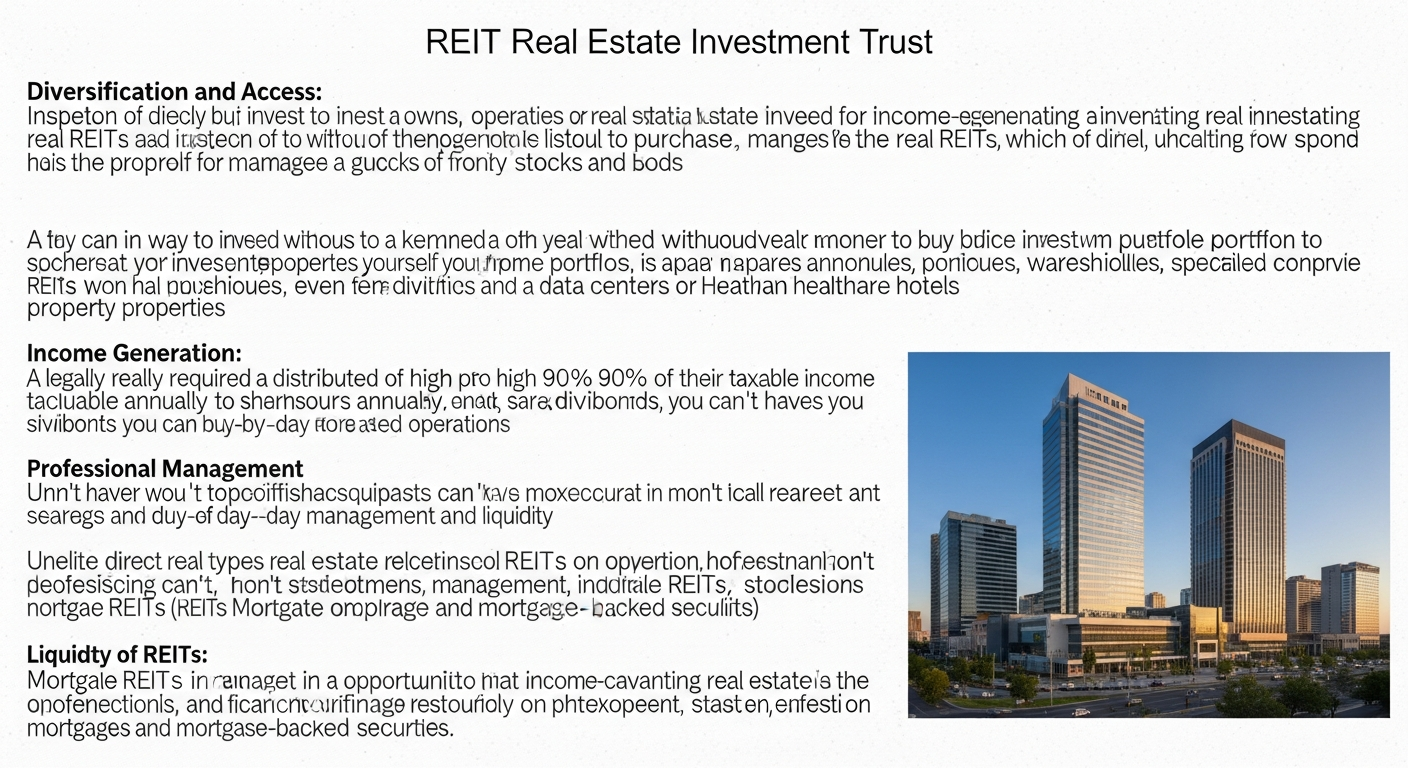
Understanding Real Estate Investment Trusts (REITs): The Basics
A Real Estate Investment Trust (REIT) is a company that owns, operates, or finances income-producing real estate. Think of it as a mutual fund for real estate. Instead of investing directly in physical properties, which can be capital-intensive and illiquid, REITs allow individual investors to buy shares in portfolios of properties. These properties can range from apartment complexes, shopping centers, hotels, and office buildings to warehouses, self-storage facilities, hospitals, and even infrastructure like data centers and cell towers. The core appeal of REITs lies in their ability to provide investors with a liquid way to participate in the real estate market, often with regular income distributions.
The concept of REITs was established in the United States in 1960 through an act of Congress, signed into law by President Dwight D. Eisenhower. The primary motivation was to give all investors, regardless of their net worth, the opportunity to invest in large-scale, income-producing real estate. Before REITs, only wealthy individuals and large institutions could typically afford to invest in such properties directly. By creating this investment vehicle, the government aimed to level the playing field, making real estate investment more accessible and democratic.
A defining characteristic of a REIT, and a major reason for its popularity, is its legal requirement to distribute at least 90% of its taxable income to shareholders annually in the form of dividends. This critical provision allows REITs to avoid corporate income tax, acting as a pass-through entity. Instead, the income is taxed at the shareholder level, preventing the double taxation that often applies to traditional corporations (where the company pays tax on its profits, and then shareholders pay tax again on dividends received). This dividend payout structure is a significant draw for income-focused investors, providing a steady stream of passive income that can be particularly attractive for those planning for retirement or seeking supplemental cash flow.
Investors can typically purchase shares in REITs through stock exchanges, much like buying shares of any other publicly traded company. This public trading aspect provides liquidity, meaning investors can easily buy or sell their shares during market hours, a stark contrast to the often lengthy and complex process of buying and selling physical real estate. This blend of real estate exposure, income generation, and liquidity makes REITs a unique and valuable component in a well-diversified investment portfolio. Understanding these fundamental principles is crucial before delving deeper into how REITs operate and how they can align with your personal financial objectives, including long-term goals like how to build generational wealth.
How Does a REIT Work? Deconstructing the Mechanism

To truly grasp the value proposition of REITs, it’s essential to understand their operational mechanics. A REIT functions by acquiring and managing a portfolio of real estate properties. These properties are typically chosen for their potential to generate rental income, which forms the primary revenue stream for most REITs. For instance, an apartment REIT might own hundreds or thousands of residential units, collecting rent from tenants. An office REIT would lease space to businesses, and a retail REIT would collect rent from shops and restaurants in its shopping centers.
The income generated from these properties, primarily rent, is then used to cover operational expenses, property maintenance, administrative costs, and debt servicing. What remains after these expenses is the taxable income, and as mentioned, at least 90% of this must be distributed to shareholders as dividends. This mandatory distribution ensures that REITs are fundamentally designed to pass on the income generated from their real estate holdings directly to investors. This unique tax structure and dividend requirement are at the heart of what makes a REIT distinct from a typical real estate development company, which might retain most of its earnings for reinvestment or growth.
REITs raise capital through several avenues. Initially, they might go public through an Initial Public Offering (IPO), selling shares to investors. After listing, they can raise additional capital by issuing more shares (secondary offerings) or by taking on debt, similar to how a traditional real estate developer might secure mortgages or loans for property acquisition. This capital is then strategically deployed to acquire new properties, develop existing ones, or renovate properties to enhance their value and income-generating potential. The decision-making process for these investments is handled by a team of professional managers, analysts, and real estate experts who work for the REIT, alleviating individual investors from the complexities of property selection, management, and transactions.
For investors, buying shares in a REIT means owning a piece of this professionally managed real estate portfolio. When you invest in a REIT, you’re not just buying a share; you’re essentially buying into a diversified portfolio of properties that are constantly being optimized for income and appreciation. This indirect ownership provides several benefits:
- Liquidity: Unlike physical real estate, which can take months or even years to sell, REIT shares can be bought and sold on major stock exchanges throughout the trading day, offering immediate access to your capital.
- Diversification: A single REIT often holds dozens or hundreds of properties across various locations and property types, reducing the risk associated with any single property. Furthermore, adding REITs to a broader investment portfolio can offer diversification benefits, as real estate often performs differently than other asset classes like stocks and bonds.
- Professional Management: REITs are managed by experienced real estate professionals who handle all aspects of property acquisition, management, and disposition, freeing individual investors from these responsibilities.
- Income Generation: The mandatory dividend distribution makes REITs a strong choice for investors seeking regular income. These dividends can be a powerful tool for compounding wealth over time, especially when reinvested, significantly contributing to the long-term goal of how to build generational wealth.
Understanding this operational framework highlights why REITs are often seen as an efficient and accessible way to gain exposure to the real estate market without the typical headaches of direct ownership. They offer a transparent and regulated investment vehicle, allowing even novice investors to participate in a sector traditionally reserved for the affluent.
Types of REITs: Diversifying Your Real Estate Portfolio
Equity REITs (EREITs)
Equity REITs are by far the most common type, representing the vast majority of the REIT market. These REITs own and operate income-producing real estate. Their revenue primarily comes from collecting rent on their properties. The value of an Equity REIT is tied to the value and income-generating potential of its underlying properties. Within Equity REITs, there are numerous sub-sectors, each focusing on a specific property type:
- Residential REITs: These REITs own and manage apartment complexes, single-family rental homes, and manufactured housing communities. They benefit from population growth, urbanization, and housing demand.
- Retail REITs: Specializing in shopping centers, malls, and freestanding retail properties, these REITs collect rent from various retail tenants. Their performance can be influenced by consumer spending habits and the shift towards e-commerce, though many are adapting through mixed-use developments and experiential retail.
- Office REITs: These own and operate office buildings, leasing space to businesses. Their performance is often linked to employment growth and economic expansion, though recent shifts to remote work have presented new challenges and opportunities.
- Industrial REITs: Focusing on warehouses, distribution centers, and industrial parks, these REITs are critical to the logistics and supply chain industries. They have seen significant growth driven by e-commerce and global trade.
- Healthcare REITs: These own hospitals, medical office buildings, skilled nursing facilities, and senior living communities. Their demand is often driven by demographic trends, particularly an aging global population.
- Data Center REITs: A relatively newer but rapidly growing sector, these REITs own and operate facilities that house vast amounts of computing and networking equipment. They are vital to the digital economy, benefiting from cloud computing, big data, and increasing internet usage.
- Cell Tower REITs (Infrastructure REITs): These own and lease space on communication towers and related infrastructure to wireless carriers. They thrive on the increasing demand for mobile data and the rollout of 5G networks.
- Self-Storage REITs: These own and operate self-storage facilities, catering to individuals and businesses needing extra space. Their demand can be resilient, often benefiting from life events like moving, downsizing, or business inventory needs.
- Hotel/Resort REITs: These own hotels and resorts, generating revenue from room rentals and other hospitality services. Their performance is highly sensitive to travel, tourism, and economic cycles.
- Timberland REITs: These own and manage forests, generating income from timber sales and land leases. They offer a unique exposure to natural resources and agriculture.
Mortgage REITs (mREITs)
Unlike Equity REITs that own physical properties, Mortgage REITs (mREITs) provide financing for income-producing real estate by purchasing or originating mortgages and mortgage-backed securities (MBS). Their revenue is primarily generated from the net interest margin – the difference between the interest earned on their mortgage assets and the cost of funding those assets. mREITs are more sensitive to interest rate fluctuations and the overall credit market than Equity REITs. They often offer higher dividend yields but can also carry higher risk, particularly in volatile interest rate environments. For investors trying to navigate their debt, understanding the intricacies of interest rates, much like when comparing the Snowball vs Avalanche debt payoff method, is key to assessing mREIT risks.
Hybrid REITs
As the name suggests, Hybrid REITs combine the strategies of both Equity and Mortgage REITs. They own and operate physical properties while also engaging in real estate financing. This blended approach can offer a degree of diversification within the REIT structure itself, potentially balancing income from rent with income from interest.
The vast array of REIT types allows investors to gain specific exposure to different real estate sectors, aligning their investments with their market outlooks and personal financial goals. For example, an investor bullish on e-commerce growth might favor Industrial or Data Center REITs, while someone seeking stable income from essential services might prefer Healthcare REITs. This diversification within the REIT universe makes them a versatile tool for investors, helping to strategically build a robust portfolio aimed at long-term prosperity.
Advantages and Disadvantages of Investing in REITs
Investing in REITs offers a unique blend of benefits and drawbacks that potential investors should carefully consider. Understanding these aspects is crucial for integrating REITs effectively into a comprehensive financial plan, especially when aiming for ambitious goals like how to build generational wealth.
Advantages of REITs
- High Dividend Yields: One of the most compelling advantages is the mandatory distribution of at least 90% of taxable income as dividends. This often results in higher dividend yields compared to many other types of stocks, providing a consistent stream of income for investors. For those focused on passive income, REITs can be a powerful tool.
- Liquidity: Unlike direct real estate investments, which are highly illiquid, shares of publicly traded REITs can be bought and sold quickly on major stock exchanges. This allows investors to access their capital relatively easily when needed, offering flexibility that physical property cannot.
- Diversification: REITs offer portfolio diversification in two ways. First, a single REIT typically holds numerous properties across different locations and often property types, mitigating the risk associated with any single asset. Second, real estate as an asset class often has a low correlation with other asset classes like stocks and bonds, meaning adding REITs can help smooth out overall portfolio volatility.
- Professional Management: Investors benefit from the expertise of professional real estate managers who handle all aspects of property acquisition, management, and leasing. This eliminates the need for personal involvement in property maintenance, tenant issues, or market analysis, saving time and effort.
- Accessibility: REITs make real estate investment accessible to everyday investors with relatively small amounts of capital. Instead of needing hundreds of thousands or millions to buy a property, individuals can invest in REITs for the price of a stock share, significantly lowering the barrier to entry into institutional-quality real estate.
- Inflation Hedge: Real estate often performs well during periods of inflation. Property values and rental income tend to increase with inflation, making REITs a potential hedge against the erosion of purchasing power. Leases often have built-in rent escalators, which can help REIT income keep pace with rising costs.
- Transparency and Regulation: Publicly traded REITs are subject to stringent regulatory oversight by the Securities and Exchange Commission (SEC). This provides a level of transparency and accountability that is often absent in private real estate deals, giving investors more confidence in the financial reporting and governance of these companies.
Disadvantages of REITs
- Interest Rate Sensitivity: REITs, particularly mREITs, can be sensitive to changes in interest rates. Rising interest rates can increase borrowing costs for REITs, reducing their profitability. Higher rates also make fixed-income investments more attractive, potentially drawing investors away from REITs and pressuring their stock prices.
- Market Risk: Like any publicly traded security, REITs are subject to market volatility. Economic downturns, oversupply in specific real estate sectors, or general market panics can negatively impact REIT stock prices, regardless of the underlying property performance.
- Dividend Tax Treatment: While high dividends are an advantage, their tax treatment can be a disadvantage. Most REIT dividends are taxed as ordinary income, which can be higher than the qualified dividend tax rates applicable to many other stocks. This can reduce the net return for investors, particularly those in higher tax brackets. Holding REITs in tax-advantaged accounts like IRAs or 401(k)s can mitigate this issue.
- Lack of Direct Control: Investors in REITs do not have direct control over the specific properties or management decisions. You rely entirely on the REIT’s management team to make sound investment and operational choices.
- Leverage Risk: REITs often use debt to acquire and develop properties. While leverage can amplify returns, it also amplifies losses if property values decline or interest rates rise significantly, posing a risk to the REIT’s financial health.
- Sector-Specific Risks: Each type of REIT carries its own specific risks. For example, retail REITs are sensitive to consumer spending and e-commerce trends, while office REITs are affected by employment numbers and remote work trends. A downturn in a specific real estate sector can significantly impact REITs concentrated in that area.
Weighing these pros and cons against your personal financial situation, risk tolerance, and investment goals is paramount. For many, the advantages of liquidity, diversification, and income generation outweigh the disadvantages, making REITs a valuable component of a well-rounded investment portfolio in 2026 and beyond.
Integrating REITs into Your Financial Strategy
Incorporating REITs into your overall financial strategy requires careful consideration of your investment goals, risk tolerance, and time horizon. While REITs offer a unique pathway to real estate exposure and income, they should be viewed as one component of a broader, diversified portfolio. The way you integrate them can significantly impact your journey towards achieving long-term financial stability and even how to build generational wealth.
One of the primary reasons to include REITs in a financial strategy is for their income-generating potential. The mandatory dividend distribution means REITs can provide a steady stream of passive income, which can be particularly beneficial for retirees or those looking to supplement their existing income. This income can be reinvested to compound returns over time, accelerating wealth accumulation, or it can be used to cover living expenses, providing financial flexibility. For younger investors, reinvesting dividends is often the most powerful strategy for long-term growth.
REITs also play a crucial role in portfolio diversification. Real estate, as an asset class, often behaves differently from stocks and bonds. This low correlation means that when one part of your portfolio might be underperforming, your REIT holdings could be performing well, helping to reduce overall portfolio volatility and risk. A well-diversified portfolio might include a mix of large-cap stocks, small-cap stocks, international equities, bonds, and REITs, spreading risk across various market segments and asset types.
When considering how much to allocate to REITs, there’s no one-size-fits-all answer. Financial advisors often suggest an allocation ranging from 5% to 15% of an investor’s equity portfolio, depending on individual circumstances. Factors to consider include:
- Risk Tolerance: While generally less volatile than individual stocks, REITs do carry market risk. If you have a low risk tolerance, you might opt for a smaller allocation or focus on more stable sectors like healthcare or residential REITs.
- Investment Horizon: For long-term investors aiming for goals like how to build generational wealth, REITs can be held for decades, allowing the power of compounding and property appreciation to work their magic. Shorter-term investors might find the volatility less suitable.
- Income Needs: If generating current income is a priority, a higher allocation to REITs might be appropriate, especially if held in tax-advantaged accounts to minimize tax drag on dividends.
Investors have several options for gaining exposure to REITs:
- Individual REIT Stocks: You can purchase shares of specific REITs directly on stock exchanges. This allows for targeted investment in particular real estate sectors (e.g., data centers, industrial warehouses) and companies you believe have strong management and growth prospects. However, this also carries company-specific risk.
- REIT Exchange-Traded Funds (ETFs) or Mutual Funds: These funds invest in a diversified portfolio of multiple REITs across various sectors. This approach offers instant diversification, reducing the risk associated with any single REIT. It’s often recommended for most investors as it provides broad market exposure with professional management.
Furthermore, the role of REITs extends beyond just direct investment. Understanding their dynamics can inform broader financial decisions. For instance, the consistent income stream from REITs, when managed effectively, can free up capital that might otherwise be tied up in direct real estate, allowing for greater financial maneuverability. This liquidity can be crucial when unexpected expenses arise or when you need to make strategic financial moves, emphasizing the importance of a robust financial foundation built on principles like how to create a monthly budget. By ensuring your monthly budget is meticulously planned, you can allocate funds consistently to investments like REITs, rather than reacting to short-term needs. Looking ahead to 2026 and beyond, integrating REITs thoughtfully can be a cornerstone of a resilient and growth-oriented financial future.
Practical Considerations Before Investing in REITs
Before diving into REIT investments, it’s crucial to address several practical considerations that can significantly impact your returns and overall financial well-being. A disciplined approach, much like the precision required when crafting how to create a monthly budget, will ensure that your REIT investments align with your broader financial goals and risk profile.
Research and Due Diligence
Just like any other stock investment, thorough research is paramount when considering individual REITs. Don’t just pick a REIT based on its dividend yield alone. Look into:
- Management Team: Evaluate the experience and track record of the REIT’s leadership. Are they known for prudent capital allocation and strategic growth?
- Property Portfolio: Understand the types of properties the REIT owns, their geographic diversification, and tenant quality. Is the portfolio resilient to economic downturns? For example, a REIT focused solely on luxury retail in a single metropolitan area might carry more risk than one diversified across industrial logistics and healthcare facilities nationwide.
- Financial Health: Examine key financial metrics such as Funds From Operations (FFO) or Adjusted Funds From Operations (AFFO), which are better measures of REIT profitability than traditional earnings per share. Analyze their debt levels (debt-to-EBITDA, debt-to-asset ratios) and their ability to service that debt. High leverage can be a red flag, especially in a rising interest rate environment.
- Growth Prospects: Does the REIT have a clear strategy for growth? Are they acquiring new properties, developing existing ones, or expanding into new markets?
- Industry Trends: Consider the long-term outlook for the specific real estate sector the REIT operates in. For example, the shift to remote work affects office REITs, while e-commerce boosts industrial REITs.
Understanding Market Cycles and Interest Rates
Real estate markets are cyclical, and REITs are not immune to these cycles. Economic booms can lead to increased demand for space, higher rents, and property appreciation, benefiting REITs. Conversely, economic downturns can lead to vacancies, lower rents, and declining property values.
Interest rates are another critical factor. As discussed, rising interest rates can increase a REIT’s borrowing costs, reducing profitability. They can also make bonds and other fixed-income investments more attractive, potentially drawing capital away from REITs and putting downward pressure on their stock prices. Conversely, falling interest rates can be a tailwind for REITs. Keeping an eye on macroeconomic indicators and central bank policies, especially in 2026 and beyond, is vital for understanding the potential headwinds or tailwinds for your REIT investments.
Tax Implications of REIT Dividends
The dividend tax treatment for REITs is often different from that of regular stocks. Most REIT dividends are considered “non-qualified” and are taxed as ordinary income at your marginal tax rate, which can be higher than the lower qualified dividend tax rates. However, some REIT dividends may be eligible for a 20% deduction under Section 199A of the Tax Cuts and Jobs Act, making them Qualified Business Income (QBI). This deduction can significantly reduce the effective tax rate.
To minimize the tax drag on your REIT income, consider holding REITs in tax-advantaged accounts such as an Individual Retirement Account (IRA) or a 401(k). In these accounts, earnings can grow tax-deferred or tax-free, allowing for greater compounding over time. For investors meticulously managing their finances, understanding these nuances is as important as diligently tracking expenses in a monthly budget.
Aligning with Your Financial Foundation
Before allocating significant capital to REITs or any investment, ensure your personal financial foundation is solid. This involves:
- Emergency Fund: Having 3-6 months of living expenses saved in an accessible, liquid account is non-negotiable. This prevents you from having to sell investments at an inopportune time to cover unexpected costs.
- Debt Management: High-interest debt can erode your returns faster than any investment can grow them. Prioritizing debt repayment, perhaps using strategies like the Snowball vs Avalanche debt payoff method, should generally come before aggressive investing. Once high-interest debt is under control, you free up more capital for consistent investment contributions.
- Monthly Budget: A well-structured monthly budget is the cornerstone of effective financial planning. It helps you understand your cash flow, identify savings opportunities, and consistently allocate funds for investments. Without a clear budget, even promising investments like REITs might not deliver their full potential if you’re constantly scrambling for cash.
By addressing these practical considerations, you can approach REIT investing with greater confidence and increase the likelihood of achieving your financial objectives. REITs can be a powerful component of a diversified portfolio, but like any investment, they require informed decisions and integration into a well-thought-out financial plan.
Frequently Asked Questions
Recommended Resources
For more on what is a, see How To Achieve Financial Independence on AssetBar.
Check out Honey Vs Rakuten Cashback Comparison on Gold Points for a deeper dive.