


Tax-Loss Harvesting: An Advanced Strategy to Slash Your Investment Taxes in 2026
As you navigate the exciting world of investing and wealth building, you’ll quickly discover that the market isn’t always on an upward trajectory. There will be periods of volatility, and sometimes, the value of your investments will decline. While seeing red in your portfolio can be disheartening, astute investors know that even losses can be leveraged to your advantage, thanks to a powerful strategy known as tax-loss harvesting. For those ready to move beyond basic investing, understanding and implementing tax-loss harvesting can be a game-changer for your financial health.
At Fin3go, our mission is to empower you with the knowledge to make smarter financial decisions. This comprehensive guide will demystify tax-loss harvesting, explaining what it is, how it works, and how you can strategically use it to reduce your tax bill and enhance your investment returns, all while adhering to the latest tax regulations for 2026 and beyond.
What is Tax-Loss Harvesting? The Core Concept
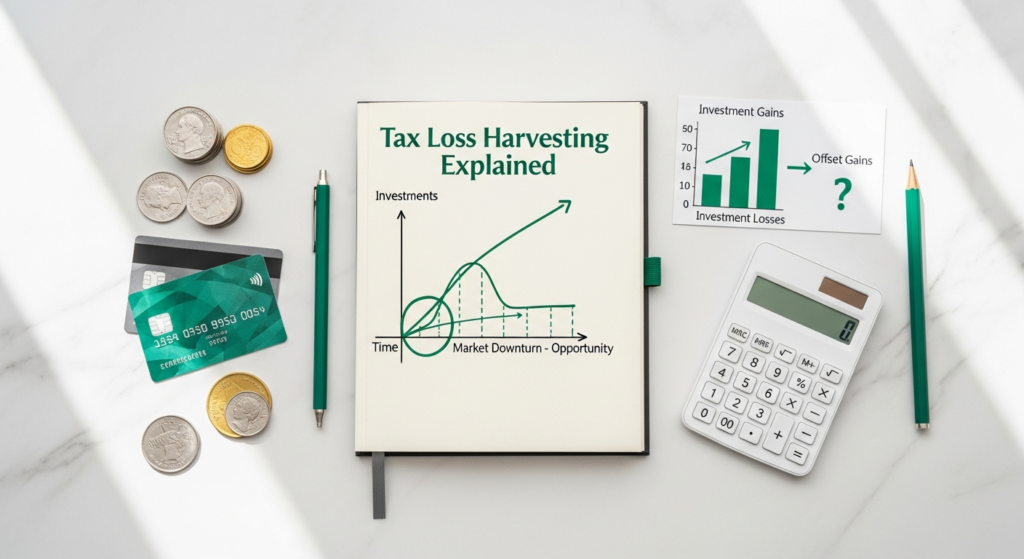
At its heart, tax-loss harvesting is a strategic maneuver that involves selling investments that have lost value to “realize” a capital loss. This realized loss can then be used to offset capital gains you may have incurred from selling other investments for a profit. If your losses exceed your gains, you can even use a portion of the excess to reduce your ordinary income, providing a direct reduction in your taxable income for the year.
This isn’t about manipulating the market or making impulsive decisions; it’s about intelligent tax planning. Instead of simply holding onto a losing investment hoping it recovers, tax-loss harvesting allows you to acknowledge the loss, take its tax benefit, and then reinvest the proceeds into a similar (but not “substantially identical”) investment. This way, you maintain your desired asset allocation and market exposure while simultaneously generating a valuable tax deduction.
How Does Tax-Loss Harvesting Work in Practice? A Step-by-Step Guide
Implementing tax-loss harvesting involves a clear sequence of actions, all designed to maximize your tax efficiency. Here’s a breakdown of the process:
- Identify Underperforming Assets: Regularly review your investment portfolio, particularly your taxable brokerage accounts, for investments trading below your original purchase price. These are your potential candidates for tax-loss harvesting.
- Sell the Losing Investment: You sell the identified security (e.g., a stock, ETF, or mutual fund) for less than what you paid for it. This act “realizes” the capital loss, turning it from a theoretical loss on paper into an actual loss that can be reported to the IRS.
- Offset Capital Gains: The realized capital loss is first used to offset any capital gains you’ve incurred during the year. For instance, if you sold another stock for a $5,000 profit (a capital gain) and harvested a $3,000 loss from another, your net capital gain for tax purposes would be reduced to $2,000.
- Offset Ordinary Income: If your total realized capital losses for the year exceed your total capital gains, you can use up to $3,000 of that excess loss to reduce your ordinary income (such as salary, interest, or dividends). For example, if you have $7,000 in excess losses, you can deduct $3,000 against your ordinary income, potentially moving you into a lower tax bracket.
- Carry Forward Excess Losses: Any remaining capital losses beyond the $3,000 ordinary income deduction can be carried forward indefinitely to offset capital gains (and up to $3,000 of ordinary income) in future tax years. This makes tax-loss harvesting a strategy with long-term benefits.
- Reinvest (Strategically): After selling, you often want to remain invested in the market to meet your long-term goals. You can reinvest the proceeds into a different, but similar, investment. This is where the infamous “Wash-Sale Rule” comes into play, which we’ll discuss in detail next.
The Critical Wash-Sale Rule: Don’t Get Caught!
One of the most crucial aspects of tax-loss harvesting, and often the trickiest for investors, is the Wash-Sale Rule. The IRS implemented this rule to prevent investors from claiming a tax deduction while essentially maintaining the same investment position. It’s designed to stop you from selling a security at a loss, immediately buying it back, and claiming the tax benefit without any real change in your economic position.
Here’s how the Wash-Sale Rule works for the 2026 tax year and beyond:
- You cannot claim a capital loss if you buy, or enter into a contract or option to buy, “substantially identical” stock or securities within a 30-day period before or after the sale. This creates a 61-day window (30 days before the sale, the day of the sale, and 30 days after the sale).
- The rule applies to you, your spouse, and any controlled entities (like an IRA or a company you own). This means if you sell a stock at a loss in your taxable brokerage account and your spouse buys the same stock in their account within the 61-day window, it’s still considered a wash sale.
- If a wash sale occurs, the loss is disallowed for tax purposes in the current year. However, it’s not entirely lost; the disallowed loss is typically added to the cost basis of the newly purchased, substantially identical shares. This defers the tax benefit until you sell the new shares.
What does “Substantially Identical” mean?
This is where it gets nuanced. “Substantially identical” generally refers to securities that are interchangeable and have the same rights and privileges. For example:
- Selling shares of Company A and buying shares of Company A within the 61-day window is a wash sale.
- Selling a mutual fund and buying shares of the same mutual fund is a wash sale.
- Selling shares of an ETF tracking the S&P 500 and buying shares of a different ETF that also tracks the S&P 500 can be considered substantially identical by the IRS, depending on the specific characteristics and holdings of the ETFs. This is a gray area where careful consideration or professional advice is often warranted.
- Selling shares of an S&P 500 ETF and buying shares of a Nasdaq 100 ETF is generally NOT considered substantially identical, as they track different indices.
To avoid a wash sale, you generally have a few options:
- Wait at least 31 days before repurchasing the identical security.
- Reinvest in a security that is similar in investment objectives but not “substantially identical” (e.g., swapping one large-cap growth ETF for another from a different provider, or moving from an S&P 500 fund to a total market fund).
- Invest the proceeds into a completely different asset class.
Adhering strictly to the Wash-Sale Rule is paramount for successful tax-loss harvesting. Automation tools offered by some robo-advisors are designed to help you avoid this pitfall.
The Significant Benefits of Smart Tax-Loss Harvesting
When executed correctly, tax-loss harvesting offers several compelling advantages for investors aiming for greater tax efficiency and long-term wealth accumulation:
- Immediate Tax Savings: The most direct benefit is the reduction in your current year’s tax liability. By offsetting capital gains, you pay less tax immediately, and by reducing ordinary income (up to $3,000 annually as of 2026), you directly lower your taxable income.
- Reduced Future Tax Bills: Any excess losses beyond what you use in the current year can be carried forward indefinitely. This creates a valuable “loss carryforward” that can offset future capital gains, potentially saving you taxes for years to come, even in highly profitable market environments.
- Maintain Portfolio Allocation: By immediately reinvesting in a “similar but not substantially identical” asset, you can maintain your desired asset allocation and stay invested in the market. This ensures you don’t miss out on potential future gains while still capturing the tax benefit of the loss.
- Enhanced After-Tax Returns: By consistently minimizing your tax obligations through strategic harvesting, you effectively boost your net investment returns. The money saved on taxes can remain invested and continue to grow, compounding over time.
- Flexibility in Investment Decisions: Tax-loss harvesting provides a practical opportunity to re-evaluate your investment choices. If an asset is consistently underperforming, harvesting the loss and reinvesting in a different, more promising security can align your portfolio better with your goals.
It’s important to remember that the primary goal of investing is to grow wealth, and tax strategies should always support that overarching objective, not dictate it. Tax-loss harvesting is a tool to make your successful investment journey even more efficient.
Who Should Consider Tax-Loss Harvesting and When to Do It?
While beneficial, tax-loss harvesting isn’t for every investor in every situation. Here’s who stands to gain the most and the ideal times to implement this strategy:
Who Should Consider It?
- Investors with Taxable Brokerage Accounts: This is the fundamental requirement. Tax-loss harvesting is only applicable to investments held in accounts where capital gains and losses are taxable (e.g., individual or joint brokerage accounts). It does not apply to tax-advantaged accounts like 401(k)s, IRAs, or HSAs.
- Individuals with Significant Capital Gains: If you’ve sold other investments at a profit during the year, tax-loss harvesting is an excellent way to reduce or eliminate the tax due on those gains.
- High-Income Earners: Those in higher income tax brackets will experience a greater impact from the $3,000 ordinary income deduction, as the tax savings represent a larger percentage of the deduction.
- Long-Term Investors with Diversified Portfolios: Investors who hold a variety of assets over the long term are more likely to have both winning and losing positions simultaneously, creating opportunities for harvesting.
When to Implement It?
Many investors mistakenly believe tax-loss harvesting is solely a year-end activity. While year-end is a popular time for tax planning, opportunities exist throughout the year:
- Throughout the Year (Opportunistically): The best approach is to monitor your portfolio regularly. Market downturns, specific sector corrections, or individual stock declines can present harvesting opportunities at any time. Don’t wait until December 31st!
- During Market Corrections or Bear Markets: These periods often create widespread losses across portfolios, offering numerous chances to harvest.
- When Rebalancing Your Portfolio: If you’re selling certain assets to bring your portfolio back to your target allocation, you might find some of those assets are trading at a loss, making it a perfect time to harvest.
- Before Realizing Large Capital Gains: If you anticipate selling a highly appreciated asset later in the year, you can proactively harvest losses earlier to offset that future gain.
- Before Year-End (Final Review): A final portfolio review in November or early December is always a good practice to ensure you’ve maximized your tax-loss harvesting opportunities for the current tax year.
Potential Pitfalls and Drawbacks to Consider
While powerful, tax-loss harvesting isn’t without its potential downsides or complexities. Being aware of these can help you avoid costly mistakes:
- Complexity and Tracking: For investors managing many individual securities, tracking cost bases, sale dates, and adherence to the wash-sale rule can become complex. Without proper record-keeping, you risk violating rules or failing to claim eligible losses. Robo-advisors and good tax software can simplify this.
- Transaction Costs: Each buy and sell transaction may incur trading fees, though many brokerages now offer commission-free trading for stocks and ETFs. For mutual funds, there might be redemption fees or other charges. These costs, however small, can erode some of the tax benefits if not considered.
- Risk of Violating the Wash-Sale Rule: This is the biggest pitfall. Accidentally buying a “substantially identical” security within the 61-day window can lead to your loss being disallowed, negating your efforts and potentially complicating your tax filing.
- Focusing on Taxes Over Investment Strategy: The primary goal of investing is to meet your financial objectives. You should never sell an investment solely for a tax loss if you believe strongly in its long-term potential and selling it fundamentally disrupts your well-thought-out investment strategy. The tax benefit should be a bonus, not the sole driver.
- Not Applicable to Retirement Accounts: As mentioned, this strategy provides no benefit in tax-advantaged accounts like IRAs, Roth IRAs, 401(k)s, 403(b)s, etc. Selling an investment at a loss in these accounts does not generate a deductible capital loss.
- Market Rebound Risk: If you sell a security at a loss and then wait the 31+ days to repurchase it (or a similar one), there’s a risk that the market, or that specific security, could rebound significantly during your waiting period, causing you to miss out on those gains. This is why immediate reinvestment in a non-identical but similar asset is often preferred.
Ultimately, a balanced approach is key. Tax-loss harvesting is a powerful tool when used judiciously and in alignment with your overall investment philosophy and financial goals. Always consult with a qualified tax professional or financial advisor for personalized advice, especially as tax laws and interpretations can change.
Tax-loss harvesting is a sophisticated yet accessible strategy for investors looking to optimize their portfolio’s tax efficiency. By strategically selling losing investments to offset capital gains and even a portion of ordinary income, you can significantly reduce your tax burden in the current year and build a valuable reserve of carryforward losses for the future. Understanding the Wash-Sale Rule is paramount, as is the importance of aligning this tax strategy with your broader investment goals. When implemented thoughtfully, tax-loss harvesting transforms market downturns into opportunities for greater wealth accumulation, making your investment journey more tax-efficient and ultimately more rewarding.