
Online vs Traditional Banks: Navigating Your Financial Future in 2026
Affiliate disclosure: This article may contain affiliate links. Recommendations are independent and editorially driven.
The financial landscape is in constant flux, evolving at a pace that often leaves consumers pondering their choices. Among the most significant shifts is the dichotomy between traditional brick-and-mortar banks and their increasingly popular digital counterparts: online banks. For decades, the towering edifice of a bank building represented stability, trust, and the tangible presence of one’s financial security. Today, however, a seamless app interface, instant digital transactions, and globally accessible customer support define the cutting edge of personal finance. This fundamental divergence creates a critical question for individuals and families alike: which banking model, online vs traditional banks, offers the optimal blend of convenience, security, and value?
Understanding this evolving choice isn’t merely about picking a service provider; it’s about aligning your banking experience with your lifestyle, financial goals, and comfort with technology. Traditional banks, with their extensive branch networks and personalized face-to-face interactions, continue to appeal to those who value human connection and direct assistance. They offer a sense of physical security and a historical legacy of trust that resonates deeply with many. Conversely, online banks, unburdened by the overhead of physical branches, promise lower fees, higher interest rates, and unparalleled accessibility through digital platforms. They cater to a generation of digital natives and busy professionals who prioritize efficiency, speed, and mobile-first solutions.
This comprehensive guide from fin3go will delve deep into the nuances of both banking models in 2026. We’ll explore their fundamental characteristics, dissect their advantages and disadvantages, and conduct a head-to-head comparison across critical factors like fees, interest rates, customer service, technology, and security. Our goal is to equip you with the knowledge necessary to make an informed decision, one that empowers you to confidently navigate your financial future and optimize your banking experience. Whether you’re a long-time patron of a local branch or a curious explorer of digital finance, join us as we unpack the crucial differences and similarities in the ongoing debate of online vs traditional banks.
The Evolving Landscape of Banking: Why This Comparison Matters More Than Ever
The financial services industry has undergone a monumental transformation over the past two decades, largely driven by technological innovation and shifting consumer expectations. What was once a slow-moving, heavily regulated sector dominated by a few major players has diversified into a vibrant ecosystem where fintech startups and established institutions compete and collaborate. This evolution has brought the debate of online vs traditional banks to the forefront of personal finance discussions, making it a pivotal consideration for anyone managing their money.
Historically, banking was synonymous with physical presence. Customers visited branches to deposit checks, apply for loans, and discuss their financial matters face-to-face with a banker. This model, while offering a tangible sense of security and personalized service, often came with limitations: restricted operating hours, geographical constraints, and slower transaction processing. The advent of the internet and subsequently, mobile technology, began to chip away at these limitations, introducing convenience unimaginable in previous eras. Initially, traditional banks responded by offering online portals and mobile apps, augmenting their existing services rather than replacing them.
However, a new breed of financial institution emerged: the pure-play online bank. These entities were built from the ground up without physical branches, leveraging technology to deliver services exclusively through digital channels. This model allowed them to operate with significantly lower overheads, translating into benefits for consumers such as higher interest rates on savings, lower (or no) monthly fees, and innovative digital tools. The rapid adoption of smartphones further accelerated this trend, making banking accessible anytime, anywhere, with just a few taps on a screen.
In 2026, the distinction between online and traditional banking is more nuanced than a simple either/or. Many traditional banks have heavily invested in their digital capabilities, offering robust online and mobile experiences that rival those of their pure-play online competitors. Conversely, some online-first institutions are experimenting with limited physical footprints or partnerships to offer cash deposit/withdrawal options. This convergence means that consumers aren’t just choosing between two distinct categories but rather evaluating a spectrum of services, features, and user experiences.
The relevance of this comparison extends beyond mere convenience. It touches upon crucial aspects of financial well-being, including how quickly you can access your funds, how much you pay in fees, the interest you earn on your savings, and the breadth of financial products available to you. Moreover, as digital literacy becomes increasingly vital, understanding the security protocols and technological innovations offered by each model is paramount. For fin3go users, who are often at the intersection of personal finance and fintech, discerning the optimal banking solution is a fundamental step towards achieving financial empowerment and efficiency in an increasingly digital world. This deep dive aims to provide clarity in a complex and rapidly changing environment.
Understanding Traditional Banks: The Enduring Pillars of Finance
Traditional banks, often referred to as brick-and-mortar institutions, represent the historical bedrock of the financial industry. These are the banks with physical branches, ATMs on every corner (or at least in every major town), and a long-standing presence in communities. Their model is built on personal interaction, a tangible footprint, and a comprehensive suite of services that have evolved over centuries. While their digital offerings have significantly advanced, the core identity of a traditional bank remains rooted in its physical infrastructure and the human element it provides.
Key Characteristics and Offerings
Traditional banks are defined by several key characteristics that distinguish them from their online counterparts:
- Physical Branch Network: The most obvious characteristic is their network of physical branches. These branches serve as points of contact for customers, allowing for face-to-face consultations, complex transaction handling, and personalized problem-solving.
- Broad Product Portfolio: They typically offer a wide array of financial products and services under one roof. This includes checking accounts, savings accounts, certificates of deposit (CDs), money market accounts, personal loans, mortgages, auto loans, credit cards, business banking services, investment services, and sometimes even insurance.
- In-Person Services: The ability to walk into a branch and speak with a teller or a personal banker is a hallmark. This is invaluable for cash transactions (deposits and withdrawals), notarization services, safe deposit boxes, cashier’s checks, wire transfers, and getting advice on complex financial matters.
- Established Trust and Legacy: Many traditional banks have been in operation for decades, if not centuries, building a reputation for stability and reliability. This long history often instills a strong sense of trust among customers, particularly older generations or those wary of purely digital entities.
- Integrated Digital Offerings: Recognizing the shift in consumer preferences, nearly all traditional banks now offer robust online banking platforms and mobile apps. These allow customers to check balances, pay bills, transfer funds, deposit checks remotely, and manage cards without visiting a branch.
Advantages of Traditional Banking
Despite the rise of digital alternatives, traditional banks offer compelling advantages that continue to attract and retain a significant customer base:
- Personalized Face-to-Face Service: For many, the ability to speak directly with a banker is paramount. This human interaction is crucial for complex transactions, applying for significant loans (like mortgages), resolving disputes, or seeking tailored financial advice. It builds relationships and trust.
- Convenient Cash Handling: Traditional banks excel in managing physical cash. Depositing large sums, withdrawing specific denominations, or getting cashier’s checks is straightforward at a branch. Their extensive ATM networks also make cash access readily available.
- Comprehensive Financial Solutions: Having all your financial needs – from daily banking to mortgages, investments, and business services – under one institution can simplify financial management. This “one-stop shop” approach is highly valued by many.
- Security and Familiarity: The physical presence of a branch often provides a sense of security and familiarity. Customers know exactly where to go if they have an issue, and the tangible nature of the institution can be reassuring.
- Specialized Services: Traditional banks often provide services like notary publics, safe deposit boxes, and medallion signature guarantees, which are difficult or impossible to obtain through online-only institutions.
Disadvantages of Traditional Banking
However, the traditional model also comes with its drawbacks, particularly in an increasingly digital world:
- Higher Fees and Lower Interest Rates: The extensive overhead of maintaining physical branches, a large staff, and robust infrastructure often translates into higher fees for customers (monthly maintenance fees, ATM fees, overdraft fees) and typically lower interest rates on savings accounts compared to online banks.
- Limited Accessibility and Operating Hours: While branches offer in-person service, they are limited by geographical location and specific operating hours. This can be inconvenient for those with busy schedules or who live far from a branch.
- Slower Processes: Some processes, especially those requiring physical paperwork or multiple approvals, can be slower at traditional banks compared to the near-instantaneous digital transactions offered by online banks.
- Potential for Bureaucracy: Large traditional institutions can sometimes be perceived as bureaucratic, with multiple layers of management and processes that may feel impersonal or slow to adapt to new technologies or customer needs.
- Less Innovative Technology (Historically): While traditional banks have improved, some may lag behind pure-play online banks in adopting cutting-edge fintech innovations and delivering seamless, highly intuitive digital experiences.
For many, the physical presence and human touch of traditional banks remain indispensable. They offer a grounded, comprehensive banking experience that caters to a wide range of needs, particularly for those who value personal interaction and in-person services for their financial affairs.
[INLINE IMAGE 1: place after second H2 | alt=”online vs traditional banks concept illustration”]
Exploring Online Banks: The Digital Revolution in Finance
Online banks, also known as digital banks or neobanks (though there are subtle distinctions), represent the vanguard of the financial industry’s digital transformation. Born from the internet age and amplified by mobile technology, these institutions operate primarily, if not exclusively, through digital channels. Their business model is fundamentally different from traditional banks, leveraging technology to minimize overhead and maximize efficiency, which often translates into significant benefits for consumers. In 2026, the market share and influence of online banks continue to grow rapidly, challenging the established order and reshaping consumer expectations for banking services.
Defining Pure-Play Digital Banking
A pure-play online bank is a financial institution that exists entirely in the digital realm, without any physical branches where customers can conduct transactions or seek in-person assistance. Their operations are built around a robust technological infrastructure, offering services primarily through websites and highly functional mobile applications. Key characteristics include:
- No Physical Branches: This is the defining feature. The absence of brick-and-mortar locations drastically reduces operational costs, allowing these banks to pass savings on to customers.
- Mobile-First Experience: Online banks often design their services with a mobile-first approach. Their apps are typically intuitive, user-friendly, and packed with features that empower customers to manage their finances on the go.
- Lower Overhead, Higher Returns: With minimal physical infrastructure and often leaner staff, online banks incur lower operational costs. This enables them to offer more competitive financial products, such as higher interest rates on savings accounts and lower or no monthly fees.
- Innovative Features: Being digital-native, these banks are often quicker to adopt and integrate new financial technologies. This can include advanced budgeting tools, real-time transaction alerts, AI-powered financial insights, peer-to-peer payment integration, and streamlined account opening processes.
- Regulated and Insured: Crucially, reputable online banks are just as regulated and insured (e.g., by the FDIC in the U.S.) as traditional banks, providing the same level of security for customer deposits.
It’s important to distinguish between pure-play online banks and the digital offerings of traditional banks. While traditional banks have online and mobile apps, they still maintain their branch networks. Pure-play online banks have no such physical fallback, making their digital experience the entirety of their customer interaction.
Advantages of Online Banking
The benefits of banking digitally are particularly compelling for a modern, digitally-savvy consumer:
- Higher Interest Rates and Lower Fees: This is often the primary draw. Due to lower operating costs, online banks can afford to pay higher interest rates on savings and offer checking accounts with no monthly maintenance fees, no minimum balance requirements, and fewer ATM fees (often reimbursing out-of-network ATM charges).
- Unparalleled Convenience and Accessibility: Banking is available 24/7 from anywhere with an internet connection. This means managing accounts, paying bills, transferring money, and even opening new accounts can be done from the comfort of your home or while traveling, at any time of day or night.
- User-Friendly Technology and Innovative Features: Online banking apps are typically designed for ease of use, with sleek interfaces and intuitive navigation. They often include advanced features like round-up savings programs, sub-accounts for specific goals, detailed spending analytics, and virtual card numbers for enhanced security.
- Speed and Efficiency: Digital transactions are often processed faster. Account opening can take minutes, funds can transfer almost instantly between accounts, and mobile check deposits are typically credited quickly.
- Environmental Friendliness: Reduced reliance on paper statements, physical branches, and transportation contributes to a lower environmental footprint, appealing to eco-conscious consumers.
Disadvantages of Online Banking
Despite their numerous advantages, online banks also present certain drawbacks that may make them less suitable for everyone:
- Lack of In-Person Support: The absence of physical branches means no face-to-face interaction. For complex issues, technical difficulties, or those who prefer human contact, relying solely on phone, chat, or email support can be a frustration.
- Cash Handling Challenges: Depositing cash can be inconvenient. While some online banks partner with retail locations or offer deposit options through certain ATMs, it’s rarely as straightforward as walking into a traditional bank branch. Withdrawing large sums of cash can also be more complicated.
- Reliance on Technology: A strong internet connection and comfort with digital platforms are essential. Outages, technical glitches, or a lack of digital literacy can hinder access to funds and services.
- Limited Specialized Services: Services like notary publics, safe deposit boxes, cashier’s checks, or wire transfers often require workarounds or are not directly offered by pure-play online banks.
- Less Suitable for Complex Financial Needs: While they offer robust basic banking, online banks might not have the same depth of personalized financial advisory services, complex lending products (like certain types of business loans), or investment platforms as larger, full-service traditional institutions.
Online banks represent a forward-thinking approach to personal finance, offering efficiency, cost savings, and convenience that resonate strongly with a growing segment of the population. However, their digital-first nature requires a certain level of comfort with technology and an understanding of how to navigate banking without a physical point of contact.
Key Differences: A Head-to-Head Showdown
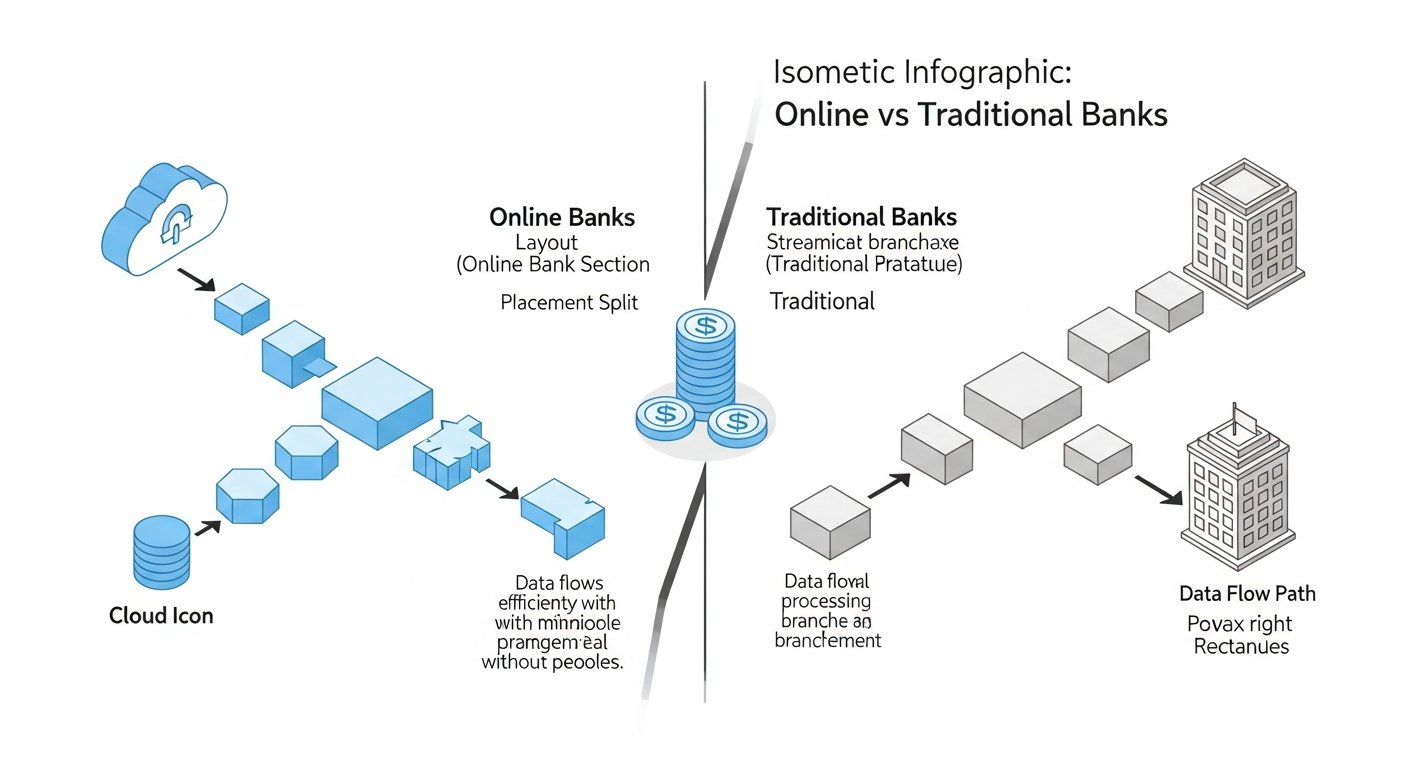
To truly understand the choice between online vs traditional banks, it’s essential to compare them directly across several critical dimensions. This section provides a comprehensive side-by-side analysis, highlighting where each model excels and where it might fall short, helping you weigh the options based on your personal priorities and financial habits.
Accessibility and Convenience
Traditional Banks:
- Accessibility: Dependent on physical branch locations and ATM networks. Access is limited by geographical proximity and branch operating hours.
- Convenience: In-person services offer a tangible sense of security and direct assistance. Great for cash transactions, complex issues, or those who prefer human interaction. Digital offerings provide 24/7 access but often as an augmentation to physical services.
Online Banks:
- Accessibility: 24/7 access from anywhere with an internet connection via mobile apps and websites. Highly convenient for those who are always on the go or don’t live near a traditional branch.
- Convenience: Banking at your fingertips, anytime, anywhere. Instant transfers, mobile check deposits, and digital tools enhance efficiency. Less convenient for direct cash handling or situations requiring physical presence.
Fees and Interest Rates
Traditional Banks:
- Fees: Often charge monthly maintenance fees (though waiveable with certain conditions), overdraft fees, ATM fees (especially out-of-network), and various service fees.
- Interest Rates: Typically offer lower interest rates on savings accounts and CDs due to higher operational costs.
Online Banks:
- Fees: Known for low or no monthly maintenance fees, minimal or no overdraft fees, and often reimburse out-of-network ATM fees. Fewer hidden charges.
- Interest Rates: Generally provide significantly higher interest rates on savings accounts and CDs, making them attractive for growing wealth.
Customer Service and Support
Traditional Banks:
- Customer Service: Offers a full spectrum of support: in-person at branches, phone support, email, and increasingly, live chat. The ability to speak face-to-face with a dedicated banker is a major advantage for personalized service and complex issue resolution.
- Support Quality: Can vary, but the option for direct human interaction provides a level of reassurance and problem-solving not always available online.
Online Banks:
- Customer Service: Primarily relies on digital channels: phone support, email, in-app chat, and sometimes AI-driven chatbots. Some offer 24/7 support.
- Support Quality: Can be highly efficient and responsive through digital channels, but the lack of in-person options can be a disadvantage for those who prefer physical interaction or have very intricate issues requiring detailed explanations.
Technology and Innovation
Traditional Banks:
- Technology: Have made significant strides in digital transformation, offering sophisticated mobile apps and online platforms for standard banking tasks. However, legacy systems can sometimes hinder rapid innovation or seamless integration of cutting-edge fintech.
- Innovation: Often focus on incremental improvements and integrating digital services into their existing infrastructure.
Online Banks:
- Technology: Built on modern technological infrastructure, designed for speed, security, and intuitive user experience. Early adopters of new fintech features, AI, and robust security protocols.
- Innovation: Continuously push the boundaries with budgeting tools, sub-accounts, real-time analytics, virtual card numbers, and seamless integration with other financial apps.
Product and Service Range
Traditional Banks:
- Product Range: Typically offers a comprehensive suite of financial products and services, including checking, savings, mortgages, personal loans, auto loans, credit cards, business banking, investment services, and wealth management, often under one umbrella.
- Specialized Services: Provides services like safe deposit boxes, notary publics, cashier’s checks, and foreign currency exchange, which are often unavailable or require workarounds with online banks.
Online Banks:
- Product Range: Often focuses on core banking products like checking, savings, and CDs. While many now offer credit cards and some personal loans, their range of specialized lending (e.g., complex mortgages, specific business loans) or investment services may be narrower than full-service traditional banks.
- Specialized Services: Generally do not offer physical services like safe deposit boxes or notarization. Cash handling is often through third-party partnerships or limited ATM networks.
Security and Regulation
Traditional Banks:
- Security: Benefit from a long-standing reputation and robust, multi-layered security protocols honed over decades. FDIC/NCUA insured deposits.
- Regulation: Heavily regulated by state and federal agencies, providing a strong framework of consumer protection and financial stability.
Online Banks:
- Security: Employ state-of-the-art digital security measures, including encryption, multi-factor authentication, and fraud monitoring, often surpassing traditional banks in certain digital protections. FDIC/NCUA insured deposits.
- Regulation: Subject to the same rigorous federal regulations as traditional banks (e.g., FDIC in the U.S. or equivalent bodies internationally), ensuring deposits are protected and operations are compliant.
Here’s a comparison table summarizing these key differences:
| Feature/Service | Traditional Banks | Online Banks |
|---|---|---|
| Physical Presence | Extensive branch network for in-person services, cash handling, advisory. | No physical branches; all services digital. |
| Accessibility | Limited by branch hours and geographic location. | 24/7 access from anywhere via app/web. Highly convenient. |
| Fees | Often higher monthly maintenance fees, ATM fees, overdraft fees. | Typically low or no monthly fees, ATM fee reimbursements, minimal overdrafts. |
| Interest Rates | Generally lower rates on savings accounts and CDs. | Significantly higher interest rates on savings accounts and CDs. |
| Cash Handling | Easy cash deposits/withdrawals at branches and extensive ATM networks. | More challenging for cash deposits (e.g., third-party partnerships, specific ATMs). Withdrawals via ATM networks. |
| Customer Service | In-person, phone, email, chat. Valued for human interaction, complex issues. | Phone, email, in-app chat (often 24/7). Efficient, but no face-to-face. |
| Technology | Robust digital offerings, but sometimes slower to adopt cutting-edge fintech due to legacy systems. | Modern, intuitive apps; quick adoption of innovative features (budgeting, AI, P2P). |
| Product Range | Comprehensive: checking, savings, loans (mortgage, auto, personal), credit cards, investments, business banking, wealth management. | Strong core banking (checking, savings, CDs); growing but potentially narrower range of specialized loans and investments. |
| Specialized Services | Notary, safe deposit boxes, cashier’s checks, foreign currency exchange (in-person). | Generally not offered directly; workarounds or third-party solutions needed. |
| Security & Regulation | FDIC/NCUA insured; robust security protocols, long-standing trust. | FDIC/NCUA insured; state-of-the-art digital security (encryption, MFA). |
This comparison table underscores that neither option is universally “better.” The ideal choice hinges entirely on an individual’s financial habits, priorities, and comfort with technology.
[INLINE IMAGE 2: place after fourth H2 | alt=”online vs traditional banks comparison illustration”]
Hybrid Models and the Future of Banking
The clear distinction between online vs traditional banks is becoming increasingly blurred as the financial industry continues to evolve. In 2026, we are witnessing the proliferation of hybrid models and innovative approaches that aim to capture the best aspects of both worlds. This convergence is driven by consumer demand for both digital convenience and the foundational security and trust often associated with traditional institutions. Understanding these evolving models is key to predicting the future trajectory of personal finance.
The Rise of Neobanks and Fintech Partnerships
Beyond the established pure-play online banks (like Ally or Discover Bank), a new wave of financial innovators has emerged: neobanks. While often functionally similar to online banks in their lack of physical branches and reliance on digital platforms, neobanks typically operate with slightly different regulatory structures. Many neobanks aren’t chartered banks themselves but rather partner with existing traditional banks to provide FDIC-insured accounts and other services. This allows them to focus intensely on user experience, cutting-edge technology, and niche offerings without the full regulatory burden of a traditional bank.
- Focus on User Experience: Neobanks are renowned for their sleek, intuitive apps, gamified financial management tools, and personalized insights. They often target specific demographics or financial needs, such as gig economy workers, budget-conscious millennials, or those looking for specific spending insights.
- Faster Innovation Cycles: Unencumbered by legacy systems, neobanks can iterate and deploy new features much faster than traditional banks. This includes advanced budgeting, automated savings, early access to paychecks, and crypto integration.
- Strategic Partnerships: These entities frequently form partnerships with other fintech companies, retail chains (for cash deposits), and payment processors to expand their service offerings and compensate for the lack of physical presence. For example, some neobanks allow cash deposits at major retail stores via barcode scanning.
- Bridging the Gap: By leveraging the stability of partner banks for deposit insurance while providing a purely digital front-end, neobanks effectively offer a hybrid experience, combining the security of traditional banking with the agility and innovation of digital platforms.
Simultaneously, traditional banks are not standing still. They are aggressively investing in their digital transformation, often acquiring fintech startups, partnering with technology providers, or launching their own standalone digital brands. This push is aimed at modernizing their offerings, streamlining processes, and appealing to younger, digitally-native customers who might otherwise gravitate towards online-only options. These efforts blur the lines, making it harder to distinguish between a “traditional” bank with excellent digital tools and a “digital” bank. For instance, many large traditional banks now offer mobile check deposit, advanced budgeting tools, and even peer-to-peer payment integration directly within their apps.
What to Expect in the Coming Years
The trajectory of banking in the coming years points towards an increasingly integrated and personalized experience:
- Further Convergence: The distinction between online and traditional banks will continue to diminish. Expect traditional banks to offer more online-only, high-yield savings products, and online banks to explore limited physical touchpoints or robust partnerships for essential physical services.
- Hyper-Personalization: AI and machine learning will drive highly personalized financial advice, product recommendations, and automated savings strategies, available through both traditional and online platforms. Your banking app might act as a personal financial coach, anticipating your needs before you even realize them.
- Embedded Finance: Banking services will increasingly be embedded into non-financial platforms. Imagine getting a loan offer directly within an e-commerce checkout or managing your budget within your favorite social media app. This makes financial services more contextual and accessible.
- Open Banking and APIs: The trend towards open banking, where consumers can securely share their financial data with third-party providers via APIs, will accelerate. This will foster greater competition, innovation, and interoperability between different financial services.
- Cryptocurrency and Blockchain Integration: While still in nascent stages, expect more traditional and online banks to offer services related to cryptocurrencies, stablecoins, and blockchain technology, whether through direct holdings, trading platforms, or using blockchain for faster international payments.
- Enhanced Security Measures: As digital threats evolve, so too will security. Biometric authentication, behavioral analytics, and advanced encryption will become standard, safeguarding digital transactions and personal data.
The future of banking is not about one model definitively winning over the other. Instead, it’s about a dynamic ecosystem where institutions adapt, innovate, and collaborate to provide a diverse range of services that cater to an equally diverse set of consumer preferences. The choice of online vs traditional banks will increasingly involve evaluating institutions based on their specific features, technological capabilities, and how well they integrate into your overall financial life, rather than just their physical presence.
Explore the latest fintech innovations that are shaping the banking world.
Making the Right Choice for Your Financial Needs
Deciding between online vs traditional banks is a highly personal decision, influenced by your financial habits, lifestyle, technological comfort, and specific banking needs. There’s no single “best” option; rather, it’s about finding the institution that best aligns with your priorities. This section will guide you through the process of assessing your needs and help you understand who benefits most from each banking model.
Assessing Your Priorities
Before making a choice, take stock of what truly matters to you in a banking relationship. Consider the following questions:
- How do you handle cash? Do you frequently deposit cash from tips, a small business, or gifts? Do you often need to withdraw large sums? If so, traditional banks with physical branches might be more convenient. If cash is rarely part of your financial life, an online bank could work.
- How important is in-person interaction? Do you prefer to discuss complex financial matters face-to-face? Do you value having a dedicated banker who knows your financial history? If so, a traditional bank’s branch network is invaluable. If you’re comfortable with digital communication (phone, chat, email), an online bank will suffice.
- Are fees and interest rates a primary concern? Are you looking to minimize monthly fees and maximize the interest earned on your savings? If cost-effectiveness is your top priority, online banks typically offer better rates and fewer fees.
- How comfortable are you with technology? Are you adept at using mobile apps and online platforms for all your financial needs? Do you embrace new digital tools? If yes, online banks offer a seamless experience. If you prefer simpler interfaces or are less tech-savvy, a traditional bank might be more reassuring.
- What kind of financial products do you need? Do you require a full suite of services, including mortgages, complex loans, wealth management, or business banking, all from one institution? A traditional bank is more likely to offer this comprehensive package. If you primarily need checking and savings accounts with good rates, an online bank might be ideal.
- How often do you travel or move? If you frequently move or travel internationally, a bank with 24/7 digital access and potentially global ATM fee reimbursements (often found in online banks) can be more convenient than finding new branches in different locations.
- What is your appetite for innovation? Do you want access to cutting-edge budgeting tools, early paycheck access, or integration with advanced fintech platforms? Online banks and neobanks are generally at the forefront of these innovations.
Who Benefits Most from Online Banking?
Online banks are particularly well-suited for individuals who:
- Are digitally savvy and comfortable with technology: Those who prefer managing finances via apps and websites, and don’t require in-person assistance.
- Prioritize low fees and high interest rates: Individuals focused on maximizing savings growth and minimizing banking costs.
- Rarely handle physical cash: If most of your transactions are digital, and cash deposits/withdrawals are infrequent, an online bank’s limited cash handling options won’t be an issue.
- Seek convenience and 24/7 access: Busy professionals, frequent travelers, or those living in areas without easy access to traditional branches.
- Are budget-conscious and value financial tools: Those who appreciate detailed spending analytics, automated savings, and budgeting features often integrated into online banking apps.
- Prefer streamlined, efficient processes: Individuals who value quick account opening, instant transfers, and fast customer service responses through digital channels.
For example, a young professional who gets paid via direct deposit, pays bills online, uses mobile payment apps, and wants to earn high interest on their emergency fund would find an online bank exceptionally beneficial.
Who Benefits Most from Traditional Banking?
Traditional banks remain the preferred choice for those who:
- Value in-person customer service and relationships: Individuals who prefer face-to-face discussions for complex transactions, loan applications, or financial planning.
- Frequently deal with cash: Small business owners, individuals who receive cash payments, or those who need to make regular cash deposits or withdrawals find branches indispensable.
- Require a full suite of integrated financial services: Those needing mortgages, business loans, comprehensive wealth management, or specialized services like safe deposit boxes from a single provider.
- Are less comfortable with technology: Individuals who prefer a more hands-on, guided approach to banking and might be wary of purely digital interactions.
- Prioritize a strong local presence and community connection: Customers who value banking with an institution that has a physical presence in their community and may offer local services or support.
- Need specialized physical services: Such as notary publics, cashier’s checks, or foreign currency exchange on demand.
Consider a small business owner who regularly deposits cash, needs a business loan, and prefers to discuss their financial strategy with a personal banker; a traditional bank would likely be the better fit.
Ultimately, some individuals may find the ideal solution in a hybrid approach: using an online bank for daily checking and high-yield savings, while maintaining a secondary account with a traditional bank for occasional cash transactions or specialized services. This strategy allows you to leverage the strengths of both online vs traditional banks, tailoring your banking experience to your precise needs in 2026. The key is to be proactive in assessing your financial habits and making an informed choice that supports your overall financial well-being.
Discover the best high-yield savings accounts for 2026.
Security Concerns: Debunking Myths and Understanding Protections
One of the most common concerns when discussing online vs traditional banks, particularly for those new to digital finance, revolves around security. It’s a natural instinct to associate physical presence with security, leading to a perception that traditional banks are inherently safer than their online counterparts. However, this perception often stems from outdated information and overlooks the sophisticated security measures implemented by digital institutions. In 2026, both online and traditional banks operate under stringent regulations and employ advanced technologies to protect customer funds and data.
FDIC/NCUA Insurance: Your Deposits Are Protected
Perhaps the most critical piece of information for any bank customer is deposit insurance. In the United States, most legitimate banks, whether online or traditional, are members of either the Federal Deposit Insurance Corporation (FDIC) or the National Credit Union Administration (NCUA). This insurance protects your deposits up to $250,000 per depositor, per ownership category, per insured bank.
- FDIC for Banks: The FDIC insures deposits in banks and savings associations. This means if an FDIC-insured online bank or traditional bank fails, your money (up to the limit) is safe and will be returned to you. The key is to ensure your chosen institution is FDIC-insured, which nearly all reputable U.S. banks are.
- NCUA for Credit Unions: Similarly, the NCUA provides deposit insurance for credit unions. Credit unions are member-owned financial cooperatives that operate similarly to banks but often have a community focus. If you’re considering an online credit union or a traditional one, check for NCUA insurance.
The crucial takeaway here is that the insurance status of a bank’s deposits is independent of its physical presence. An online bank with FDIC or NCUA insurance offers the same fundamental protection for your savings as a traditional bank with a branch on Main Street. This directly debunks the myth that your money is inherently less safe in an online bank. Always verify the insurance status of any financial institution you consider.
Fraud Prevention and Digital Safeguards
Beyond deposit insurance, both types of banks invest heavily in cybersecurity and fraud prevention. However, their approaches and capabilities can differ slightly:
- Traditional Banks’ Security:
- Physical Security: Branches have security guards, vaults, and surveillance systems.
- Digital Security: They employ encryption (SSL/TLS), firewalls, multi-factor authentication (MFA), fraud detection algorithms, and secure login processes for their online and mobile platforms.
- Human Oversight: A large staff allows for more manual review and intervention in suspicious activities.
While robust, traditional banks often contend with legacy IT systems that can be slower to update or more vulnerable to certain types of attacks if not meticulously maintained.
- Online Banks’ Security:
- Digital-First Security: As digital-native entities, online banks are built with state-of-the-art cybersecurity from the ground up. This includes advanced encryption for data in transit and at rest, biometric authentication (fingerprint, facial recognition), and sophisticated real-time fraud monitoring.
- Proactive Threat Detection: They often leverage AI and machine learning to analyze transaction patterns and identify suspicious activity faster, sending instant alerts to customers.
- Virtual Card Numbers: Some online banks offer virtual card numbers for online purchases, adding an extra layer of protection by masking your actual card details.
- Session Timeouts and Strong Password Enforcement: Strict protocols are usually in place to ensure secure access.
Because their entire
Online vs Traditional Banks: Navigating Your Financial Future in 2026
Affiliate disclosure: This article may contain affiliate links. Recommendations are independent and editorially driven.
The financial landscape is in constant flux, evolving at a pace that often leaves consumers pondering their choices. Among the most significant shifts is the dichotomy between traditional brick-and-mortar banks and their increasingly popular digital counterparts: online banks. For decades, the towering edifice of a bank building represented stability, trust, and the tangible presence of one’s financial security. Today, however, a seamless app interface, instant digital transactions, and globally accessible customer support define the cutting edge of personal finance. This fundamental divergence creates a critical question for individuals and families alike: which banking model, online vs traditional banks, offers the optimal blend of convenience, security, and value?
Understanding this evolving choice isn’t merely about picking a service provider; it’s about aligning your banking experience with your lifestyle, financial goals, and comfort with technology. Traditional banks, with their extensive branch networks and personalized face-to-face interactions, continue to appeal to those who value human connection and direct assistance. They offer a sense of physical security and a historical legacy of trust that resonates deeply with many. Conversely, online banks, unburdened by the overhead of physical branches, promise lower fees, higher interest rates, and unparalleled accessibility through digital platforms. They cater to a generation of digital natives and busy professionals who prioritize efficiency, speed, and mobile-first solutions.
This comprehensive guide from fin3go will delve deep into the nuances of both banking models in 2026. We’ll explore their fundamental characteristics, dissect their advantages and disadvantages, and conduct a head-to-head comparison across critical factors like fees, interest rates, customer service, technology, and security. Our goal is to equip you with the knowledge necessary to make an informed decision, one that empowers you to confidently navigate your financial future and optimize your banking experience. Whether you’re a long-time patron of a local branch or a curious explorer of digital finance, join us as we unpack the crucial differences and similarities in the ongoing debate of online vs traditional banks.
The Evolving Landscape of Banking: Why This Comparison Matters More Than Ever
The financial services industry has undergone a monumental transformation over the past two decades, largely driven by technological innovation and shifting consumer expectations. What was once a slow-moving, heavily regulated sector dominated by a few major players has diversified into a vibrant ecosystem where fintech startups and established institutions compete and collaborate. This evolution has brought the debate of online vs traditional banks to the forefront of personal finance discussions, making it a pivotal consideration for anyone managing their money.
Historically, banking was synonymous with physical presence. Customers visited branches to deposit checks, apply for loans, and discuss their financial matters face-to-face with a banker. This model, while offering a tangible sense of security and personalized service, often came with limitations: restricted operating hours, geographical constraints, and slower transaction processing. The advent of the internet and subsequently, mobile technology, began to chip away at these limitations, introducing convenience unimaginable in previous eras. Initially, traditional banks responded by offering online portals and mobile apps, augmenting their existing services rather than replacing them.
However, a new breed of financial institution emerged: the pure-play online bank. These entities were built from the ground up without physical branches, leveraging technology to deliver services exclusively through digital channels. This model allowed them to operate with significantly lower overheads, translating into benefits for consumers such as higher interest rates on savings, lower (or no) monthly fees, and innovative digital tools. The rapid adoption of smartphones further accelerated this trend, making banking accessible anytime, anywhere, with just a few taps on a screen.
In 2026, the distinction between online and traditional banking is more nuanced than a simple either/or. Many traditional banks have heavily invested in their digital capabilities, offering robust online and mobile experiences that rival those of their pure-play online competitors. Conversely, some online-first institutions are experimenting with limited physical footprints or partnerships to offer cash deposit/withdrawal options. This convergence means that consumers aren’t just choosing between two distinct categories but rather evaluating a spectrum of services, features, and user experiences.
The relevance of this comparison extends beyond mere convenience. It touches upon crucial aspects of financial well-being, including how quickly you can access your funds, how much you pay in fees, the interest you earn on your savings, and the breadth of financial products available to you. Moreover, as digital literacy becomes increasingly vital, understanding the security protocols and technological innovations offered by each model is paramount. For fin3go users, who are often at the intersection of personal finance and fintech, discerning the optimal banking solution is a fundamental step towards achieving financial empowerment and efficiency in an increasingly digital world. This deep dive aims to provide clarity in a complex and rapidly changing environment.
Understanding Traditional Banks: The Enduring Pillars of Finance
Traditional banks, often referred to as brick-and-mortar institutions, represent the historical bedrock of the financial industry. These are the banks with physical branches, ATMs on every corner (or at least in every major town), and a long-standing presence in communities. Their model is built on personal interaction, a tangible footprint, and a comprehensive suite of services that have evolved over centuries. While their digital offerings have significantly advanced, the core identity of a traditional bank remains rooted in its physical infrastructure and the human element it provides.
Key Characteristics and Offerings
Traditional banks are defined by several key characteristics that distinguish them from their online counterparts:
- Physical Branch Network: The most obvious characteristic is their network of physical branches. These branches serve as points of contact for customers, allowing for face-to-face consultations, complex transaction handling, and personalized problem-solving.
- Broad Product Portfolio: They typically offer a wide array of financial products and services under one roof. This includes checking accounts, savings accounts, certificates of deposit (CDs), money market accounts, personal loans, mortgages, auto loans, credit cards, business banking services, investment services, and sometimes even insurance.
- In-Person Services: The ability to walk into a branch and speak with a teller or a personal banker is a hallmark. This is invaluable for cash transactions (deposits and withdrawals), notarization services, safe deposit boxes, cashier’s checks, wire transfers, and getting advice on complex financial matters.
- Established Trust and Legacy: Many traditional banks have been in operation for decades, if not centuries, building a reputation for stability and reliability. This long history often instills a strong sense of trust among customers, particularly older generations or those wary of purely digital entities.
- Integrated Digital Offerings: Recognizing the shift in consumer preferences, nearly all traditional banks now offer robust online banking platforms and mobile apps. These allow customers to check balances, pay bills, transfer funds, deposit checks remotely, and manage cards without visiting a branch.
Advantages of Traditional Banking
Despite the rise of digital alternatives, traditional banks offer compelling advantages that continue to attract and retain a significant customer base:
- Personalized Face-to-Face Service: For many, the ability to speak directly with a banker is paramount. This human interaction is crucial for complex transactions, applying for significant loans (like mortgages), resolving disputes, or seeking tailored financial advice. It builds relationships and trust.
- Convenient Cash Handling: Traditional banks excel in managing physical cash. Depositing large sums, withdrawing specific denominations, or getting cashier’s checks is straightforward at a branch. Their extensive ATM networks also make cash access readily available.
- Comprehensive Financial Solutions: Having all your financial needs – from daily banking to mortgages, investments, and business services – under one institution can simplify financial management. This “one-stop shop” approach is highly valued by many.
- Security and Familiarity: The physical presence of a branch often provides a sense of security and familiarity. Customers know exactly where to go if they have an issue, and the tangible nature of the institution can be reassuring.
- Specialized Services: Traditional banks often provide services like notary publics, safe deposit boxes, and medallion signature guarantees, which are difficult or impossible to obtain through online-only institutions.
Disadvantages of Traditional Banking
However, the traditional model also comes with its drawbacks, particularly in an increasingly digital world:
- Higher Fees and Lower Interest Rates: The extensive overhead of maintaining physical branches, a large staff, and robust infrastructure often translates into higher fees for customers (monthly maintenance fees, ATM fees, overdraft fees) and typically lower interest rates on savings accounts compared to online banks.
- Limited Accessibility and Operating Hours: While branches offer in-person service, they are limited by geographical location and specific operating hours. This can be inconvenient for those with busy schedules or who live far from a branch.
- Slower Processes: Some processes, especially those requiring physical paperwork or multiple approvals, can be slower at traditional banks compared to the near-instantaneous digital transactions offered by online banks.
- Potential for Bureaucracy: Large traditional institutions can sometimes be perceived as bureaucratic, with multiple layers of management and processes that may feel impersonal or slow to adapt to new technologies or customer needs.
- Less Innovative Technology (Historically): While traditional banks have improved, some may lag behind pure-play online banks in adopting cutting-edge fintech innovations and delivering seamless, highly intuitive digital experiences.
For many, the physical presence and human touch of traditional banks remain indispensable. They offer a grounded, comprehensive banking experience that caters to a wide range of needs, particularly for those who value personal interaction and in-person services for their financial affairs.
[INLINE IMAGE 1: place after second H2 | alt=”online vs traditional banks concept illustration”]
Exploring Online Banks: The Digital Revolution in Finance
Online banks, also known as digital banks or neobanks (though there are subtle distinctions), represent the vanguard of the financial industry’s digital transformation. Born from the internet age and amplified by mobile technology, these institutions operate primarily, if not exclusively, through digital channels. Their business model is fundamentally different from traditional banks, leveraging technology to minimize overhead and maximize efficiency, which often translates into significant benefits for consumers. In 2026, the market share and influence of online banks continue to grow rapidly, challenging the established order and reshaping consumer expectations for banking services.
Defining Pure-Play Digital Banking
A pure-play online bank is a financial institution that exists entirely in the digital realm, without any physical branches where customers can conduct transactions or seek in-person assistance. Their operations are built around a robust technological infrastructure, offering services primarily through websites and highly functional mobile applications. Key characteristics include:
- No Physical Branches: This is the defining feature. The absence of brick-and-mortar locations drastically reduces operational costs, allowing these banks to pass savings on to customers.
- Mobile-First Experience: Online banks often design their services with a mobile-first approach. Their apps are typically intuitive, user-friendly, and packed with features that empower customers to manage their finances on the go.
- Lower Overhead, Higher Returns: With minimal physical infrastructure and often leaner staff, online banks incur lower operational costs. This enables them to offer more competitive financial products, such as higher interest rates on savings accounts and lower or no monthly fees.
- Innovative Features: Being digital-native, these banks are often quicker to adopt and integrate new financial technologies. This can include advanced budgeting tools, real-time transaction alerts, AI-powered financial insights, peer-to-peer payment integration, and streamlined account opening processes.
- Regulated and Insured: Crucially, reputable online banks are just as regulated and insured (e.g., by the FDIC in the U.S.) as traditional banks, providing the same level of security for customer deposits.
It’s important to distinguish between pure-play online banks and the digital offerings of traditional banks. While traditional banks have online and mobile apps, they still maintain their branch networks. Pure-play online banks have no such physical fallback, making their digital experience the entirety of their customer interaction.
Advantages of Online Banking
The benefits of banking digitally are particularly compelling for a modern, digitally-savvy consumer:
- Higher Interest Rates and Lower Fees: This is often the primary draw. Due to lower operating costs, online banks can afford to pay higher interest rates on savings and offer checking accounts with no monthly maintenance fees, no minimum balance requirements, and fewer ATM fees (often reimbursing out-of-network ATM charges).
- Unparalleled Convenience and Accessibility: Banking is available 24/7 from anywhere with an internet connection. This means managing accounts, paying bills, transferring money, and even opening new accounts can be done from the comfort of your home or while traveling, at any time of day or night.
- User-Friendly Technology and Innovative Features: Online banking apps are typically designed for ease of use, with sleek interfaces and intuitive navigation. They often include advanced features like round-up savings programs, sub-accounts for specific goals, detailed spending analytics, and virtual card numbers for enhanced security.
- Speed and Efficiency: Digital transactions are often processed faster. Account opening can take minutes, funds can transfer almost instantly between accounts, and mobile check deposits are typically credited quickly.
- Environmental Friendliness: Reduced reliance on paper statements, physical branches, and transportation contributes to a lower environmental footprint, appealing to eco-conscious consumers.
Disadvantages of Online Banking
Despite their numerous advantages, online banks also present certain drawbacks that may make them less suitable for everyone:
- Lack of In-Person Support: The absence of physical branches means no face-to-face interaction. For complex issues, technical difficulties, or those who prefer human contact, relying solely on phone, chat, or email support can be a frustration.
- Cash Handling Challenges: Depositing cash can be inconvenient. While some online banks partner with retail locations or offer deposit options through certain ATMs, it’s rarely as straightforward as walking into a traditional bank branch. Withdrawing large sums of cash can also be more complicated.
- Reliance on Technology: A strong internet connection and comfort with digital platforms are essential. Outages, technical glitches, or a lack of digital literacy can hinder access to funds and services.
- Limited Specialized Services: Services like notary publics, safe deposit boxes, cashier’s checks, or wire transfers often require workarounds or are not directly offered by pure-play online banks.
- Less Suitable for Complex Financial Needs: While they offer robust basic banking, online banks might not have the same depth of personalized financial advisory services, complex lending products (like certain types of business loans), or investment platforms as larger, full-service traditional institutions.
Online banks represent a forward-thinking approach to personal finance, offering efficiency, cost savings, and convenience that resonate strongly with a growing segment of the population. However, their digital-first nature requires a certain level of comfort with technology and an understanding of how to navigate banking without a physical point of contact.
Key Differences: A Head-to-Head Showdown
To truly understand the choice between online vs traditional banks, it’s essential to compare them directly across several critical dimensions. This section provides a comprehensive side-by-side analysis, highlighting where each model excels and where it might fall short, helping you weigh the options based on your personal priorities and financial habits.
Accessibility and Convenience
Traditional Banks:
- Accessibility: Dependent on physical branch locations and ATM networks. Access is limited by geographical proximity and branch operating hours.
- Convenience: In-person services offer a tangible sense of security and direct assistance. Great for cash transactions, complex issues, or those who prefer human interaction. Digital offerings provide 24/7 access but often as an augmentation to physical services.
Online Banks:
- Accessibility: 24/7 access from anywhere with an internet connection via mobile apps and websites. Highly convenient for those who are always on the go or don’t live near a traditional branch.
- Convenience: Banking at your fingertips, anytime, anywhere. Instant transfers, mobile check deposits, and digital tools enhance efficiency. Less convenient for direct cash handling or situations requiring physical presence.
Fees and Interest Rates
Traditional Banks:
- Fees: Often charge monthly maintenance fees (though waiveable with certain conditions), overdraft fees, ATM fees (especially out-of-network), and various service fees.
- Interest Rates: Typically offer lower interest rates on savings accounts and CDs due to higher operational costs.
Online Banks:
- Fees: Known for low or no monthly maintenance fees, minimal or no overdraft fees, and often reimburse out-of-network ATM fees. Fewer hidden charges.
- Interest Rates: Generally provide significantly higher interest rates on savings accounts and CDs, making them attractive for growing wealth.
Customer Service and Support
Traditional Banks:
- Customer Service: Offers a full spectrum of support: in-person at branches, phone support, email, and increasingly, live chat. The ability to speak face-to-face with a dedicated banker is a major advantage for personalized service and complex issue resolution.
- Support Quality: Can vary, but the option for direct human interaction provides a level of reassurance and problem-solving not always available online.
Online Banks:
- Customer Service: Primarily relies on digital channels: phone support, email, in-app chat, and sometimes AI-driven chatbots. Some offer 24/7 support.
- Support Quality: Can be highly efficient and responsive through digital channels, but the lack of in-person options can be a disadvantage for those who prefer physical interaction or have very intricate issues requiring detailed explanations.
Technology and Innovation
Traditional Banks:
- Technology: Have made significant strides in digital transformation, offering sophisticated mobile apps and online platforms for standard banking tasks. However, legacy systems can sometimes hinder rapid innovation or seamless integration of cutting-edge fintech.
- Innovation: Often focus on incremental improvements and integrating digital services into their existing infrastructure.
Online Banks:
- Technology: Built on modern technological infrastructure, designed for speed, security, and intuitive user experience. Early adopters of new fintech features, AI, and robust security protocols.
- Innovation: Continuously push the boundaries with budgeting tools, sub-accounts, real-time analytics, virtual card numbers, and seamless integration with other financial apps.
Product and Service Range
Traditional Banks:
- Product Range: Typically offers a comprehensive suite of financial products and services, including checking, savings, mortgages, personal loans, auto loans, credit cards, business banking, investment services, and wealth management, often under one umbrella.
- Specialized Services: Provides services like safe deposit boxes, notary publics, cashier’s checks, and foreign currency exchange, which are often unavailable or require workarounds with online banks.
Online Banks:
- Product Range: Often focuses on core banking products like checking, savings, and CDs. While many now offer credit cards and some personal loans, their range of specialized lending (e.g., complex mortgages, specific business loans) or investment services may be narrower than full-service traditional banks.
- Specialized Services: Generally do not offer physical services like safe deposit boxes or notarization. Cash handling is often through third-party partnerships or limited ATM networks.
Security and Regulation
Traditional Banks:
- Security: Benefit from a long-standing reputation and robust, multi-layered security protocols honed over decades. FDIC/NCUA insured deposits.
- Regulation: Heavily regulated by state and federal agencies, providing a strong framework of consumer protection and financial stability.
Online Banks:
- Security: Employ state-of-the-art digital security measures, including encryption, multi-factor authentication, and fraud monitoring, often surpassing traditional banks in certain digital protections. FDIC/NCUA insured deposits.
- Regulation: Subject to the same rigorous federal regulations as traditional banks (e.g., FDIC in the U.S. or equivalent bodies internationally), ensuring deposits are protected and operations are compliant.
Here’s a comparison table summarizing these key differences:
Feature/Service Traditional Banks Online Banks Physical Presence Extensive branch network for in-person services, cash handling, advisory. No physical branches; all services digital. Accessibility Limited by branch hours and geographic location. 24/7 access from anywhere via app/web. Highly convenient. Fees Often higher monthly maintenance fees, ATM fees, overdraft fees. Typically low or no monthly fees, ATM fee reimbursements, minimal overdrafts. Interest Rates Generally lower rates on savings accounts and CDs. Significantly higher interest rates on savings accounts and CDs. Cash Handling Easy cash deposits/withdrawals at branches and extensive ATM networks. More challenging for cash deposits (e.g., third-party partnerships, specific ATMs). Withdrawals via ATM networks. Customer Service In-person, phone, email, chat. Valued for human interaction, complex issues. Phone, email, in-app chat (often 24/7). Efficient, but no face-to-face. Technology Robust digital offerings, but sometimes slower to adopt cutting-edge fintech due to legacy systems. Modern, intuitive apps; quick adoption of innovative features (budgeting, AI, P2P). Product Range Comprehensive: checking, savings, loans (mortgage, auto, personal), credit cards, investments, business banking, wealth management. Strong core banking (checking, savings, CDs); growing but potentially narrower range of specialized loans and investments. Specialized Services Notary, safe deposit boxes, cashier’s checks, foreign currency exchange (in-person). Generally not offered directly; workarounds or third-party solutions needed. Security & Regulation FDIC/NCUA insured; robust security protocols, long-standing trust. FDIC/NCUA insured; state-of-the-art digital security (encryption, MFA). This comparison table underscores that neither option is universally “better.” The ideal choice hinges entirely on an individual’s financial habits, priorities, and comfort with technology.
[INLINE IMAGE 2: place after fourth H2 | alt=”online vs traditional banks comparison illustration”]
Hybrid Models and the Future of Banking
The clear distinction between online vs traditional banks is becoming increasingly blurred as the financial industry continues to evolve. In 2026, we are witnessing the proliferation of hybrid models and innovative approaches that aim to capture the best aspects of both worlds. This convergence is driven by consumer demand for both digital convenience and the foundational security and trust often associated with traditional institutions. Understanding these evolving models is key to predicting the future trajectory of personal finance.
The Rise of Neobanks and Fintech Partnerships
Beyond the established pure-play online banks (like Ally or Discover Bank), a new wave of financial innovators has emerged: neobanks. While often functionally similar to online banks in their lack of physical branches and reliance on digital platforms, neobanks typically operate with slightly different regulatory structures. Many neobanks aren’t chartered banks themselves but rather partner with existing traditional banks to provide FDIC-insured accounts and other services. This allows them to focus intensely on user experience, cutting-edge technology, and niche offerings without the full regulatory burden of a traditional bank.
- Focus on User Experience: Neobanks are renowned for their sleek, intuitive apps, gamified financial management tools, and personalized insights. They often target specific demographics or financial needs, such as gig economy workers, budget-conscious millennials, or those looking for specific spending insights.
- Faster Innovation Cycles: Unencumbered by legacy systems, neobanks can iterate and deploy new features much faster than traditional banks. This includes advanced budgeting, automated savings, early access to paychecks, and crypto integration.
- Strategic Partnerships: These entities frequently form partnerships with other fintech companies, retail chains (for cash deposits), and payment processors to expand their service offerings and compensate for the lack of physical presence. For example, some neobanks allow cash deposits at major retail stores via barcode scanning.
- Bridging the Gap: By leveraging the stability of partner banks for deposit insurance while providing a purely digital front-end, neobanks effectively offer a hybrid experience, combining the security of traditional banking with the agility and innovation of digital platforms.
Simultaneously, traditional banks are not standing still. They are aggressively investing in their digital transformation, often acquiring fintech startups, partnering with technology providers, or launching their own standalone digital brands. This push is aimed at modernizing their offerings, streamlining processes, and appealing to younger, digitally-native customers who might otherwise gravitate towards online-only options. These efforts blur the lines, making it harder to distinguish between a “traditional” bank with excellent digital tools and a “digital” bank. For instance, many large traditional banks now offer mobile check deposit, advanced budgeting tools, and even peer-to-peer payment integration directly within their apps.
What to Expect in the Coming Years
The trajectory of banking in the coming years points towards an increasingly integrated and personalized experience:
- Further Convergence: The distinction between online and traditional banks will continue to diminish. Expect traditional banks to offer more online-only, high-yield savings products, and online banks to explore limited physical touchpoints or robust partnerships for essential physical services.
- Hyper-Personalization: AI and machine learning will drive highly personalized financial advice, product recommendations, and automated savings strategies, available through both traditional and online platforms. Your banking app might act as a personal financial coach, anticipating your needs before you even realize them.
- Embedded Finance: Banking services will increasingly be embedded into non-financial platforms. Imagine getting a loan offer directly within an e-commerce checkout or managing your budget within your favorite social media app. This makes financial services more contextual and accessible.
- Open Banking and APIs: The trend towards open banking, where consumers can securely share their financial data with third-party providers via APIs, will accelerate. This will foster greater competition, innovation, and interoperability between different financial services.
- Cryptocurrency and Blockchain Integration: While still in nascent stages, expect more traditional and online banks to offer services related to cryptocurrencies, stablecoins, and blockchain technology, whether through direct holdings, trading platforms, or using blockchain for faster international payments.
- Enhanced Security Measures: As digital threats evolve, so too will security. Biometric authentication, behavioral analytics, and advanced encryption will become standard, safeguarding digital transactions and personal data.
The future of banking is not about one model definitively winning over the other. Instead, it’s about a dynamic ecosystem where institutions adapt, innovate, and collaborate to provide a diverse range of services that cater to an equally diverse set of consumer preferences. The choice of online vs traditional banks will increasingly involve evaluating institutions based on their specific features, technological capabilities, and how well they integrate into your overall financial life, rather than just their physical presence.
Explore the latest fintech innovations that are shaping the banking world.
Making the Right Choice for Your Financial Needs
Deciding between online vs traditional banks is a highly personal decision, influenced by your financial habits, lifestyle, technological comfort, and specific banking needs. There’s no single “best” option; rather, it’s about finding the institution that best aligns with your priorities. This section will guide you through the process of assessing your needs and help you understand who benefits most from each banking model.
Assessing Your Priorities
Before making a choice, take stock of what truly matters to you in a banking relationship. Consider the following questions:
- How do you handle cash? Do you frequently deposit cash from tips, a small business, or gifts? Do you often need to withdraw large sums? If so, traditional banks with physical branches might be more convenient. If cash is rarely part of your financial life, an online bank could work.
- How important is in-person interaction? Do you prefer to discuss complex financial matters face-to-face? Do you value having a dedicated banker who knows your financial history? If so, a traditional bank’s branch network is invaluable. If you’re comfortable with digital communication (phone, chat, email), an online bank will suffice.
- Are fees and interest rates a primary concern? Are you looking to minimize monthly fees and maximize the interest earned on your savings? If cost-effectiveness is your top priority, online banks typically offer better rates and fewer fees.
- How comfortable are you with technology? Are you adept at using mobile apps and online platforms for all your financial needs? Do you embrace new digital tools? If yes, online banks offer a seamless experience. If you prefer simpler interfaces or are less tech-savvy, a traditional bank might be more reassuring.
- What kind of financial products do you need? Do you require a full suite of services, including mortgages, complex loans, wealth management, or business banking, all from one institution? A traditional bank is more likely to offer this comprehensive package. If you primarily need checking and savings accounts with good rates, an online bank might be ideal.
- How often do you travel or move? If you frequently move or travel internationally, a bank with 24/7 digital access and potentially global ATM fee reimbursements (often found in online banks) can be more convenient than finding new branches in different locations.
- What is your appetite for innovation? Do you want access to cutting-edge budgeting tools, early paycheck access, or integration with advanced fintech platforms? Online banks and neobanks are generally at the forefront of these innovations.
Who Benefits Most from Online Banking?
Online banks are particularly well-suited for individuals who:
- Are digitally savvy and comfortable with technology: Those who prefer managing finances via apps and websites, and don’t require in-person assistance.
- Prioritize low fees and high interest rates: Individuals focused on maximizing savings growth and minimizing banking costs.
- Rarely handle physical cash: If most of your transactions are digital, and cash deposits/withdrawals are infrequent, an online bank’s limited cash handling options won’t be an issue.
- Seek convenience and 24/7 access: Busy professionals, frequent travelers, or those living in areas without easy access to traditional branches.
- Are budget-conscious and value financial tools: Those who appreciate detailed spending analytics, automated savings, and budgeting features often integrated into online banking apps.
- Prefer streamlined, efficient processes: Individuals who value quick account opening, instant transfers, and fast customer service responses through digital channels.
For example, a young professional who gets paid via direct deposit, pays bills online, uses mobile payment apps, and wants to earn high interest on their emergency fund would find an online bank exceptionally beneficial.
Who Benefits Most from Traditional Banking?
Traditional banks remain the preferred choice for those who:
- Value in-person customer service and relationships: Individuals who prefer face-to-face discussions for complex transactions, loan applications, or financial planning.
- Frequently deal with cash: Small business owners, individuals who receive cash payments, or those who need to make regular cash deposits or withdrawals find branches indispensable.
- Require a full suite of integrated financial services: Those needing mortgages, business loans, comprehensive wealth management, or specialized services like safe deposit boxes from a single provider.
- Are less comfortable with technology: Individuals who prefer a more hands-on, guided approach to banking and might be wary of purely digital interactions.
- Prioritize a strong local presence and community connection: Customers who value banking with an institution that has a physical presence in their community and may offer local services or support.
- Need specialized physical services: Such as notary publics, cashier’s checks, or foreign currency exchange on demand.
Consider a small business owner who regularly deposits cash, needs a business loan, and prefers to discuss their financial strategy with a personal banker; a traditional bank would likely be the better fit.
Ultimately, some individuals may find the ideal solution in a hybrid approach: using an online bank for daily checking and high-yield savings, while maintaining a secondary account with a traditional bank for occasional cash transactions or specialized services. This strategy allows you to leverage the strengths of both online vs traditional banks, tailoring your banking experience to your precise needs in 2026. The key is to be proactive in assessing your financial habits and making an informed choice that supports your overall financial well-being.
Discover the best high-yield savings accounts for 2026.
Security Concerns: Debunking Myths and Understanding Protections
One of the most common concerns when discussing online vs traditional banks, particularly for those new to digital finance, revolves around security. It’s a natural instinct to associate physical presence with security, leading to a perception that traditional banks are inherently safer than their online counterparts. However, this perception often stems from outdated information and overlooks the sophisticated security measures implemented by digital institutions. In 2026, both online and traditional banks operate under stringent regulations and employ advanced technologies to protect customer funds and data.
FDIC/NCUA Insurance: Your Deposits Are Protected
Perhaps the most critical piece of information for any bank customer is deposit insurance. In the United States, most legitimate banks, whether online or traditional, are members of either the Federal Deposit Insurance Corporation (FDIC) or the National Credit Union Administration (NCUA). This insurance protects your deposits up to $250,000 per depositor, per ownership category, per insured bank.
- FDIC for Banks: The FDIC insures deposits in banks and savings associations. This means if an FDIC-insured online bank or traditional bank fails, your money (up to the limit) is safe and will be returned to you. The key is to ensure your chosen institution is FDIC-insured, which nearly all reputable U.S. banks are.
- NCUA for Credit Unions: Similarly, the NCUA provides deposit insurance for credit unions. Credit unions are member-owned financial cooperatives that operate similarly to banks but often have a community focus. If you’re considering an online credit union or a traditional one, check for NCUA insurance.
The crucial takeaway here is that the insurance status of a bank’s deposits is independent of its physical presence. An online bank with FDIC or NCUA insurance offers the same fundamental protection for your savings as a traditional bank with a branch on Main Street. This directly debunks the myth that your money is inherently less safe in an online bank. Always verify the insurance status of any financial institution you consider.
Fraud Prevention and Digital Safeguards
Beyond deposit insurance, both types of banks invest heavily in cybersecurity and fraud prevention. However, their approaches and capabilities can differ slightly:
- Traditional Banks’ Security:
- Physical Security: Branches have security guards, vaults, and surveillance systems.
- Digital Security: They employ encryption (SSL/TLS), firewalls, multi-factor authentication (MFA), fraud detection algorithms, and secure login processes for their online and mobile platforms.
- Human Oversight: A large staff allows for more manual review and intervention in suspicious activities.
While robust, traditional banks often contend with legacy IT systems that can be slower to update or more vulnerable to certain types of attacks if not meticulously maintained.
- Online Banks’ Security:
- Digital-First Security: As digital-native entities, online banks are built with state-of-the-art cybersecurity from the ground up. This includes advanced encryption for data in transit and at rest, biometric authentication (fingerprint, facial recognition), and sophisticated real-time fraud monitoring.
- Proactive Threat Detection: They often leverage AI and machine learning to analyze transaction patterns and identify suspicious activity faster, sending instant alerts to customers.
- Virtual Card Numbers: Some online banks offer virtual card numbers for online purchases, adding an extra layer of protection by masking your actual card details.
- Session Timeouts and Strong Password Enforcement: Strict protocols are usually in place to ensure secure access.
Because their entire